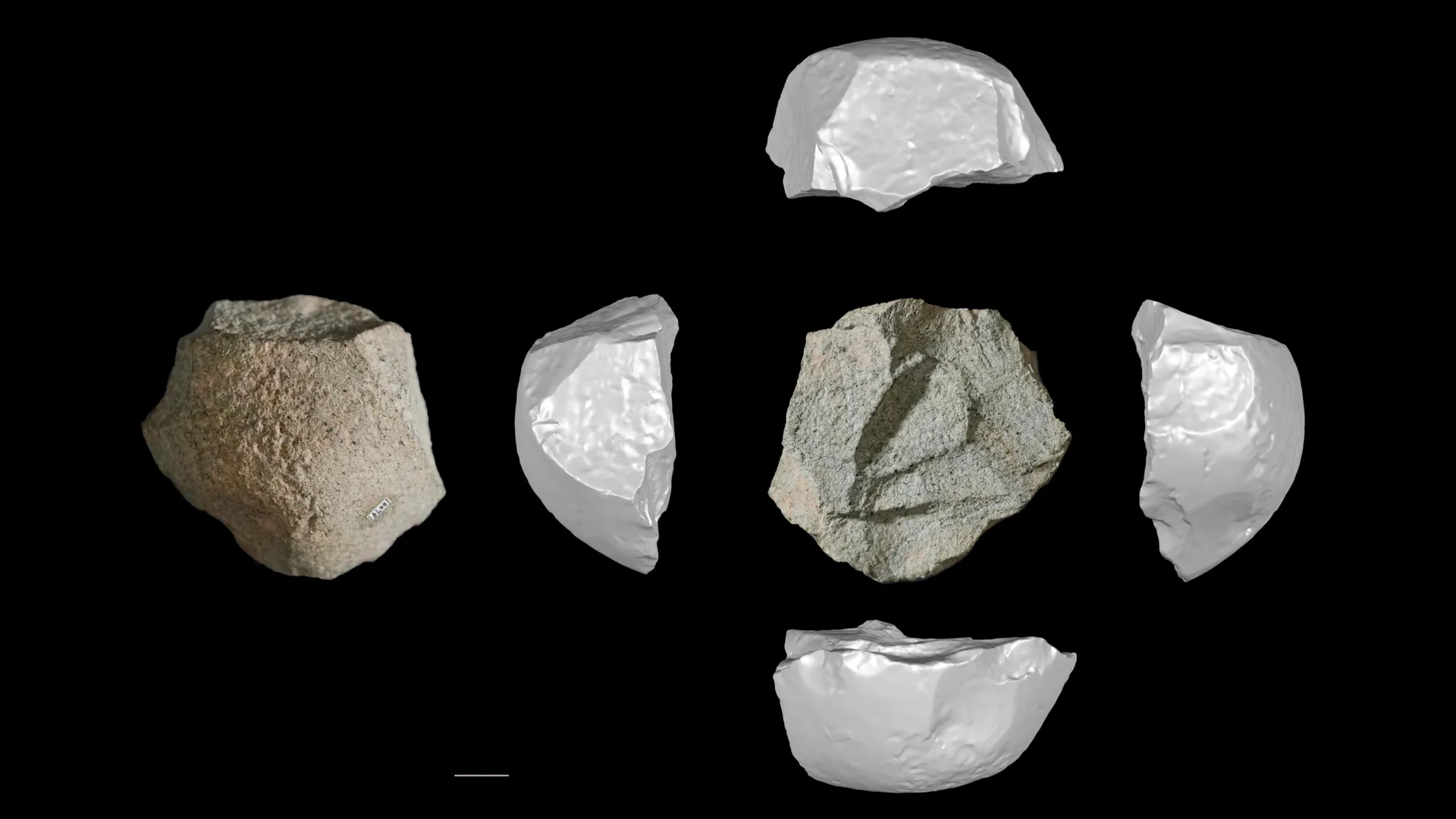
Archaeologists working at an ancient site in central China have uncovered evidence that early humans may have become more inventive while living through a brutal ice age. The discovery comes from the Lingjing archaeological site, where researchers have spent more than 10 years excavating animal bones and sophisticated stone tools linked to an extinct human relative called Homo juluensis.
A new study found that the site dates back about 146,000 years, placing it squarely within a cold glacial period rather than a warmer era as scientists once believed. The findings challenge the long-standing idea that creativity and technological advances mainly developed during times of environmental stability and abundance.
“People often imagine creativity as something that flourishes in good times,” says Yuchao Zhao, the assistant curator of East Asian archaeology at the Field Museum in Chicago and the lead author of a paper describing the findings in the Journal of Human Evolution. “Finding out that these stone tools were made during a harsh ice age tells a different story. Hard times can force us to adapt.”
Advanced Stone Tools From Ancient China
Zhao and his colleagues, led by senior author Zhangyang Li of Shandong University, have been studying the unusually sophisticated stone tools discovered at Lingjing. The site was once occupied by Homo juluensis, an ancient human group related to modern humans (Homo sapiens). Researchers believe these populations may have interacted with our own ancestors.
Homo juluensis possessed a mix of physical characteristics seen in several ancient human groups. They had very large brains along with traits associated with archaic humans in East Asia and Neanderthals in Europe.
For many years, archaeologists believed early humans in East Asia during the late Middle Pleistocene (300,000-120,000 years ago) showed relatively limited technological development compared to populations in Africa and Europe. The Lingjing discoveries are forcing scientists to reconsider that assumption.
At first glance, the disc-shaped stone cores found at the site may not seem remarkable. However, detailed analysis revealed they were created using a highly organized manufacturing process. Homo juluensis carefully struck smaller stones against larger stone cores to shape useful cutting flakes.
Some of the cores were worked evenly on both sides, while others followed a more deliberate design. In those cases, one side functioned mainly as a striking platform while the opposite side was prepared to produce sharp flakes. Researchers say these asymmetrical designs demonstrate that the toolmakers understood how to manage the stones as three-dimensional objects rather than simply chipping away randomly.
“This was not casual flake production, but a technology that required planning, precision, and a deep understanding of stone properties and fracture mechanics,” says Zhao. “The underlying logic of this system — and the cognitive abilities it reflects — shows important similarities to Middle Paleolithic technologies often associated with Neanderthals in Europe and with human ancestors in Africa, suggesting that advanced technological thinking was not limited to western Eurasia.”
Crystals Inside Bones Revealed the Site’s True Age
The new study also reshaped scientists’ understanding of when these tools were made.
Lingjing appears to have been a butchering site where Homo juluensis processed animals such as deer. Alongside the stone tools, archaeologists uncovered many animal bones. One rib bone from a deer-like animal contained sparkling calcite crystals that turned out to be crucial for dating the site.
Calcite crystals naturally contain tiny amounts of uranium. Over long periods of time, that uranium slowly transforms into thorium. By measuring the ratio between the two elements, scientists can determine the age of the crystal formation.
“The calcite crystals inside the bone acted like a natural clock, allowing us to refine the age of the site,” says Zhao.
Earlier estimates suggested the Lingjing tools were no older than about 126,000 years. The new crystal analysis pushed the age back by roughly 20,000 years to around 146,000 years ago.
That difference may sound small, but it dramatically changes the environmental context of the site.
Creativity During an Ice Age
“Even though these tools are just a little bit older than we’d previously thought, the entire story is changed,” says Zhao. “During the Pleistocene, Earth repeatedly shifted between colder ice-age periods and warmer intervals between them. We used to think these tools were made 126,000 years ago, during a warm interglacial period, but based on the new dates suggested by the crystals, some of these tools were actually produced 146,000 years ago, during a harsh, cold glacial period.”
The revised timeline suggests these ancient humans were developing complex technology while coping with extreme environmental stress rather than during comfortable conditions. Researchers say the findings support the idea that hardship itself may have encouraged innovation and adaptability.
“Altogether, this research reveals a much richer story of innovation, intelligence, and human evolution in East Asia,” says Zhao.