
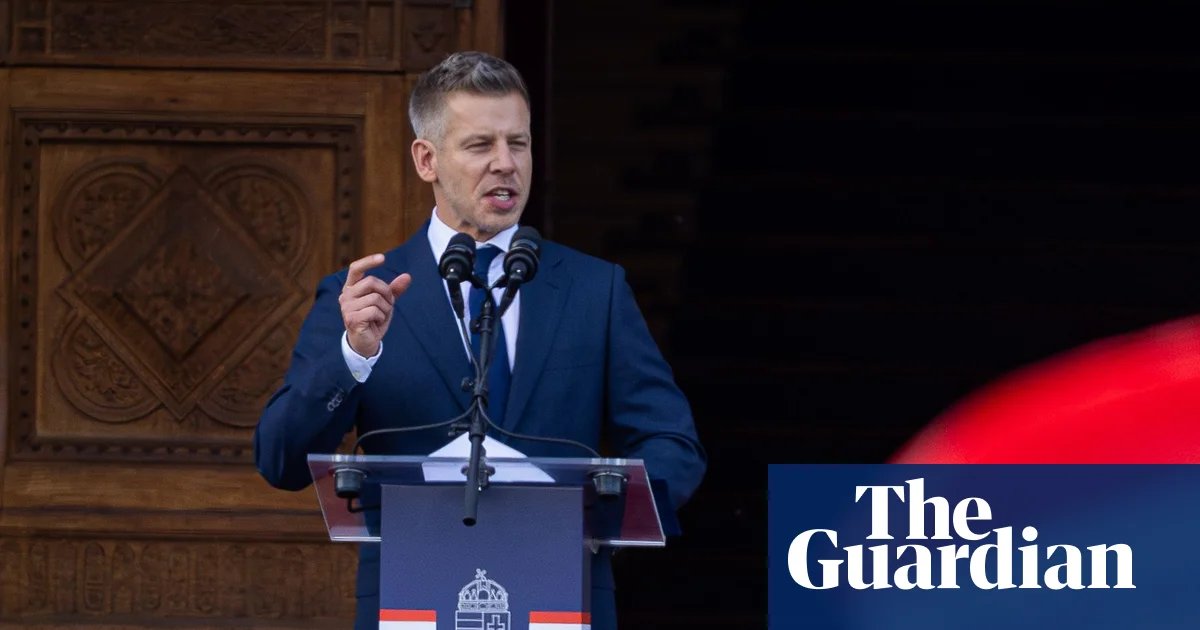
Moments after he was sworn in as Hungary’s prime minister, Péter Magyar apologised to those who had been maligned by the state during Viktor Orbán’s time in power as questions continue to swirl over what lies ahead for the country as it launches into a new era.
Magyar used his first speech as prime minister on Saturday to address the many in Hungary who had paid a personal price for speaking up about the steady erosion of rights under Orbán and his Fidesz party.
“I apologise to all those civilians, teachers, journalists, health workers and public figures who have been stigmatised, harassed, or treated as enemies for daring to speak out, for daring to stand up for the vulnerable, for criticising, or for simply expressing a different opinion,” he said. “I apologise.”
It was a poignant nod to how Orbán, arguably the world’s most successful populist leader, had targeted civil society groups and media outlets critical of his government for years, launching investigations, smear campaigns and bogging them down in bureaucracy.
Those who went against the former leader at times ended up in court. The liberal mayor of Budapest, Gergely Karácsony, and a Roma organiser in Pécs were charged for organising Pride marches – a first in the EU. One of the country’s most prominent investigative journalists was charged with espionage.
In the wake of Magyar and his Tisza party’s landslide victory last month, the espionage charges – described by the Committee to Protect Journalists as baseless – were dropped.
Magyar used his platform on Saturday to strike a very different tone, calling on Hungarians to come together and pledging to build a country that would be more free, humane and hopeful than under Orbán’s populist nationalist movement.
“What connects us will be stronger than what divides us,” he said. “Hungary will be home for every Hungarian, and everyone can feel like they have a place in the Hungarian nation. Family, friends and communities will be able to speak to each other again.”
Veronika Kövesdi, a researcher at Budapest’s Eötvös Loránd University, told the news site Telex it was the kind of speech that could help Hungary heal as it seeks to turn the page on the wounds left by the past 16 years under Orbán.
“It’s a very special act … There are material things that people want to see this government do, but there are also emotional expectations,” she said. “We’re talking about healing, a shift in public sentiment, or the way we talk to each other. Society wants this.”
She described it as an act of reconciliation, “but he highlights that making peace with something doesn’t mean that we will forget it”.
Magyar’s message of unity stood in sharp contrast to Orbán, who skipped Saturday’s ceremony, breaking with decades of tradition by not shaking his successor’s hand.
Instead he reaffirmed his rhetoric on Sunday, echoing the language that had led critics to accuse him of seeking to rally support by scaremongering.
“The new guys must understand one thing very clearly. If you do not fight for Hungary in Brussels, the Brusselians will walk all over you,” he wrote on social media.
“Giving up our patriotic position and surrendering national sovereignty for money or political approval would be a historic mistake. Foreign elites must not be allowed to decide our future for us!”
As Magyar prepares to push through his cabinet nominations this week, questions linger as to what kind of leader he will be.
As he crisscrossed the country in the run-up to the election, he promised to crack down on corruption and restore democratic institutions, vowing to dismantle Orbán’s system “brick by brick”.
Beyond that, however, the details of what his government will do are vague. Magyar ran a tight campaign, carefully staying on-message as he sought to avoid providing fodder for the estimated 80% of Hungary’s media controlled by Fidesz loyalists.
Analysts were quick to point out that his ability to rally crowds and tendency to dodge hardline questioning from journalists – along with his background as a top member of Fidesz until recently – was reminiscent of another leader.
“In a way, Magyar is like Orbán 20 years ago without all the baggage, the corruption and the mistakes made in power,” Andrzej Sadecki, the lead analyst at the Warsaw-based Centre for Eastern Studies (OSW), told Agence France-Presse.
Many of those who voted for Magyar were swift to acknowledge the similarities, describing their votes for Tisza as a gamble born out of hope that he would prove to be fundamentally different from the other former Fidesz members.
“Magyar is not a saint, but Fidesz needs to go,” Anita, 33, said last month as she walked her dog in a park in Kecskemét, a small city about 50 miles south of Budapest.
A recent poll suggested that more than 70% of Hungarians who voted for Magyar wanted his government to do more to address the climate crisis and to protect LGBTQ+ rights, hinting at the conflicting pressures he faces.
The pressures are made worse by the fact that left-of-centre and liberal parties are absent from parliament for the first time since 1990.
Even so, some of the country’s most prominent liberals, such as Budapest’s mayor, seemed willing to give Magyar the benefit of the doubt.
“It’s been a long time since I saw so many happy, liberated people in Budapest,” Karácsony wrote on social media on Saturday. “It’s a great start.”


