
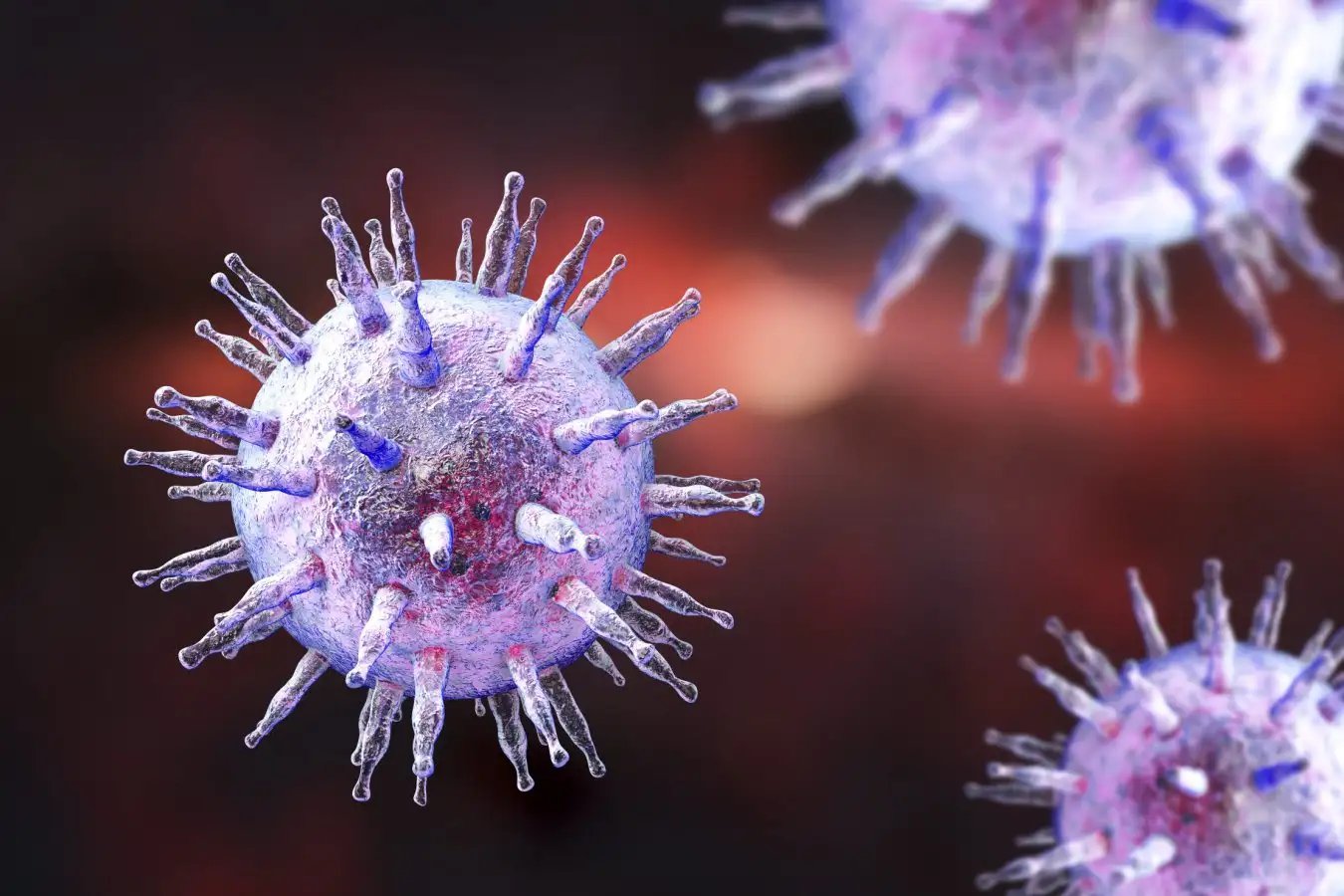
Most people catch the Epstein-Barr virus, but only a small proportion become seriously ill
Kateryna Kon/Shutterstock
Evidence is mounting that the Epstein-Barr virus contributes to multiple sclerosis, and we’re starting to understand how. A study of more than 600,000 people has revealed that the virus hijacks our immune cells, disrupting the normal functioning of the immune system, and activates genes that increase the risk of multiple sclerosis.
The virus – which most people catch at some point in their lives, but few develop complications from – seems to particularly affect a type of immune cell called B-cells, which produce antibodies against infections. “I think it’s very clear that this virus lives in B-cells,” says Kate Attfield at the University of Oxford, who wasn’t involved in the study. “It’s manipulating B-cells to its own advantage.”
Multiple sclerosis (MS) is an autoimmune condition, in which the body’s immune system goes rogue and attacks healthy tissues. It involves other types of immune cells, called T-cells, entering the brain and causing widespread damage, especially to the fatty substance that wraps around neurons. MS – which affects nearly 2 million people globally – causes a wide array of symptoms, from problems with vision and balance to tremor. In some people, the symptoms wax and wane, while in others, they progressively worsen.
Researchers have suspected that Epstein-Barr virus (EBV) was involved for decades, but it was difficult to demonstrate because more than 90 per cent of people are infected with EBV – which can cause “mono” or glandular fever – at some point. It took a 2022 study of 10 million people to show that MS is far more likely in people who have had EBV than in those who haven’t.
The challenge is figuring out why some people go on to develop MS. A study published in January found evidence of a genetic effect: about one in 10 people carry variants that seem to predispose them to having more EBV in their bodies post-infection, some of which were also associated with greater risk of MS and other autoimmune conditions.
Now, researchers led by Yoshiaki Yasumizu at Yale School of Medicine have taken a closer look at the impact of EBV.
The researchers, who declined to be interviewed, studied 617,186 people, gathered by the UK Biobank and a US study called All of Us. They all had their genomes sequenced, from their blood and/or saliva, and submitted their medical records. Because EBV often lives permanently in the body once it has infected a person, the researchers could detect its DNA.
In line with previous research, they found that a minority of the people had far more EBV DNA than the average – 1 per cent of them carried 64 per cent of the total EBV DNA from the blood collected in the studies.
The researchers then performed a genome-wide association analysis, looking for genetic variants associated with vulnerability to EBV. They found 39 regions of the genome that were associated with having EBV DNA. About a third of the variants associated with this were also linked to a risk of developing MS, and a severe form of the condition.
Next, the team focused on B-cells. Across nearly 471,000 B-cells from 38 people, they found 1069 infected by EBV. These cells were behaving abnormally; for instance, they were strongly expressing some of the genes linked to a higher risk of both MS and having EBV DNA. Furthermore, the infected B-cells had activated signalling pathways that turn on T-cells, the very immune cells that attack the brain in MS.
A key question is what the variants linked to EBV and MS risk are actually doing, says Ingrid Kockum at the Karolinska Institute in Stockholm, Sweden. She points out that the associations do not all go the same way: some variants were associated with both higher EBV load and higher MS risk, but others were associated with lower EBV levels yet higher MS risk.
This suggests the immune system can increase or decrease MS risk, depending on how it behaves. “If you have a high antibody response, then maybe you can keep down the viral load,” thus reducing your MS risk, says Kockum. A variant that weakened the initial antibody response would therefore be associated with both greater EBV levels and higher MS risk.
Some genetic variants might lead to “an exacerbated immune response that then tips you over the edge [into MS],” adds Attfield, while others might mean that “someone’s immune system isn’t doing a very good job of managing the virus”, leading to a higher viral load that could also contribute to MS. “It’s very difficult to prove one or the other,” she says.
In the long term, different research groups want to develop treatments against MS. Immune cells that fight EBV have shown promise as a treatment, and there are vaccines against EBV in development that might also be protective.
However, Attfield cautions that we need to know more about how the condition develops. Tackling EBV may help to prevent MS, but it’s less clear if doing so would be beneficial once it is already underway. That’s because we don’t know if MS continues under its own steam beyond a certain point, or if it is always driven by the virus. “[EBV] may, at that point, have nothing to do with it, or it may be intrinsic to it,” says Attfield.
Topics:


