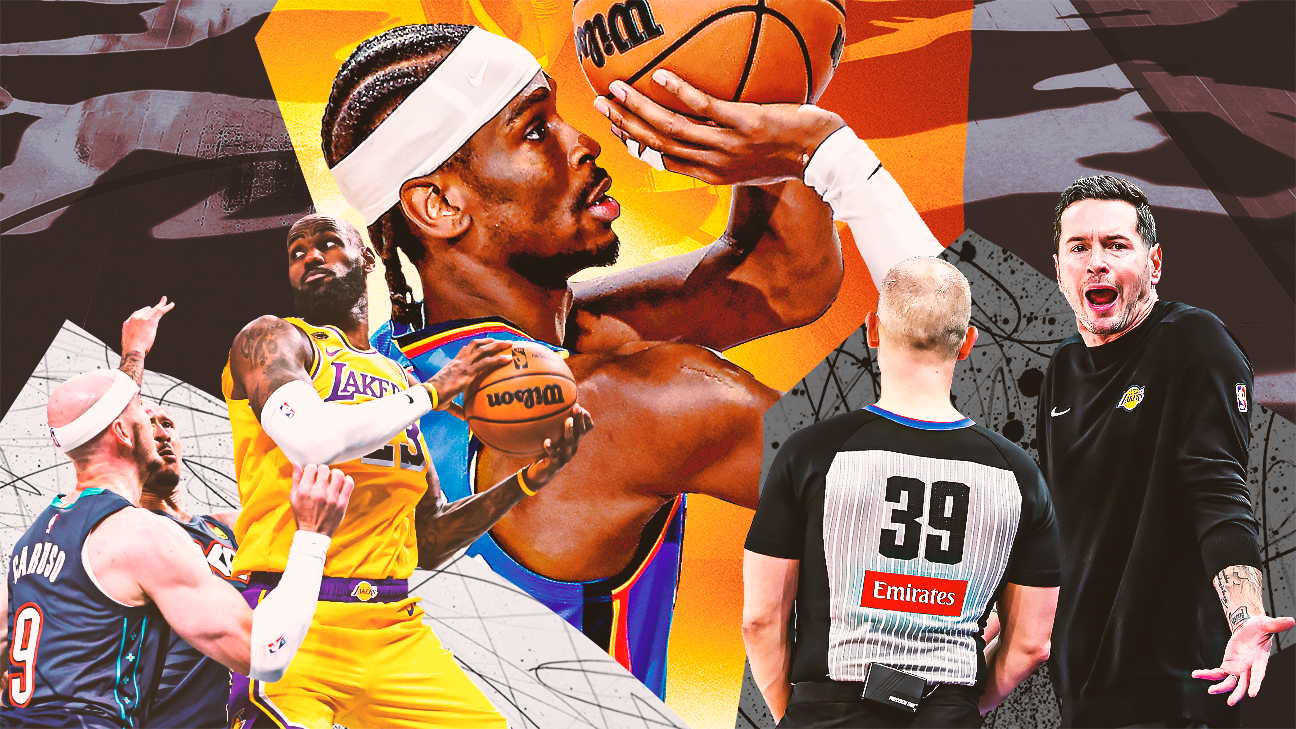
AS SOON AS the final buzzer sounded, Austin Reaves stomped out to midcourt to confront crew chief John Goble, delivering a closing argument of sorts after the contentious conversations that occurred between the officials and Los Angeles Lakers throughout Game 2.
Once again, officiating would be a primary focal point following a convincing win by the Oklahoma City Thunder.
As LeBron James and several other Lakers surrounded Reaves and the referee on the OKC logo, Oklahoma City’s players observed the surreal scene. Laughter broke out among the Thunder, who had seized control of the game with reigning MVP Shai Gilgeous-Alexander sitting on the bench in foul trouble early in the second half.
“Do we get a meeting, too?” Gilgeous-Alexander joked at the moment.
It’s not a laughing matter to the Lakers and a lot of others around the league. As a potential dynasty rises in Oklahoma City, there are frequent complaints by competitors about the Thunder getting a friendly whistle.
“I just think it’s all distractions away from the court,” Gilgeous-Alexander told ESPN. “That’s how I see it. Whether they’re right or wrong, the refs have made a call, and unless you challenge it, they’re not going to change it.
“It’s just another thing I can’t control, so I really don’t put any thought into it.”
Gilgeous-Alexander, the reigning and likely repeat MVP, and the Thunder are in the midst of a historic stretch of greatness. They joined Michael Jordan’s Chicago Bulls (1995-97) and Stephen Curry’s Golden State Warriors (2014-16, ’15-17) as the only teams in NBA history to win at least 80% of their games over a two-season span. No team has ever had a better point differential over two years than Oklahoma City.
The discourse about the Thunder — online and on the floor — is often dominated by discussions about how they’re officiated. Gilgeous-Alexander has been accused of “foul baiting,” including by Boston Celtics star Jaylen Brown following a March 12 loss to the Thunder. The prowess of Oklahoma City’s defense, the league’s stingiest in each of the past two seasons, is often partially attributed to the contact by aggressors such as Alex Caruso and Lu Dort. It has resulted in the Thunder becoming the NBA’s new villains, taking over the mantle from the Warriors.
“We’re just focused on everything that happens in between the lines, but there’s obviously noise around our team,” Oklahoma City coach Mark Daigneault said. “There’s increased attention when you’re in the position that we’re in. There’s certain things that come with the territory. I put any sort of narratives like that in that category.”
DRAYMOND GREEN FIRST caught the thunderous ire of Oklahoma City fans during the 2016 conference finals, kicking beloved center Steven Adams in the groin while flailing on a shot attempt. In the decade since, his name hasn’t been uttered through those Paycom Arena speakers without eliciting a rainstorm of jeers — a serenade he gets all over the country.
Two months after that 2016 series, Green helped recruit Kevin Durant out of Oklahoma City, sending the Warriors’ villain era into overdrive. They had a supervillain-themed team party that September, right around the time a famous cartoon spoof video was released to emphasize that label.
But the heel turn began before Durant’s arrival. The Warriors were the sport’s sweethearts during their improbable 67-win arrival season, 2015 title and 73-win stampede. But by the end of those 2016 playoffs — after the Curry mouthguard throw, the Green flagrant spree and the 3-1 collapse — there was increased craving for their demise.
“As a sports fan, if the same team dominates too much, you want to see an upset,” Steve Kerr told ESPN. “And it happens pretty quickly. We were the darling in ’15 and ’16, but by the time the Finals came around, I think the average observer was pulling for LeBron [James] to pull off the comeback. I never took it personally. I’ve done the same thing. If a team in another sport starts to dominate, I root for the upset.”
Success doesn’t just breed bubbling disdain from those who consume and commentate on the sport. It seeps most within those actively trying to chase the champions down and knock them off the pedestal.
To gain a necessary advantage in that quest, opponents spotlight what they perceive to be unfair advantages and try to manipulate the increased policing of them.
The Warriors remember dealing with it even before the Durant days. Kerr injected an ecosystem of off-ball offensive movement that fully unlocked the shooting greatness of Curry and Klay Thompson. When it vaulted them to the top of the NBA mountain, the outcry was swift and loud: Illegal screens!
“That became a constant topic of conversation,” Kerr said. “It did frustrate us. Especially if teams countered that by flopping. You run into a slightly moving screen and act like you’ve just been hit by a truck. [Andrew] Bogut in particular, when he’d set an off ball screen, guys would go flying. But all’s fair in love and war.”
Coaches complained that Thompson pushed off to generate space. The Warriors complained right back that evolving defenders were learning to hold and grapple Curry too much off the ball when the eyes of officials wandered.
Green, turning it back to modern day, sees the same type of conversations bubbling about the Thunder as they try to chase a second straight championship.
“That’s what’s going on with them,” Green said. “‘They got to be doing something.’ Nah, they just figured it out. So now it’s everybody else job to figure them out. [The rhetoric] is lazy. I don’t respect that at all.”
Green wouldn’t go as far as to disagree with some of the complaints levied in the Thunder’s direction, but he said the moaning is sour grapes from sore losers.
“Yes, they do foul,” Green said. “Yes, Shai does sell fouls. Yes, Lu Dort does some bulls‐‐‐. Yes, yes, yes, yes. All of that is true. Oh, well. If you can’t f—ing beat ’em, shut up. One thing is for certain — a team that only plays to bait fouls, and a player that only plays to bait fouls, it catches up with them in the playoffs. They lose. [The Thunder] won a championship. So shut up.”
Kerr was among the coaches to stroll through Oklahoma City this season, watch his team get smacked around and then generate postgame headlines complaining about the parade of Gilgeous-Alexander free throws (15 that March night). But he tried an indirect tactic.
“I don’t have a problem with Shai,” Kerr said. “I have a problem with the rules.”
Kerr has been on a crusade against the off-arm usage of offensive players. He’s of the belief that if the NBA rewards the league’s best scorers for hooking a defender when they use the arm bar, they should no longer allow those same scorers to shove off when a defender is forced to keep their hands up to avoid the hook.
“It’s like there’s no way to guard,” Kerr grumbled.
He sounds a bit like all the people clamoring about illegal screens in the mid-2010s, whining about the team up top.
“Well, I love Mark [Daigneault],” Kerr said. “I think he’s a great coach. I think their guys really represent the league well. They have really high character guys. I think they’re smart. We just get frustrated when they get away with using their hands defensively, but then Shai is allowed to push off. But I don’t blame them. I blame the league.”
AFTER LISTENING TO his team gripe at the officials for almost three quarters, New York Knicks coach Mike Brown felt like he needed to do his part during a March 29 game at the Paycom Center. After a whistle blew, Brown got within inches of referee Mitchell Ervin’s face and roared his disapproval.
As he anticipated, Brown got called for a technical foul, one of only two T’s he received this season. The other occurred during the Thunder’s annual visit to Madison Square Garden a few weeks earlier.
“You can’t waste your energy on the officials, and I thought we did too much of that tonight,” Brown said after the Knicks’ 111-100 loss in Oklahoma City. “And it still didn’t change. We yelled at the officials, I got a tech, and they still shot 38 free throws.”
Most of the Knicks’ complaints weren’t about foul calls against them in a game that featured 16 free throws for Gilgeous-Alexander, only one fewer than the entire New York team attempted. The Knicks took more umbrage about whistles that weren’t blown when they had the ball. During the rant that resulted in Brown’s tech, he angrily pointed to the opposite end of the floor, when New York star guard Jalen Brunson had just missed a jumper that was tightly contested — too tight, the Knicks would say — by Thunder perimeter pest Cason Wallace.
The Thunder are one of the most physical defensive teams in the league but are among the best at keeping their opponent off the free throw line. Oklahoma City allows 21.9 free throws per game in the regular season, the seventh-lowest total in the league. That has dipped to 18.4 free throws in the postseason, the lowest of the 16 playoff teams.
Is that dichotomy due to discipline or favorable officiating? Opinions vary, typically depending on which team’s jersey or quarter-zip the person wears.
“We talk all the time about grabbing and holding,” Lakers coach JJ Redick said during his pregame availability before a Feb. 9 home loss to the Thunder. “They do that on every possession. They do that for 48 minutes.”
Cleveland Cavaliers star Donovan Mitchell was even more direct after a Feb. 22 loss in Oklahoma City: “I mean, yeah, they foul. There’s no secret to that. They foul. But at the end of the day, it’s been a season and a half, two seasons. What are you going to do — keep saying the same thing? They’re not calling it. Yeah, they foul. They’re not calling it, so it’s not a foul. But it’s frustrating and you just can’t let it get under your skin.”
Caruso, for one, finds the complaints about fouls that aren’t called to be funny.
“It’s humorous to me because it’s like, what do we want to champion? Do we want to champion good, tough defense?” Caruso said. “Everyone complained because the league scored too many points. As long as we’re not malicious with it, we should be able to play the way that we want to play.”
But the Thunder, who were called for only 19 technical fouls all season, don’t necessarily mind when their opponent expends energy arguing with officials.
“When you rely on refs, sometimes it takes you out of your game,” said Dort, who does possess an expert ability to alert officials to illegal screens by sprawling to the floor after contact occurs. “I mean, we’re a physical team obviously. We play hard defense without fouling. Sometimes the other team and the other coach thinks it’s a foul, but you got to let the ref make the decision. And if they don’t make the decision, it’s not a foul. I don’t know what else to say about that.
“We try our best to play hard without fouling, and then it gets frustrating on the other side sometimes.”
“HE’S ALLOWED TO miss, too!” Detroit Pistons coach J.B. Bickerstaff hollered at veteran referee Scott Foster midway through the fourth quarter as Gilgeous-Alexander headed to the free throw line yet again. “He’s allowed to miss, too!”
The Pistons were visiting the Paycom Center a night after the Knicks, and this was the kind of game that fuels the narrative prompting fans to serenade Gilgeous-Alexander with “FREE THROW MERCHANT!” chants in hostile arenas around the league.
The Thunder pulled out a 114-110 overtime win over the short-handed Pistons, in large part because of Gilgeous-Alexander’s parade to the line. He shot 25 free throws, two more than Detroit’s team total.
“He’s elite at what he does, and you’ve got to give him a ton of credit for his skill set and his ability to create those contacts and create those whistles,” Bickerstaff said postgame. “There are rules for a reason, and he’s mastered being able to manipulate them. So that’s a talent, that’s a skill that he’s been blessed with.”
Sitting in that same seat the previous night, Brown gave Gilgeous-Alexander credit for what he referred to as “gamesmanship.”
“Shai’s the best at it in the league,” Brown said after Gilgeous-Alexander attempted 16 free throws against the Knicks. “His body control is amazing. Not only that, he knows when to attack, how to attack and who to attack, and then he still has the awareness of where everybody is on the floor. Then when he goes into his shot, he does a fantastic job of contorting his body, and if he feels any contact at all, he knows how to twitch his body or whatever to [sell the foul]. It’s just the gamesmanship to get the call. So I take my hat off to him.”
Gilgeous-Alexander has ranked among the league’s top three in total free throws attempted in each of the past four seasons. That fact has generated a lot of grumbling about “all the dropping and the falling and the flopping and the flailing,” as his friend and fellow Canadian Dillon Brooks put it midway through the Thunder’s sweep of his Phoenix Suns in the first round of the playoffs.
But at least one Thunder teammate scoffs at the suggestion that Gilgeous-Alexander benefits from a friendly whistle.
“Yeah, it could be better,” Caruso said. “It’s crazy.”
A simple statistical search supports that point.
In NBA history, guards have averaged at least 30 points per game in a season while playing enough games to qualify for the scoring title on 48 occasions. Gilgeous-Alexander’s 9.0 free throws attempted per game this season ranks 32nd on that list. The 8.8 free throws he averaged in 2024-25 ranks 33rd. The 8.7 he averaged in 2023-24 is tied for 34th.
Gilgeous-Alexander averaged 10.9 free throws per game in 2022-23, which ranks 12th among the club of 30-points-per-game guards. That occurred during Gilgeous-Alexander’s first All-Star campaign as he led the Thunder to a 40-42 record — before he would reasonably benefit from so-called “superstar calls.” (A fact that might interest those who long for the good, ol’ days: The top free throw seasons in this search belonged to Jerry West, Oscar Robertson and Michael Jordan.)
Gilgeous-Alexander, however, isn’t fretting the focus on his free throws — from fans, foes or media.
“I really don’t care at all,” said Gilgeous-Alexander, who led the league in drives per game the previous five years before ranking third this season. “The players that I grew up loving and watching when I fell in love with the game, they used their skill and their tactics to get to the free throw line. It’s just how the game has been picked up, and I’m not the only one that’s ever done it. They can pick on me all they want, but I love it. It’s amazing.”
Daigneault describes Gilgeous-Alexander as “unflappable on that stuff,” crediting the MVP’s refusal to react on this topic for setting the example for the Thunder’s desire to cut through distractions. Not that his teammates are immune to being a bit annoyed by it.
“I think it’s like they’ve got to find something to talk about,” Caruso said. “The guy is such a good human, such a good player, as far as like a star-caliber player that people should champion and want to be proud of as an NBA product. And just you have to find something. Every great player always has somebody or something that people try to tear him down for. When you look at it in a very binary way, it’s easy to not care about because it’s just like the day and age we live in. It’s the media, social media where there’s always something.
“Credit to him, I haven’t seen a player of his caliber be able to just block it out and shun it the way he has. That honestly is probably why a large portion of our team is able to do that, too. Just because if the best player’s doing that, it’s like, well, what excuse do we have?”