The idea, like many good ones, arose by accident.
It was the mid 1990s and London’s Great Osmond Street Hospital was losing a troubling number of young cardiac patients following complex heart surgery. Other hospitals were experiencing the same problem.
Surgeons Alan Goldman and Martin Elliott were among those searching for answers when they met in a break room at the hospital where, fortuitously, a Formula One race was on the television. The doctors immediately were drawn to the choreographed chaos of the pit stops, in which several people completed complex tasks perfectly in seconds.
The similarities to the operating room were obvious: the physical space was rigid, the moves repetitive, the pressure intense. Communication and focus were necessary, mistakes unacceptable. So they flew to Italy to meet with people at Scuderia Ferrari, who helped them adapt the functions of a race team to an emergency room.
The results were immediate. Lives were saved and the pit-crew model was widely adopted for pediatric surgery and neonatal resuscitation around the world.
Now the same philosophies are being used to fight dementia.
“That F1 mindset is probably the best problem-solving business out there,” said Mark Stewart, the chairperson of Race Against Dementia, a British-headquartered charity that applies Formula One-style speed, precision and collaboration to scientific research on dementia, supporting early-career researchers globally with funding and specialized training.
Ferrari driver Charles Leclerc makes a pit stop for new tires during the Chinese Grand Prix on March 15.
(Andy Wong / Associated Press)
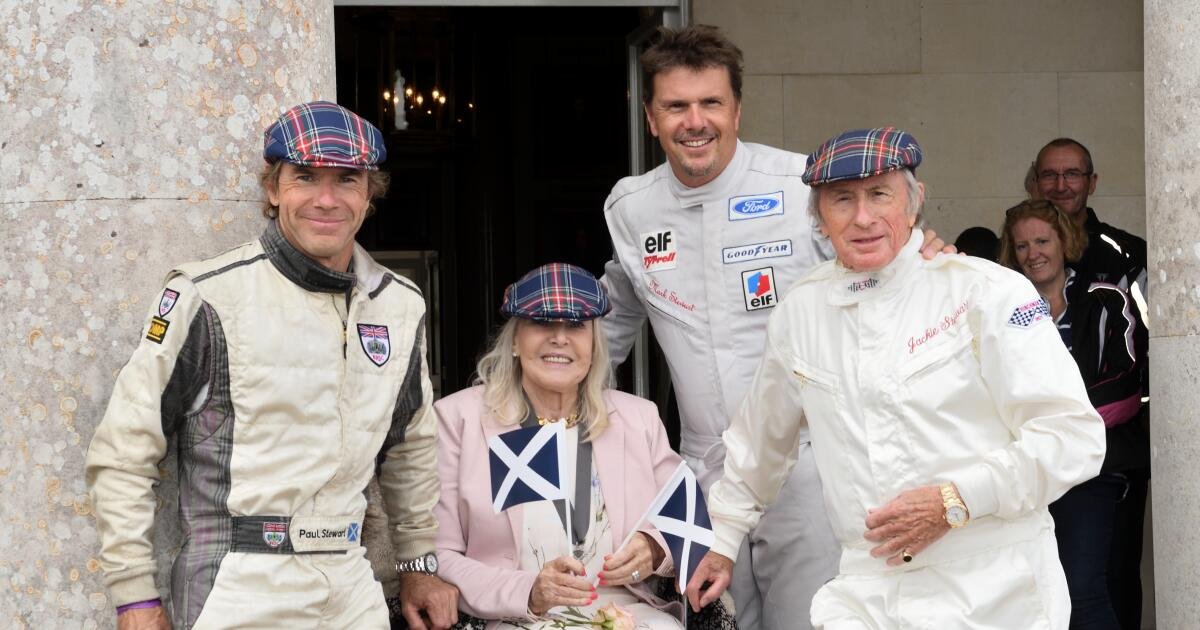
The group was founded a decade ago by Stewart’s father Sir Jackie Stewart, a three-time F1 champion and one of the most successful drivers in racing history, after his wife Helen was diagnosed with dementia. Since then, RAD has raised more than $30 million to fund 87 researchers and 52 projects all over the world.
But its biggest contribution to the fight against neurological disorders such as dementia isn’t the money it has raised or even the work it has funded. It’s the novel racing-style approach it has taken toward accelerating research and innovation, bringing Formula One into the lab much as Ferrari brought the lessons of a pit stop in the operating room a generation ago.
“That story about refining the operating room and how you bring 20 people together to take care of somebody in a really intense moment lends itself very well to Formula One. And it’s been done a number of times,” said Jonathan Neale, former chief operating officer at McLaren and a mentor to many of the RAD researchers. “Motorsports is about getting things right at the right time. It is about relentless pursuit of better in detail and understanding how tribes of people in different functions really come together.
“You need high levels of innovation but you also need high levels of execution.”
That’s what RAD has brought to dementia research.
“This constant innovation, constant working out, looking at data,” Mark Stewart said. “We’re saving months, maybe years just because of that relationship alone.”
Cara Croft, a senior lecturer in neuroscience at Queen Mary University of London and a Race Against Dementia researcher, has worked closely with McLaren’s race team the past three years, even employing its data scientists, who have helped her better categorize and understand some of the findings of her research. That partnership, she said, has proven fruitful.
“One thing is working with a team mentality; kind of we’re all united in one common goal being able to push the boundaries of innovation,” she said.

Cara Croft is a senior lecturer in neuroscience at Queen Mary University of London and a Race Against Dementia researcher.
(Race Against Dementia)
That teamwork and encouragement to try new things can be rare in medical research, said Brian A. Gordon, a cognitive neuroscientist at Washington University in St. Louis, whose work focuses on utilizing advanced neuroimaging techniques to understand the complex biology of healthy aging and neurodegenerative disorders.
“Formula One teams are relentless in their drive to succeed — collaborating to achieve a common goal. It’s a mindset and work ethic we believe can be applied to a team of dementia researchers,” Gordon said. “People haven’t thought of working in this way because biology and engineering are two disciplines that normally sit on parallel tramlines. I can’t think of any other science scheme where you get access to different people and game-changing resources in the same way that you do with Race Against Dementia.”
Gordon is not affiliated with RAD nor does he receive funding from the group. But he believes the mentality the group is preaching, one that has roots in the Ferrari pit-crew model of a generation ago, will have equally profound results.
“If you try to do everything well, you fail, right?” he asked. “You can’t be the driver of the car and the pit crew and the person engineering the car. A good Formula One team brings all the experts together so that they’re stronger by the sum of their parts. And I think that’s a good ethos to view where medical research has to go.
“You can’t just have the neurologist that does everything, or the radiologist or the PhD. Everyone has their specialized role. You do best when you’re all there firing and all cylinders.”
Neale, a mentor to many RAD researchers, said there’s little he can teach people such as Croft or Gordon about medicine or research. But after a career spent measuring progress in sometimes infinitesimal steps, he has shared experiences that are already proving valuable.
“If you look at Formula One, we were making an engineering change to the car 24 hours a day, seven days a week about every 20 minutes,” said Neale, who cycled through a number of jobs during his 16 years in F1. “When I started back in 2001, 80% of all those changes, we weren’t really sure whether it made the car fast or not because we were looking for such small changes.
“By the time I left, with simulators we were running thousands if not millions of virtual experiments in a synthetic world. You build a system that says ‘I don’t know, but I’ll test the idea.’ And you can do this in research.”
As a result, Croft and many of her colleagues have come to accept that failure often leads to progress.
“One of the key things that I like from Formula One is that they’re kind of happy if they make a car that doesn’t work very well because then they think how to make it better,” she said “This kind of fail factor, that’s something that we need to bring to the dementia field and medical research.
“If we have more clinical trials, a lot of them will fail but then some more will be successful. That’s something that is kind of a mind shift.”
And in motorsports, few things illustrate that story better than the evolution of the pit crew.

McLaren driver Oscar Piastri pits for new tires during a practice session ahead of the Miami Grand Prix on May 1.
(Lynne Sladky / Associated Press)
Pit stops — and the crews that work them — have been part of racing for more than a century, but for much of that time they were slow, methodical ordeals that could last several minutes. Leonard Wood, the chief mechanic for Wood Brothers Racing, which has been running on the NASCAR circuit for 76 years, is credited with introducing the precision, choreographed pit stop in the mid 1960s by pioneering the use of power guns to change tires, fuel venting which allowed a 58-gallon gas tank to be filled in 15 seconds and improved jacks, which could raise a car quickly.
“It all has to click,” Eddie Wood, Leonard’s nephew and the CEO of the Woods Brothers team, said. “They all have to know what the other’s doing. They key off each other and they help each other.”
The innovations quickly spread to every racing series, peaking when a McLaren team performed a four-tire pit stop for driver Lando Norris in 1.8 seconds in 2023.
The lessons that progress taught are still valuable.
“Whether it’s the rear jack guy, the fuel guy, the engineer, the driver himself, they all play that piece,” said Neale, who started with RAD in 2020. “And the collective understanding about why are we here? What is it that we’re trying to achieve and how do we nudge the odds in our favor? It’s the intensity of the scrutiny that really makes the difference.”
Croft and Neale know they aren’t necessarily close to the finish line when it comes to curing dementia. But they sense the race may be in its final laps.
“I wouldn’t be in this field of work if I didn’t think we were pushing towards solutions that can slow down dementia, treat dementia, cure dementia,” Croft said.
“I’d love to be a small part of doing something important,” Neale added.
“We all know somebody who’s had dementia or Parkinson’s disease. I think within five years we’ll see some big breakthroughs. It’s a disease and therefore scientifically [it] can be addressed. It might not mean we win tomorrow but it means we can define the gap, close the gap, show progress.”