How darkness might save migratory birds
Light pollution is dangerous for birds flying over towns and cities. Here’s how you can help
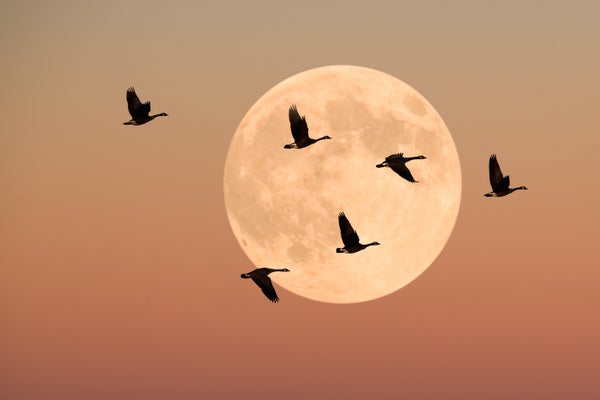
Spring migration is underway, and millions of birds will take to the skies at night to reach their breeding grounds.
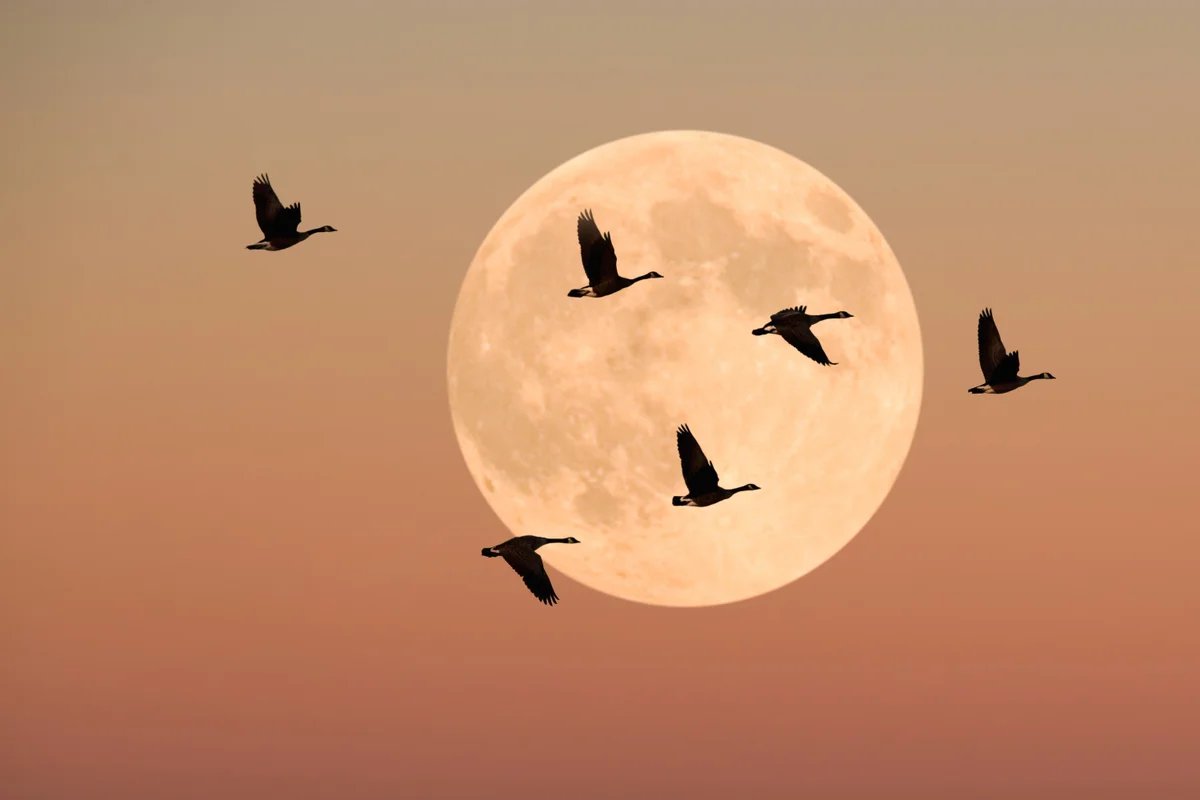
Between March and June, millions of migratory birds head north along the North American flyways. These skyward paths have been used for millennia. But as human-made structures have proliferated, birds have more frequently come into contact with the unpredictable glow emanating from windows and outdoor lights.
Migratory birds often move at night, when they navigate using specialized cells that can sense Earth’s magnetic field and take visual cues from the faint light of the moon and stars. Artificial lights disrupt this carefully tuned internal navigation system, throwing birds off their path and even trapping them in bright beams.
Each year an estimated one billion birds die by colliding with windows, and countless more exhaust themselves trying to navigate their way through artificially lit spaces. It’s a crisis for migratory species that are already facing steep population declines because of climate change, habitat loss and pesticide exposure. But this migration season, you can help at-risk birds safely reach their spring breeding grounds by keeping the lights low.
On supporting science journalism
If you’re enjoying this article, consider supporting our award-winning journalism by subscribing. By purchasing a subscription you are helping to ensure the future of impactful stories about the discoveries and ideas shaping our world today.
“Unlike a lot of these huge sources of mortality—like changing climates—that individuals can’t influence as much as we’d like to, we can truly help with the overnight lighting problem,” says S. K. Winnicki, an evolutionary ecologist and ornithologist at the Ohio State University.
Artificial light at night affects birds’ circadian rhythm (and that of humans), as well as the animals’ navigational sense. Though these effects technically exist year-round, you don’t necessarily need to keep the lights low all year to make a difference, experts say. Mitigating light pollution is most important during peak migration.
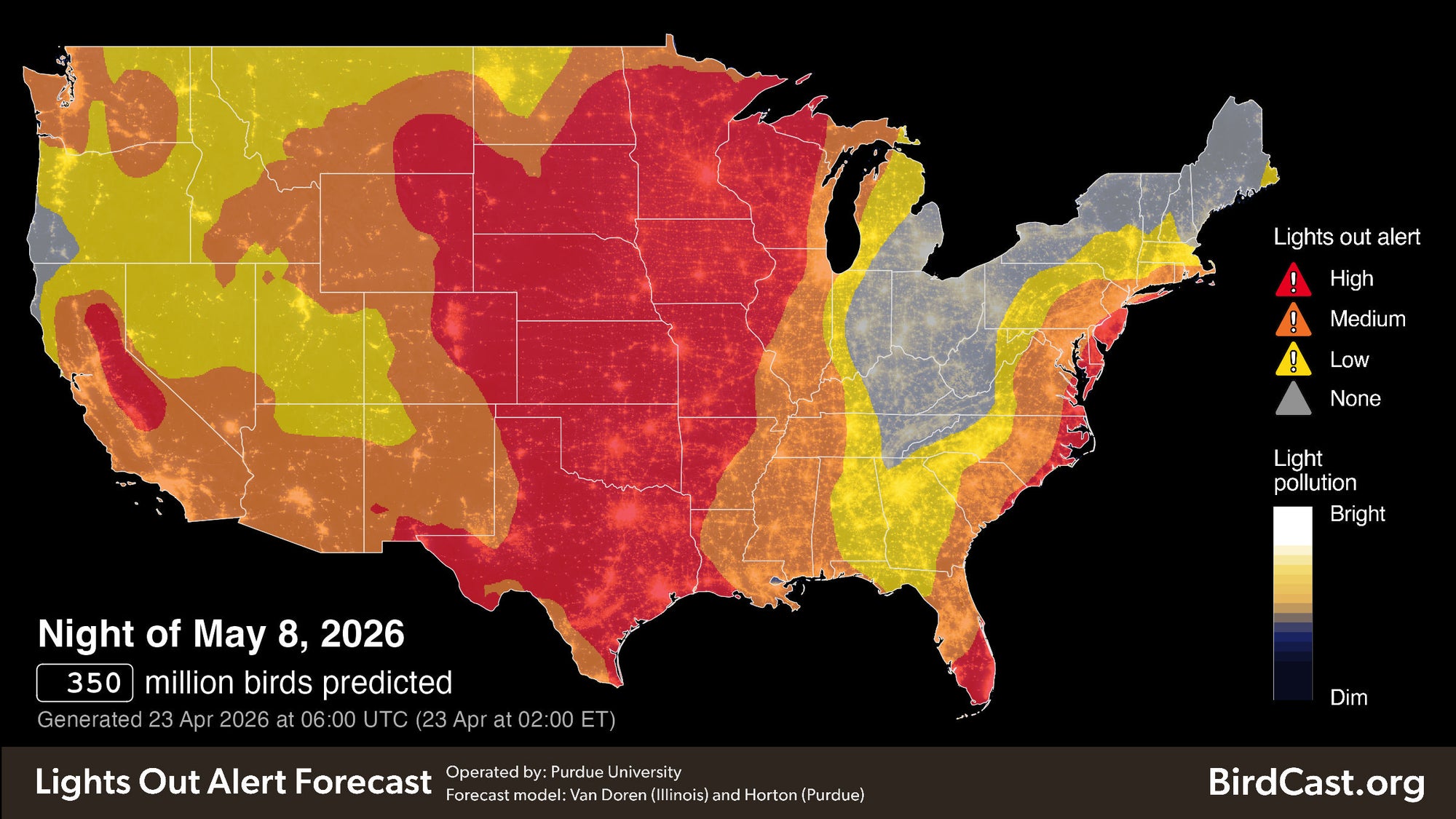
To find out when bird migration peaks in your area, find forecast maps here.
Benjamin Van Doren and Kyle Horton/ BirdCast
The amount of migratory birds overhead varies according to what the weather is and where you are located along the flyway. But generally, the number reaches its peak between two and four hours after sunset in the spring and fall. During these times, the easiest way to help birds is to turn off unneeded lights at night and to close curtains or blinds to keep interior illumination from spilling outside. And to mitigate the harms of necessary outdoor lights, experts suggest making sure they are facing down or capped to prevent them from shining up into the sky.
“On those really, really heavy migration nights, you could turn lights off that you don’t necessarily want to have off year-round,” Winnicki says. “And once the birds are in town, we should protect them.”
For birds that don’t make it out of cities before the end of the night, one of the biggest dangers is colliding with glass while looking for a green space to rest. This is what makes the urban environments a “two-part danger” to birds, says Devin Mingesbruney, program coordinator for Ohio Lights Out, a bird conservation nonprofit that is working to mitigate light pollution.
“Everyone has walked into glass at some point,” explains Dustin Partridge, senior director of conservation and science at the nonprofit NYC Bird Alliance. “It hurts our ego, but for a bird, it’s lethal…. They are going full speed headfirst, and they don’t perceive glass.”
To help migratory birds in the daytime, experts suggest adding external markers that will make the glass more visible to fast-moving fowl. These markers could be as simple as a grid of dots on the outside of the window or as complex as ultraviolet coatings that birds can see but humans can’t.
“It’s tough to be a bird,” Partridge says. “We’ve built up cities in their path, and this presents risks…, but those issues are things that can be easily fixed.”
It’s Time to Stand Up for Science
If you enjoyed this article, I’d like to ask for your support. Scientific American has served as an advocate for science and industry for 180 years, and right now may be the most critical moment in that two-century history.
I’ve been a Scientific American subscriber since I was 12 years old, and it helped shape the way I look at the world. SciAm always educates and delights me, and inspires a sense of awe for our vast, beautiful universe. I hope it does that for you, too.
If you subscribe to Scientific American, you help ensure that our coverage is centered on meaningful research and discovery; that we have the resources to report on the decisions that threaten labs across the U.S.; and that we support both budding and working scientists at a time when the value of science itself too often goes unrecognized.
In return, you get essential news, captivating podcasts, brilliant infographics, can’t-miss newsletters, must-watch videos, challenging games, and the science world’s best writing and reporting. You can even gift someone a subscription.
There has never been a more important time for us to stand up and show why science matters. I hope you’ll support us in that mission.