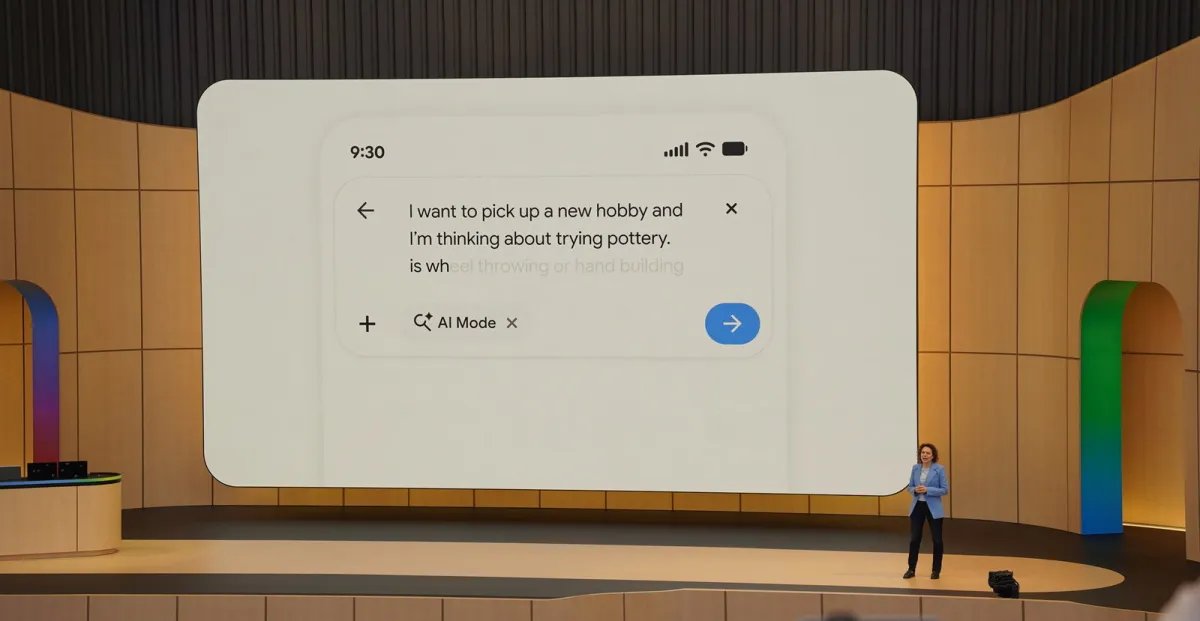
Although it was already discovered by intrepid AI power users weeks ago, Google’s new Gemini Omni model officially debuted today at the company’s annual I/O developer conference in Mountain View, California, and it marks a significantly new paradigm in the wider AI and tech marketplace.
That’s because as its “omni” (from the Latin omne — meaning “all”) prefix would suggest, this is Google’s first truly native, multimodal model, that is “a model that can create anything from any input — starting with video.”
The model marks Google’s bid to collapse the multimodal generative stack — text-to-image, image-to-video, video-to-video, audio generation — into a single foundation model with a single editing surface.
The big question for business leaders is: should you switch any of your own AI stack over to Gemini Omni now?
Unfortunately, the truth is, you may not be able to just yet — the model is only available to individual users through Google’s AI subscription plans starting with the $20 per user per month “AI Plus” plan. It can currently be accessed on the Gemini website and mobile apps, Google’s web-based Flow AI image and video editing suite, and YouTube Shorts.
While the company says it is ultimately going to be available via an application programming interface (API) — which many enterprises rely on for their AI needs — it’s not ready yet.
In a departure, Google also did not issue any public benchmarks for Gemini Omni (yet). However, third-party organizations will no doubt put it to the test on various tasks and user-reported quality metrics. In the meantime, though, its quality and speed remain somewhat subjective.
But, given the capabilities and faster editing enabled by the new Omni model, individual members of your team should probably give serious consideration to switching over to it, especially if they work creating visuals for technical diagrams, marketing and comms materials, training and corporate education courses, sales collateral, and basically anything that involves visuals.
What Omni actually is
Omni is the next chapter of the work that produced Nano Banana, the image-generation and editing model Google shipped roughly a year ago.
The first model in the family, Gemini Omni Flash, accepts any combination of text, images, audio, and video as input and produces high-quality output across the same modalities — all from a single model rather than a relay of specialized systems.
Google says the model is “natively multimodal from the ground up,” which matters less as marketing copy than as an architectural claim: a unified model can reason across modalities in the same forward pass, which generally translates into more coherent edits, fewer pipeline artifacts, and a far cleaner API surface for developers.
OpenAI started this trend back in May 2024 with the release of GPT-4o, its first natively “omni” model, also trained from the ground-up to be able to analyze and generate multiple different types of content, from text to code, imagery, and audio. However, it did not support video generation, and the model was eventually deprecated following reports of sycophancy and even users demanding OpenAI retain it after developing parasocial relationships with it.
Is Gemini Omni at risk of sparking a similarly devoted following? It remains to be seen.
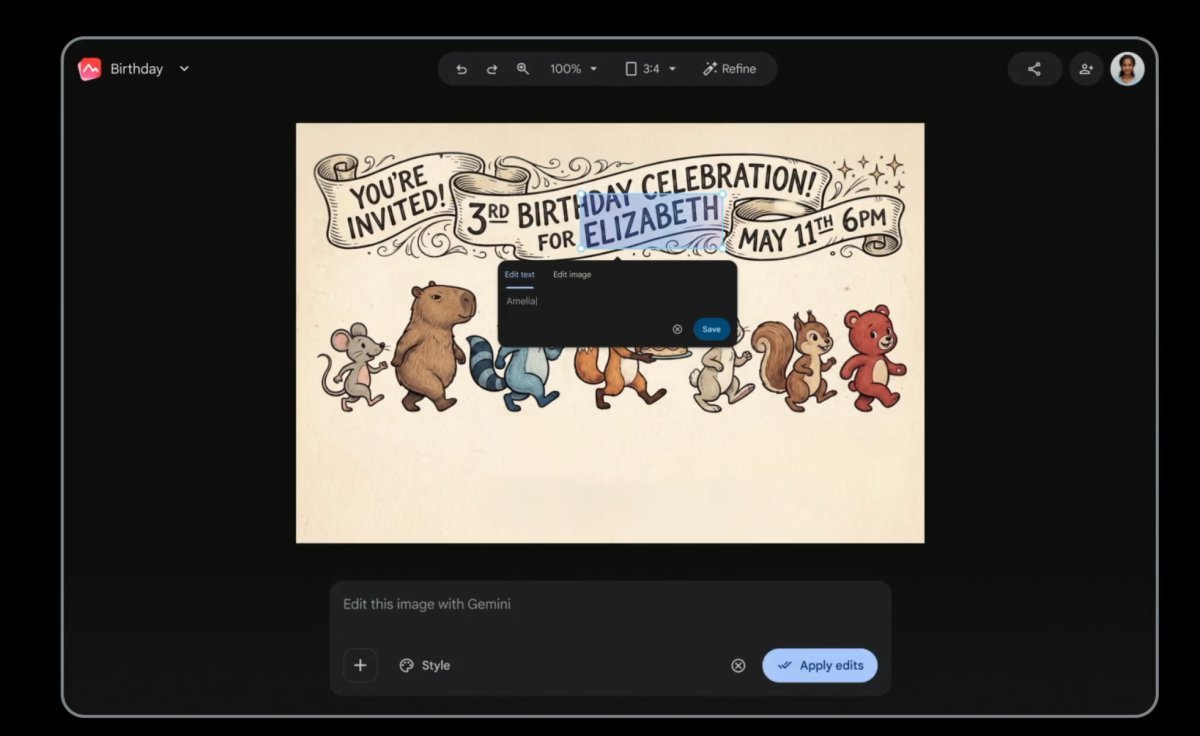
One big difference is that its headline interaction pattern is conversational video editing. Each instruction “builds on the last,” and past directions persist across turns so the video evolves coherently as the user iterates.
Practical examples Google highlighted include changing the world inside a clip, reimagining an action or camera angle, refining sequences over multiple turns, and generating explainer-style content from short prompts.
Google also emphasizes improved physics — gravity, kinetic energy, fluid dynamics — which is the kind of detail that separates “looks like AI video” from “looks like footage.”
Rollout, pricing, and the API question
The first thing enterprise leaders should read carefully is the rollout plan. Omni Flash is going live today inside the Gemini app for U.S. subscribers across AI Plus, AI Pro, and AI Ultra tiers — including the new $100-per-month AI Ultra plan Google announced at the same event.
Google says it will roll out to developers via Vertex AI APIs “in the coming weeks.” That gap is significant. Until the Vertex API is generally available, Omni is effectively a consumer and prosumer tool.
Enterprise pilots beyond individual seat-based experimentation should wait for the API, both because that’s where Google’s enterprise SLAs and data-handling commitments live, and because production-grade generative video without a programmatic interface is a non-starter.
Its pricing through the API per million tokens (presumably) will also determine its viability as an enterprise product outside of film/TV/entertainment and the arts productions.
For decision-makers weighing seat economics in the meantime, the new AI Ultra tier is positioned specifically at developers, technical leads, knowledge workers, and advanced creators, with priority access to Google Antigravity, higher usage limits, and bundled Omni Flash access.
For small creative teams under tight deadlines, that may be the fastest way to evaluate the model before the API arrives.
The enterprise use cases that really matter
It is easy to default to “marketing video” as the use case, but Omni’s value proposition for enterprises is broader if you think of it as a programmable video and media engine rather than a creative app:
-
Sales and marketing: rapid generation of variant ads, localized creative, and product demos without per-asset agency cycles.
-
Internal communications, learning and development (L&D): explainer videos, onboarding modules, and policy walkthroughs produced by non-specialists.
-
Customer support and documentation: dynamic, query-conditioned visual explainers attached to help articles.
-
Product and engineering: visualization of simulations, UI walkthroughs, and concept videos for spec reviews.
-
Field operations: short, situation-specific instructional clips generated on demand.
What changes with Omni versus the previous generation of tools is the unification. Many enterprises stitched a workflow together from text-to-image, image-to-video, lip-sync, and voice models, each with its own contract, billing, and data path. A single Vertex AI-backed model collapses procurement and observability into one place — assuming the eventual API delivers production-grade throughput and latency.
The governance story is the most underrated part
For CIOs and CISOs, the most important section of Google’s announcement is not the model card; it is the provenance and content-safety work shipping alongside it.
Every video generated by Omni carries Google’s SynthID digital watermark. Google is expanding C2PA Content Credentials across its generative tools, and launching an AI Content Detection API on Agent Platform that lets businesses identify AI-generated content from both Google and other popular models.
Partner integrations announced at the same event — including Shutterstock, Avid (in Pro Tools), and at least one major newswire — indicate where the standard is going.
For enterprises, this matters in three concrete ways:
-
It gives legal and compliance teams a defensible audit trail for AI-generated media.
-
It allows brand-safety teams to detect AI-generated material entering content pipelines from third parties.
-
And it provides a defensible answer for regulators in jurisdictions, like the EU, that are tightening rules around synthetic-media disclosure.
There is also a “Personal Avatars” program that lets creators record short videos to authorize use of their voice and likeness across generated content, as Google leaders and employees showcased themselves today in posts centered around I/O featuring their AI generated likenesses.
This puts it in direct competition with Synthesia, a UK-based AI unicorn focused primarily on enterprise-safe AI videos and avatars.
For enterprises considering executive videos, training avatars, or branded spokesperson content, the consent model here is the right starting point — but contracts and rights-management policies will need to extend to cover it.
Risks worth flagging
Omni’s main risks are familiar but worth restating.
The competitive landscape is crowded with the aforementioned Synthesia, TikTok parent company ByteDance’s acclaimed Seedance model, Kuaishou Technology’s Kling AI models, and the fast-improving open-source field all compete for the same workflows.
Lock-in to any single video model is a real concern when output quality is still leapfrogging quarterly.
Latency and cost for production-volume video generation remain unproven outside controlled demos.
In addition, the legal status of training data for generative video is unsettled in multiple jurisdictions; enterprises should require clear indemnification language before deploying generated video into customer-facing channels.
Furthermore, VentureBeat collaborator and AI YouTuber Sam Witteveen, CEO of enterprise machine learning vendor Red Dragon AI, received early access to Gemini Omni and reported the content restrictions (which some deem to be censorship) to be quite strict, potentially restricting and inhibiting all the potential use cases an enterprise would like to pursue.
Thoughts for enterprises considering adoption
Omni is worth piloting — but the structure of the pilot matters.
For most enterprises, the right move over the next 30 to 60 days is to fund a small, sanctioned experiment with one or two AI Ultra seats in marketing or L&D, while the platform and security teams use that runway to prepare for the Vertex AI API: define data-residency requirements, set up SynthID and C2PA verification in the content pipeline, and stand up the AI Content Detection API alongside existing media-governance tooling.
Treat the consumer rollout as a UX preview, not a production plan. When the API arrives, the enterprises that have already done the governance work will be the ones moving Omni into real workflows while everyone else is still drafting policy.
Omni is not, by itself, a reason to overhaul an enterprise AI strategy. But it is a strong signal that the multimodal generative stack is consolidating into single models with first-party provenance baked in — and that is a shift technical decision-makers should be planning around now.