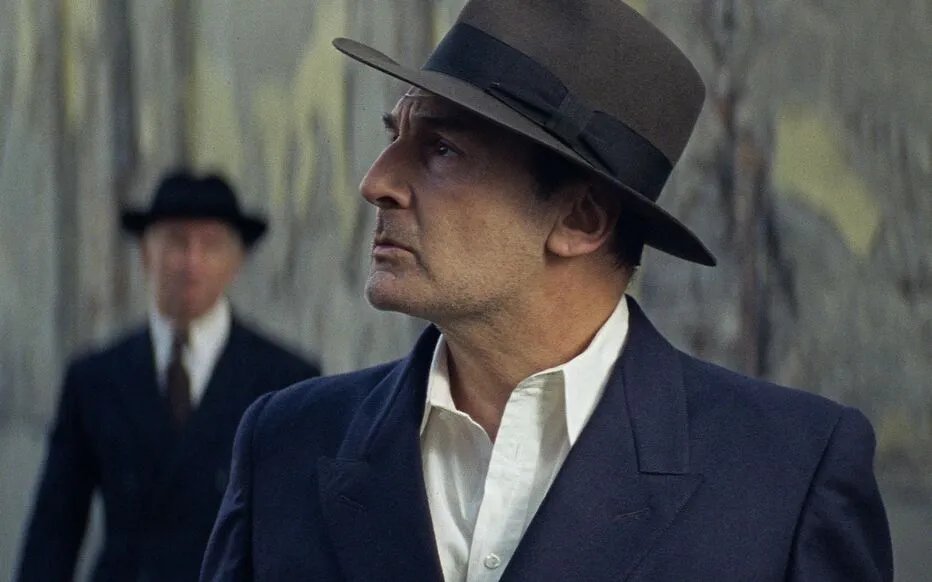
After two period movies dealing very specifically with the history of Hungary, László Nemes returns to the subject matter than brought him an Oscar for his debut feature Son of Saul (2015) — the Second World War. Set roughly a year before its predecessor, Moulin tells the true story of Jean Moulin, the head of the French Resistance movement who posed as a civil servant by day. Like Son of Saul, however, Moulin is not interested in the bigger picture. Although the opening credits suggest an epic along the lines of Jean-Pierre Melville’s Army of Shadows (1969), or even Vincente Minnelli’s The Four Horsemen of the Apocalypse (1962), Moulin is concerned only with events leading up to its hero’s death at the hands of Klaus Barbie and his sadistic Gestapo in 1943.
Son of Saul was a tight, confined, claustrophobic coup de cinema, shot by Mátyás Erdély in an edgy style that he and Nemes have never returned to. After Sunset (2018) and Orphan (2025), Moulin continues the pair’s expansion into Hollywood-style melodrama, with wide, expansive framing, but this time the colors are even more muted, and the light even more diffuse, than they were in Orphan. Moulin sometimes feels like we’re watching it through the wintry mist of a very lonely landscape. Unlike Son of Saul, we are often aware of other people in the frame, but, as the film goes to show, they are mere bystanders: Everything in this story was done for show and seen by people who did nothing to stop it.
There is paranoia in the air from the very moment “Max” (Gilles Lellouche), AKA Moulin, parachutes into Lyon under the cover of night. “I’ll never get used to it,” he mutters, making sure he’s remembered to bring French money and a sandwich. Moulin has just returned from London, where President Charles De Gaulle is in hiding, with a plan to unite the various factions of the warring rebel underground. He is a major priority for the Führer, who believes he has information about the imminent Allied invasion of Europe, but how much Moulin knows — or allows himself to know — is never revealed.
If Son of Saul was about the horrors of war, Moulin is about the climate of war, and the opening is breathtakingly tense in that respect. Nothing can be written down, and no one can know everything, so much of the dialogue is a bewildering avalanche of codewords and code names. Indeed, Moulin is using the name Jacques Martel for his return, posing as an interior decorator working for the Comtesse de Forez (Louise Bourgoin), who may or may not know she is providing his cover. Moulin steers her to the work of Giorgio De Chirico, whose eerie paintings foreshadow where the film is going.
The day after their meeting, Moulin takes the funicular to the office of Dr. Dugoujon, under the pretext of having his arthritis seen to. The Nazi secret service has been tipped off that Dugoujon’s medical practice is, in fact, a front for the Resistance, and it does seem something of a coincidence that half a dozen men of a certain age and status are gathering in the doctor’s waiting room. Moulin is taken into custody, and then released, but his freedom is short-lived. Barbie (Lars Eidinger) — the SS officer overseeing Moulin’s arrest, also known as The Butcher of Lyon — has his suspicions, and sets about trying to break him down, using various types of mental and physical torture to do so.
If you don’t know the facts of the matter, it soon becomes clear that Moulin’s fate is sealed, and yet there is a big chunk of the story still to tell. Given Moulin’s stonewalling, Barbie’s game of cat-and-mouse is going nowhere, which frustrates the hell out of him. Eidinger is perfect for the role, and his escalating temper tantrums — almost camp at first, with delicious echoes of Christoph Waltz’s Hans Landa — become frightening in their intensity. But Eidinger has some serious competition from his co-star Lellouche, who was accosted by fans wielding images from the family-orientated Asterix and Obelix franchise. Moulin, both the role and the film, could not be more different, revealing him as a fantastic actor with subtle layers of tonality that make him the perfect choice to play a character so slippery and elusive and, at the same time, so disciplined and true.
Title: Moulin
Festival: Cannes (Competition)
Director: László Nemes
Screenwriter: Olivier Demangel.
Cast: Gilles Lellouche, Lars Eidinger, Marcin Czarnak, Louise Bourgoin, Felix Léfebvre
Sales: 193 Legendary
Running time: 2 hrs 10 mins