[The story contains spoilers from the Victorian Psycho book by Virginia Feito.]
“In three months, everyone in this house will be dead.”
In her novel Victorian Psycho, author Virginia Feito is anything but subtle as she warns readers the story they’re about to embark on may not be for the faint of heart. The novel, set in the Victorian era, centers on Winifred Notty who becomes the new governess for the wealthy Pounds family, tasked with watching over the children. However, danger is lurking for the family as Winifred is a psychopath with an intent for revenge. Writing as a way to give a “fun wink” to her “favorite literary psychopath” in American Psycho, Feito blends dark humor with gothic horror in her “over the top” tale centered on “revenge against the patriarchy.”
“The humor part of it was selfishly for me to get through the guts and violence of it,” Feito says of writing the gruesome elements of the story. “A lot of it was because I really felt it was important for her as a character to draw the reader in, but also to manipulate the reader. Psychopaths are very charming and glib, and superficially. So my idea was that she would use humor to manipulate and charm us into being on her side, then turn on us, and we would feel conflicted about it.”
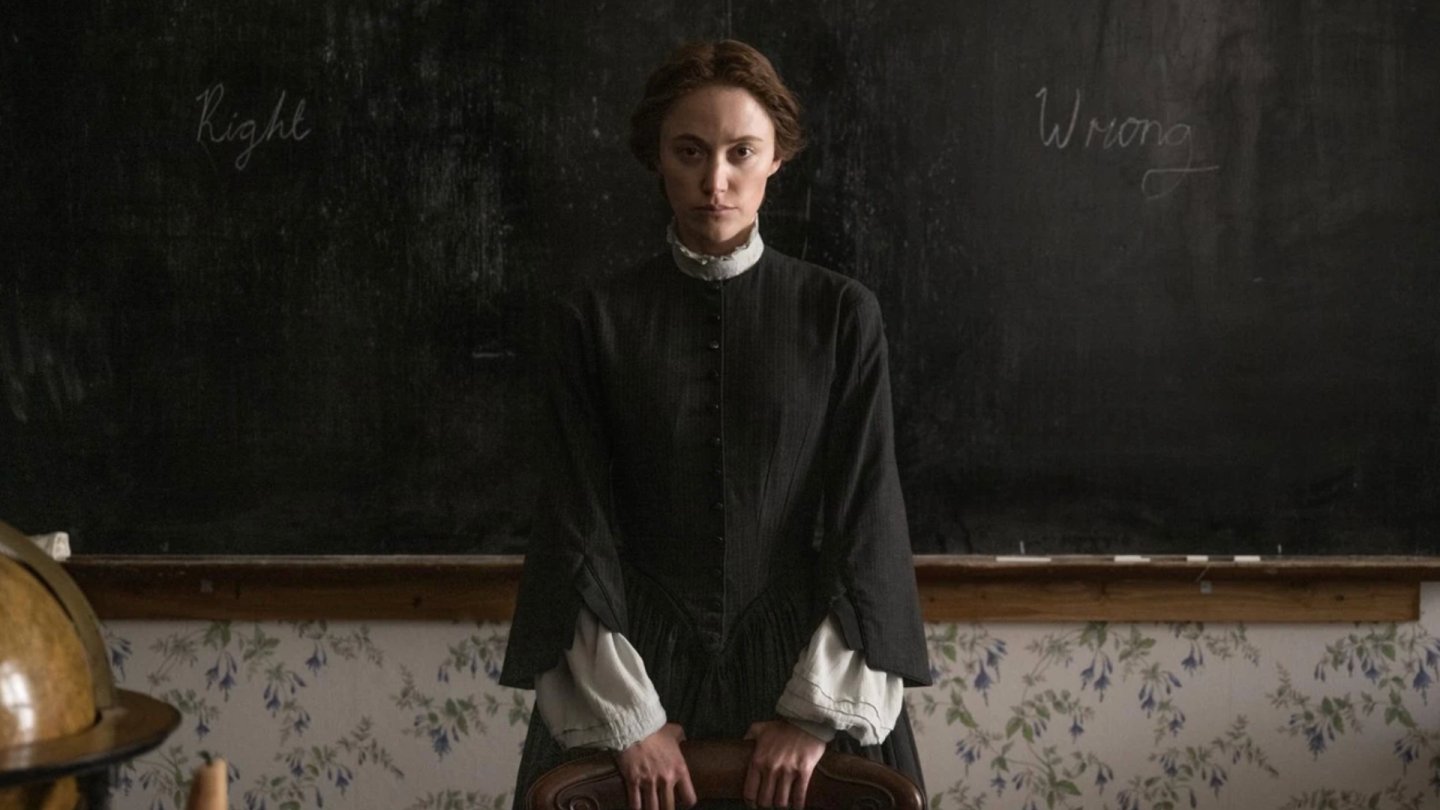
In addition to writing the 2025 novel, Feito also wrote the screenplay for the film adaptation directed by Zachary Wigon and starring Maika Monroe as Winifred. Ruth Wilson, Jason Isaacs and Thomasin McKenzie also star. After finishing the novel’s first draft, Feito says she emailed Wigon for his take because she trusts him as a storyteller. After reading, Wigon was insistent they bring the story to life: “I thought he was going to help me out with a lot of stuff, and boy, did he! He really liked it and was like, ‘I think we could do this as a movie.’”
The film, distributed by Bleecker Street and releasing to theaters on September 25, premiered at Cannes on May 21. In his review, THR critic David Rooney said there are the “faintest echoes of Wuthering Heights and Jane Eyre in the Yorkshire Moors setting” of the film with Monroe’s Winifred “dialed up to maximum madness from the minute we meet her.”
“She just completely enveloped her and became this Winifred who I’m personally in love with,” Feito says of the Reminders of Him star taking on the role of the psychopathic governess.
In an interview with THR, Feito chats about writing the psychopathic governess with dark humor, adapting the novel for screen and exploring the psychological depth of complex characters.
***
Even if you know nothing about the story, the novel’s title grabs you and seems to wink at American Psycho. Was it intentional to give readers some kind of warning or did the title come after already having written the story?
No, I think it came earlier on, and I didn’t really overthink it. I think I should have, because I feel like I walked myself into a trap accidentally, and now I’m having to kind of explain how I wasn’t setting out to write a companion necessarily to American Psycho. I didn’t think of any connection beyond the fact that it’s narrated by a psychopath. It was basically a fun wink to my favorite literary psychopath, and how that book just really affected me in the best way. That’s one of my favorite novels.
Can you talk about how this story came to be? What inspired you to create Winifred and all that was in store with her?
Usually, I’ll be looking for not really plots as much as voice, in the sense of how to write the book. The way I knew how I could write it came to me in one line, which is still in the book, which is she sensed something about how her breasts are jiggling in her corset at the very beginning, and it’s really stupid and simplistic, but I then saw what the voice is, and it’s going to be with that passive-aggressive, somewhat anachronistic tone. She’s this very sassy, sarcastic character, and it’s first person and it’s going to be [a] Period [piece.] Then I assigned her a job as a governess, and a mental health condition of a psychopath. I remember I was rereading McGlue by Ottessa Moshfegh and that was a huge inspiration, in terms of that unique voice, urgent kind of narrative, also a period piece. It felt so modern and raw. There was something in there that I really wanted to do, and I’ve always loved the Victorian era. I thought, if I was gonna make a fun kind of sassy wink at an era, what era would it be?
We start the book with the line “In three months, everyone in this house will be dead,” which I found interesting, given that the ending is basically told to us right at the beginning. Did you always know you wanted to start the story with that reveal to the reader? Can you talk about that decision?
Yeah, that also came out of the voice of this character, and also because of the Victorian literature. I think early on I was rereading a lot of Dickens, especially A Christmas Carol. The book is set during Christmas, and it’s like a countdown to Christmas, essentially. There’s this whole thing [of] past, present, and future ghosts. Winifred is telling us about her past and present, and she has these hallucinations where she believes she can see the future, so I had that thread running through the story as well. My favorite novel ever is The Secret History by Donna Tartt, and that is a whydunnit and the prologue tells you who killed Bunny, who the victim is, how he died, who killed him,l. You have literally the entire novel to figure out why. As a very curious person, that really appeals to me. I don’t need the what or the who, but the why is the most fascinating to me.
Historically, societal constraints existed during the Victorian era. How did it shape the psychology of your protagonist?
Oh, very much. I was doing all this research before I even got to writing it. I was just reading all day, and I was getting into this weird, aggressive mood, feeling how bad women have had it, and how awful children were abused legally in this era. I was like, “Why are you so angry? This doesn’t feel relevant anymore.” But it really felt very, very relevant to me while I was doing this research day in, day out. It was the beginning of COVID as well, so I was locked in my apartment. It was a really weird kind of vibe, and I guess my defense mechanism and my weapon is humor. I started to think it was all kind of funny in a very awful, violent, abusive way, and so that fed into the tone of Winifred’s personality, where it was all just so violent that it started to be ridiculous [and] really over the top. The Victorian era is also so aesthetically beautiful and pleasing, with all those big skirts, fabrics, candles, and cozy Christmas vibes. But then they’re killing all the babies.
Winifried offers dark humor, but as the story showcases her unsettling behavior, thoughts, and actions, I think it can be hard to know how you feel about this character. Did you want readers to feel conflicted about whether to sympathize with her?
I really did hope that they would have this conflict, and you’re one of the first people who told me you’ve had a conflict with it. Most people will be like, “You go girl! Kill everybody!” because you’ve had a hard time and women were abused. But then I’m like, “But what about the innocent women she murders? And the babies and children?” I understand that revenge against the patriarchy is very satisfying, and that whole aspect of revenge horror is great, but I was also questioning if maybe it’s not justified. Or that’s what I was hoping. Any layered complex reading of it makes me very happy. I certainly try to write it in a way that would make you wonder how far you would be willing to root for revenge against the patriarchy. What’s the limit?
It’s worth noting that she also uses humor to manipulate us as readers. She talks to the reader, but it makes it even more intriguing and complicated that we’re following this story with an unreliable narrator. Can you talk about getting into her psyche and how you wanted to play with readers through her voice?
Yeah, you’re so right. The humor part of it was selfishly for me to get through the guts and violence of it. A lot of it was because I really felt it was important for her as a character to draw the reader in, but also to manipulate the reader. Psychopaths are very charming and glib, and superficially. So my idea was that she would use humor to manipulate and charm us into being on her side, then turn on us, and we would feel conflicted about it. I’m so glad you picked up on that.
Virginia Feito and Victorian Psycho.
Pilar Hormaechea; W.W. Norton & Company
I love in Victorian literature when they talk to the reader. [For example] “Dear reader, I married him.” I thought if she does that, then she’s going to be using the humor in that way, and she’s also going to be winking at the reader, or telling the reader, “Don’t be so gullible.” Why not just talk to the reader and go further? One of the things they say about psychopaths is they don’t feel fear, at least they don’t feel fear the same way that we feel fear. I thought, what a delight, honestly, to live your life with no fear. I’m a person who’s afraid of everything. It was so delightful to try to get into a character who doesn’t give a shit, and feel fear. She’s been trained to hide it because she knows there’ll be consequences that are a drag for her.
This novel is getting the adaptation treatment. At what point did the adaptation conversation begin?
I knew Zach, the [film adaptation’s] director, from before. We had been talking about writing something together, working on stuff together, and as soon as I finished the first draft of Victorian Psycho, I emailed it to him genuinely for his take on it, and because I really trust him as a storyteller. I thought he was going to help me out with a lot of stuff, and boy, did he! He really liked it and was like, “I think we could do this as a movie,” and I was like, “Really?” There’s so much I didn’t know. It was hard to adapt to the screen, I think, because it’s so stream-of-consciousness. So that was really early. It was even before it was edited into the final version.
At what point did you decide that you wanted to be the one to write the screenplay for it?
We’d already been talking about working together with me writing and him directing. We’d been trying to develop some ideas, and I had already been attached to write the adaptation of my debut novel, Mrs. March. So, I guess it’s like, well, someone out there thinks I could do it. Zach certainly was very clear that we work together, and that I write the script, and under his guidance, otherwise I would have crapped my pants and run for the hills!
You just mentioned how the novel offers that stream of consciousness, which could be difficult to translate on screen. Can you talk about showcasing Winifried’s voice for the film?
Yeah, we discussed many options. We even questioned, like, should she [Winifred] break the fourth wall? We considered all of those options, but ultimately just having the spirit of that kind of weird, creepy humor in her dialogue in the script was fine for me. Because then the actress, Maika Monroe, made it her own Winifred. She just completely enveloped her and became this Winifred who I’m personally in love with. I’m going to get a restraining order from Maika probably because I’m so in awe of her and what she did (Laughs). I’m sure many people will say it’s not exactly the same Winifred as in the novel, but that makes me so excited. It’s like the voice of Winifred translated into another language. I’m sure some things have to be lost or replaced, but other things are so new, fresh and amazing.

Maika Monroe in Victorian Psycho.
Cannes Film Festival
Were there any changes in the adaptation that you felt offered a meaningful evolution of the original story?
So many. Zach is really great at filtering what needs to be said and what doesn’t, which is great, because I’m incredibly indecisive. A lot of it, I thought, was smartly translated to film, and not just with Winifred herself, but plot-wise. I think that all tied up really well. I can’t give you a clear answer because there are so many things that I don’t want to spoil. But no, it’s totally better. I feel like the movie has an elegance to it, also visually, because Zach and the amazing director of photography, Nico Aguilar, had such excellent taste. It translated visually in such a sophisticated way. The atmosphere that was important in the book is important in the movie, and it feels very, very much taken care of in that way.
Having written the original story, you already have your own perspective and intentions, but I imagine hearing others’ thoughts can offer unique insights. How did collaboration with the director, cast or film’s team reshape your understanding of the story? Were you given any interesting takeaways you hadn’t realized before?
Yeah, that happens for sure. I organically just see them as different stories. I’ve grown with it [the novel] and learned about it on my own, so I feel like I know it better than anyone. But for the film, it’s just completely different. It’s teamwork from the get-go. Everyone was so talented in this movie. I just loved every single input because I admire them so much. All their opinions were, like, 99.9 percent or 100 percent of the time really fucking interesting. And a lot of things that I was like, “Shit, I should have thought of that for the novel.” Some that I managed to maybe edit in. I think I’ve just been very spoiled.
Was there anything that you were able to really explore in writing the film that you couldn’t in the book?
Maybe certain visual devices, especially in horror. I love horror and I love horror imagery. Certain visual moments that I couldn’t have really described in the book, or it would have been too confusing or weird, I felt like we could brainstorm on and put in the movie.
What did you learn about the development process that surprised you, particularly as a first-time adaptation?
I am very surprised that any movie ever gets made. It’s a miracle. It’s insane. It’s so hard to make things work. — with everyone’s schedules; everyone rowing in the same direction; everything working and to find a fantasy; and to find the people to back you up, it’s deranged. It’s amazingly difficult. Even now, they’re still going at it strong since we finished shooting months ago. It’s a huge endeavor. It’s insane that movies exist. I’m in awe. I love movies, I thank the movie Gods. I don’t know why I got to do one, but I’m very lucky.
We’ve seen anti-heroines on screen before, but Victorian Psycho pushes that archetype into much darker territory. Having written two antiheroines, what do you think it is about stories with psychological extremes that fascinates and resonates with readers so much?
I do think we are drawn to complexity, especially psychological complexity in characters, as has been proven time and time again with the most beloved shows, movies and books. The most recent example I can think of is Succession, where they’re all technically, traditionally unlikable characters, but we’re all front row eating popcorn like, “We’re with you, Kendall!” We just want to watch, we want to know because the more complex and layered, the more it might remind us of ourselves or of our own complex situations, and things that we’re proud of in ourselves and that we’re kind of ashamed of. The more deeply you dig in there, the more connection you can have with the audience or reader — maybe that’s why a lot of them want to defend Winifred. They feel like they might also feel similarly or they want to protect her because she has been abused by this society.
Also, psychopaths and true crime, we’re just really obsessed with it. Some people say it’s morbid. I don’t. I think it’s curiosity in a good way. Curiosity to understand how that could happen to either survive it if we’re attacked — especially women because women make up like 90 percent of true crime –or maybe because we’re trying to learn, so we can avoid making more psychopaths in society in the future. We feel so safe that we would never do anything that corrupt, that it kind of makes us feel good about ourselves. I think it’s interesting, and I don’t judge anyone for being totally fascinated by psychopaths.
Your novel Mrs. March is also getting the adaptation treatment, with you writing. Can you give an update on that?
I can give an update! There’s a script that has gone through a few drafts and might be getting edited and revised, but nothing else that I can confirm.
Because you now have your books getting the adaptation treatment, I, of course, want to ask you, do you have a favorite book adaptation?
Oh man. I mean, I honestly have a lot. Nobody ever says this, but I have seen many movies that I’ve enjoyed more than books. The one that comes to mind more strongly right now is the 1994 Little Women. I love that movie even more, way more actually, than the novel, and I grew up with it. Same with The Shining.
Monroe and Ruth Wilson in Victorian Psycho.
Courtesy of Bleecker Street
Victorian Psycho releases on Sept. 25.