It was an AI-generated video of the goddess Lakshmi that convinced Eros Innovation founder Kishore Lulla that India needed a different approach to AI.
“I was playing with some LLMs and wanted to make a video out of our goddess Lakshmi,” says Lulla, sitting down with Deadline on the sidelines of Eros Innovation’s ‘AI in Asia’ summit at Marche du Film’s Cannes Next.
“It produced a fantastic model – these days if you want to produce the Goddess Lakshmi, you can go to Kling, Seedance, Grok or Gemini and the images they produce will be technically amazing. But then that Goddess started dancing like Beyonce.”
That was of course very culturally inappropriate, and so Lulla, who is also executive director of Bollywood studio Eros Media World, started researching the concept of sovereign AI – a new approach to AI development that tackles issues such as cross-border data privacy, global supply chain risks and, most importantly for an entertainment company, preservation of local linguistic and cultural nuances.
“That’s when I thought that Eros should start building its own cultural models,” Lulla says. “We own the movies, we own the cultural data – all of which was censored by the Indian government, so it won’t offend anyone – so we have the training data we need to create an AI model with culturally authentic outputs.”
Talk of sovereign AI is becoming increasingly common within national governments that have realised they need to start protecting their AI models, algorithms and data centres in the same way that they currently protect power grids and water supplies.
Within those discussions is a growing awareness that AI foundational models are basically a reflection of their training data – and that most models are being built either in China or the U.S. – so they may not reflect the legal frameworks, language and culture of other countries. Some nations, including India and the UAE, have started to invest heavily in building indigenous models.
In 2022, Lulla set up a new company within the group, Eros Innovation, which houses AI development and the ErosNow streaming platform, along with the film library’s digital streaming and character rights. Eros Studios continues as a separate entity that produces film and streaming content, using both AI and conventional filmmaking methods.
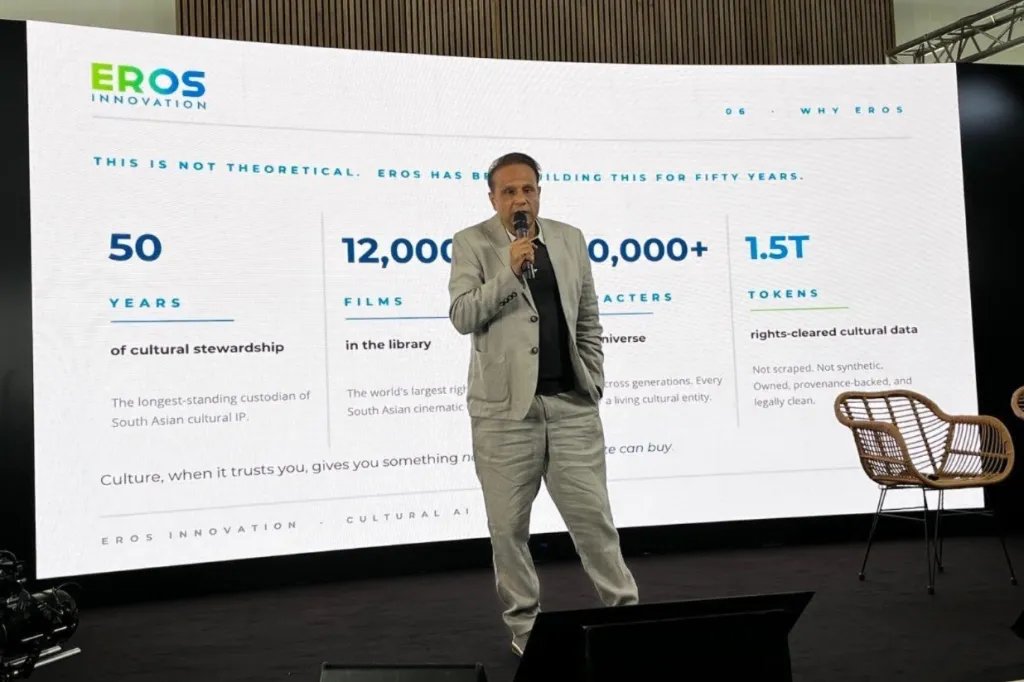
Working closely with the Indian Institute of Technology Madras (IIT Madras), Eros Innovation started building an AI “sovereign cultural” model using the group’s library of more than 10,000 movies and other content in multiple Indian languages as training data. At last year’s Waves Film Bazaar, the company announced that it had closed a funding round of around $150M to build its AI model and expand its IP portfolios.
The company’s first AI model – ErosADI – was officially launched yesterday and will be rolled out to clients including creators, institutions, enterprises and governments in coming months. The full stack includes five foundational layers: a family of Large Cultural Models; the ErosADI Rights Registry; a Unified AI Passport & Identity Layer; AI-Native Super Agents; and the Global Cultural Exchange (GCX) – designed to facilitate interaction between sovereign cultural ecosystems.
For the less techie among us – that means some of the practical applications of this technology include AI-driven video generation, pre-visualisation, editing and voice dubbing. And in a country like India – home to a huge diversity of natural and human-made environments, languages and scripts – Eros says its AI models will help filmmakers to remain culturally authentic.
Speaking on a Cannes Next panel, Eros Innovation co-founder Ridhima Lulla explained what this means in real terms; or at least the obstacles that her team came up against when they tried to create a Chennai street scene using some of the public AI models: “The language written on the road signs was completely wrong and the faces were not right for the region – so they’re still missing a lot of these specific nuances.”
Looking at AI development on a global level, Kishore Lulla says that, at the studio end of the creative spectrum, AI technology will reduce filmmaking costs by an estimated 70% – meaning that a $200M-$300M movie could be made for $50M. At the same time, filmmaking will also become democratized so that anyone who understands how to use this technology can become a creator.
“For sure there’s going to be a lot of changes and disruption in the next five years,” Lulla says. “Costs will go down and talent will lose their market share. When OTT emerged, the industry didn’t accept it, but now pay-TV and box office are declining and the streamers are calling the shots. Look at the market cap of Disney – it was $350B when it acquired Fox for $90B and now it’s just $150B.”
Not everyone is as excited about this technical revolution. Director and producer Aanand L. Rai took legal action against Eros when the company re-released his 2013 movie Raanjhanaa after using AI to digitally alter the ending. Lulla tells Deadline: “We changed the ending because we own the IP 100%, we own the character rights, and when we re-released the movie the audience loved it and it made a good gross.”
Unlike in North America, India has no unions and very little regulation to address the impact of AI in filmmaking, and for every filmmaker who pushes back, there are dozen of others who are wholeheartedly embracing the technology. India’s government is also investing in the new tech. Lulla says Eros Innovation is working closely with the Indian government in its mission to build up India’s AI creator economy. And the company’s AI ambitions go far beyond film.
“We’re working on health-related models with the Indian government to cut health center costs. So we’ll do analysis and prepare reports for the government. We’re also looking at applications in education and tourism.”
But content creation remains Eros’ core business and the group is currently using AI to develop franchises based on Indian mythology. Lulla believes India may have an edge over Hollywood in this arena, especially now that AI is reducing production costs, as the country has such a deep pool of stories and characters to work with.
“Marvel is running out of superheroes, but India is sitting on 100,000 of them. There are so many gods, and every god is a superhero. Whatever the industry is making today, that will become 10x and can you just imagine what we’ll see when we have 10 million creators.”
Eros Innovation’s ‘Asia In AI’ summit at Cannes opened with a keynote by Lulla and fireside conversation with Studio Babelsberg CEO Joerg Bachmaier. A series of panels featured speakers including Alex Serdiuk, CEO at Respeecher, which worked on The Brutalist; Asteria Senior Creative Director Paul Trillo, VFX Supervisor Martin Madsen; Christina Caspers-Röhmer, managing director of Cinesite’s Trixter and BiFan fest director Chul Shin.