
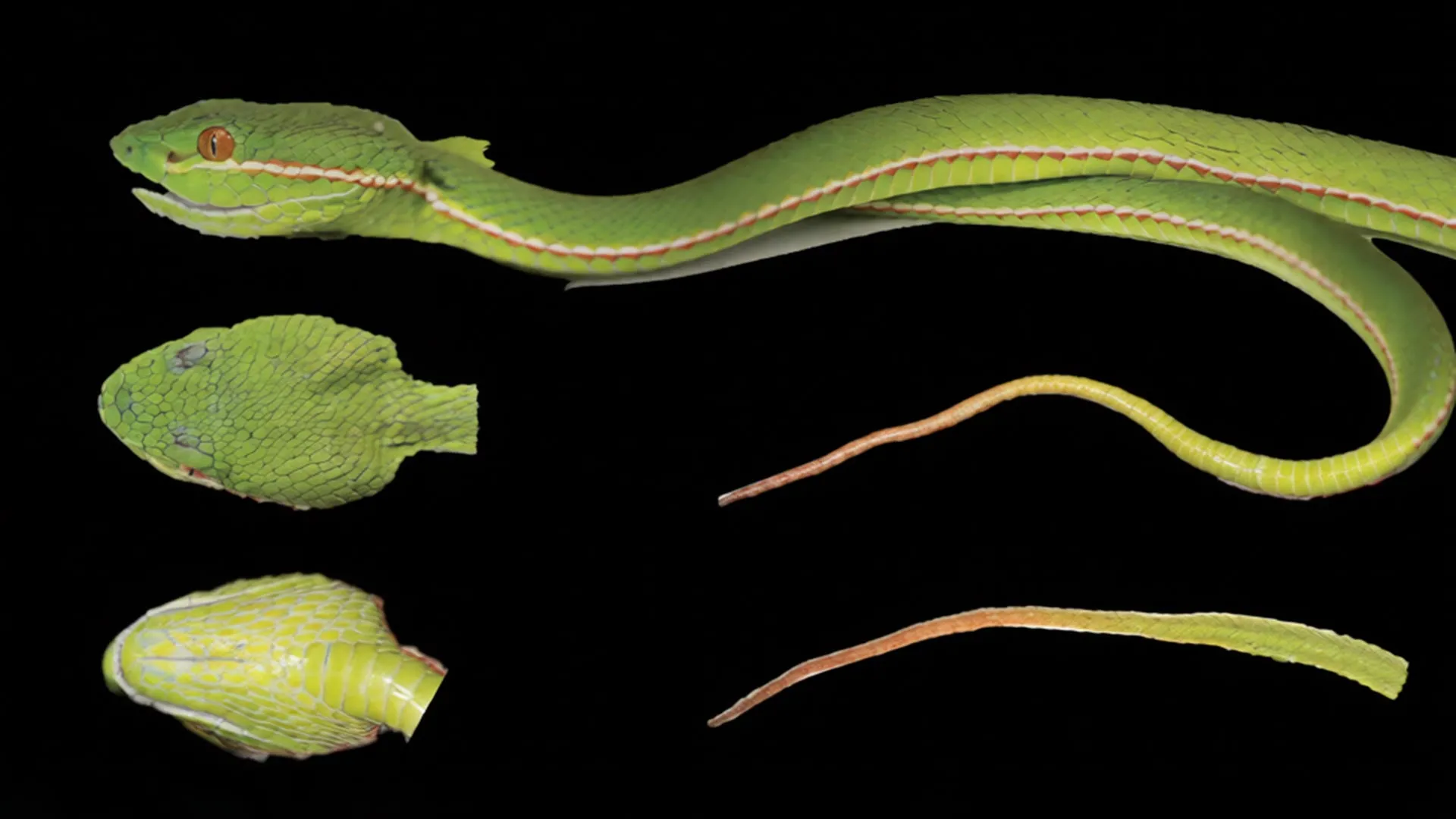
A striking new pitviper with a vivid grass-green body and amber-like eyes has been discovered in the misty mountains of western Sichuan, China. Blending seamlessly into its lush surroundings, this snake had gone unnoticed for years, hiding in one of the world’s richest biodiversity regions.
Researchers from the Chengdu Institute of Biology and the Giant Panda National Park made the discovery while studying wildlife in the West China Rain Zone. What they initially believed to be a common species turned out to be something entirely new. In recognition of the region’s cultural heritage and conservation mission, the team named the species Trimeresurus lii — the Huaxi Green Pitviper.
“The specific name lii honors Li Er, the ancient Chinese philosopher better known as Laozi,” said the research team, led by Bo Cai. “His teachings emphasize the harmonious coexistence between humans and nature, a principle that perfectly aligns with the conservation mission of the Giant Panda National Park where this species was discovered.”
DNA Reveals a Distinct Species
The Huaxi Green Pitviper is now the 58th known species in the Trimeresurus genus and only the second from its subgenus recorded in Sichuan Province. For decades, scientists had mistaken these snakes for the bamboo pitviper (T. stejnegeri) due to their nearly identical green coloration.
Detailed genetic testing and close examination of physical traits showed otherwise. DNA analysis confirmed that this population forms its own separate evolutionary branch. Researchers also identified consistent physical differences, including smooth head scales that distinguish it from related species.
Unique Appearance and Traits
The discovery, published in the open-access journal Zoosystematics and Evolution, highlights a snake well adapted to its environment. Both males and females share a bright green body, but they differ in appearance in noticeable ways. Males display a bold red and white stripe along their sides and have amber eyes, while females feature a simpler yellow stripe and orange-yellow eyes.
Venomous Snake in a Shared Habitat
Like other members of the Trimeresurus genus, the Huaxi Green Pitviper is venomous and capable of causing snakebite envenoming. Because it lives in mountainous areas that overlap with human activity, it may present a risk to local communities and visitors.
A Biodiversity Hotspot Still Full of Surprises
These snakes can grow to nearly 80 centimeters (~32 inches) in length and are found in the humid forests of Mt. Emei and Xiling Snow Mountain. This region, part of the West China Rain Zone, is considered a global biodiversity hotspot, yet many of its species remain poorly studied.
The researchers say the discovery underscores how much is still unknown, even in places that have been explored for years. “This discovery highlights the importance of continued field surveys in biodiversity hotspots,” the team stated.


