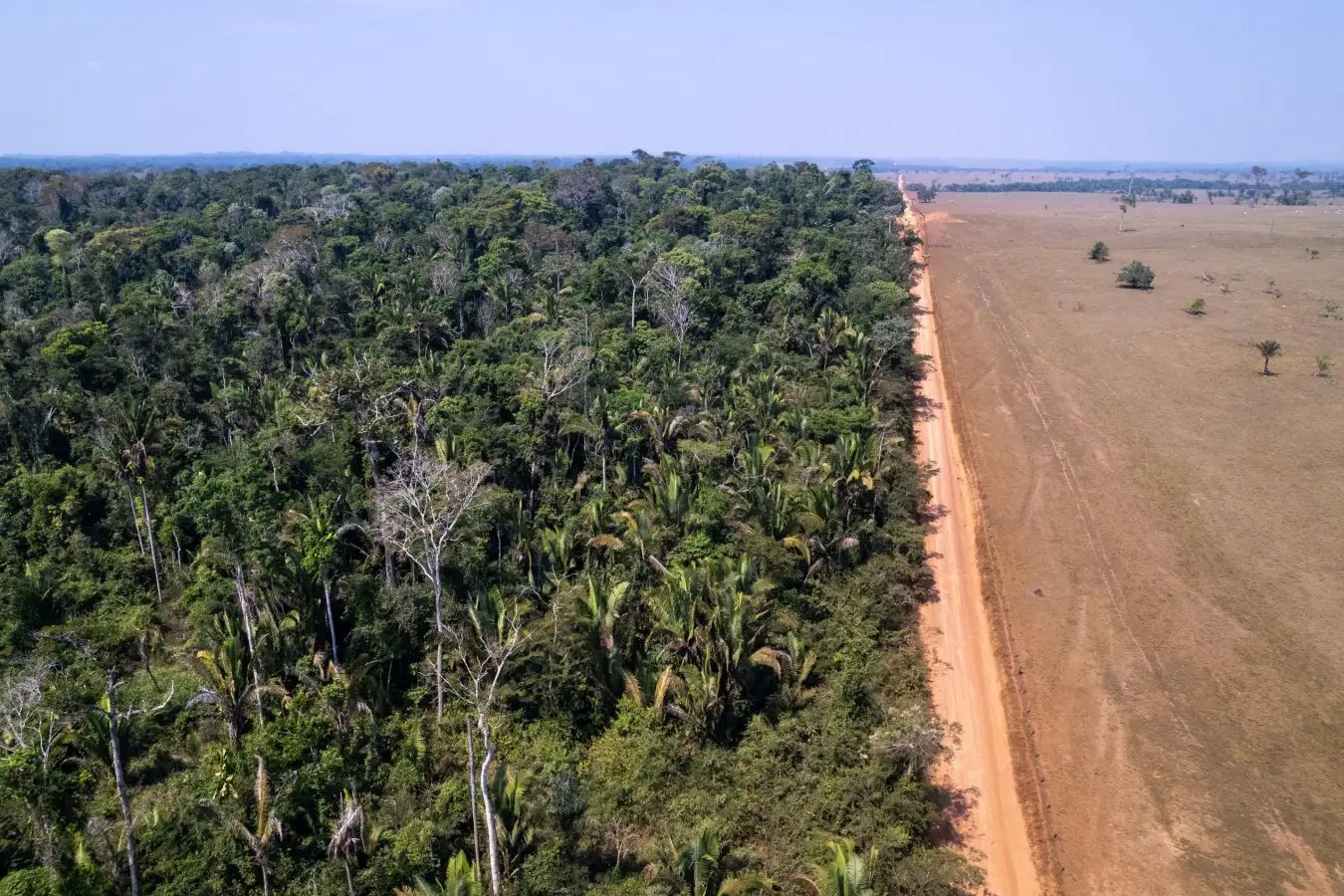
Large parts of the Amazon rainforest have been cleared for cattle ranching
Paralaxis/Alamy
Destruction of rainforest for cattle ranching is making the Amazon biome more vulnerable to irreversible collapse, which could occur within decades if deforestation continues.
A landmark 2022 study on tipping points found the Amazon would likely suffer widespread dieback at global warming of 3.5°C and potentially as low as 2°C. That’s worrying, as estimates put Earth on track to warm by about 2.6°C to 2.7°C above pre-industrial temperatures by 2100. But the research didn’t include deforestation, which has already resulted in the loss of at least 15 per cent of the Amazon.
Nico Wunderling at the Potsdam Institute for Climate Impact Research in Germany and his colleagues have now modelled Amazon dieback with scenarios involving both rising global temperatures and severe deforestation until 2050. If total forest loss increases to 22 per cent, the Amazon could suffer widespread dieback with as little as 1.5°C of global warming, they found. The world has already experienced 1.3°C to 1.4°C of warming and could hit 1.5°C by the end of this decade.
Deforestation slowed last year, but if it resurges, the Amazon could cross a tipping point as soon as 2031. The timing and extent of dieback predicted by the model varied depending on how much carbon humanity emits, with deforestation rates of 22 to 28 per cent leading to 62 to 77 per cent of the Amazon biome becoming grassland, savanna or scrubby forest.
“We found that there’s this about-2-degree reduction of the critical global warming threshold when deforestation is considered,” says Wunderling. “The reason why deforestation is so crucial is that it undermines this atmospheric moisture recycling feedback.”
Vast atmospheric rivers carry moisture from the Atlantic Ocean across the Amazon. After rain falls on one part of the forest, the trees transpire some of that moisture back into the air, which carries it to another part to repeat the process. Up to 50 per cent of the rainfall in the western Amazon is recycled from the forest itself.
But cutting down areas of the forest reduces this moisture recycling and kills off other areas downwind, which kills off further areas in a domino effect. “It only needs a little bit of a push from global warming to make these cascading transitions possible,” says Wunderling.
While concerning, the findings are based on a high deforestation rate that would eat into areas that are currently protected, according to David Armstrong McKay at the University of Sussex in the UK, who worked on the 2022 tipping point study.
Brazil lost more than 28,000 square kilometres of primary forest in 2024, equalling its previous record. But it nearly halved that rate in 2025, and President Luiz Inácio Lula da Silva has promised to halt Amazon deforestation by 2030. Achieving that would probably avoid the tipping point even if the world keeps warming.
“Stopping all deforestation is probably optimistic,” Armstrong McKay says. “But even if there is some deforestation continuing, it probably won’t meet this worst-case scenario modelled here.”
All the same, Brazil still lost about 0.5 per cent of its primary forest in 2025. And for the past two years, two-thirds of forest destruction has been due to wildfires, which typically start when farmers burn vegetation in deforested areas but then escape into the neighbouring forest.
Once almost unheard of, wildfires can now spread because the rainforest is hotter and drier, conditions that will be worsened by the El Niño climate phase later this year. As a result, the study may be underestimating the vulnerability of the Amazon, according to Dominick Spracklen at the University of Leeds, UK.
“We’re getting these much bigger fires,” he says. “That is worrying if we have moved into a new kind of regime where that can happen more and more.”
Already, the Amazon has shifted from a carbon sink to a carbon source, and widespread dieback could emit enough carbon to heat the globe by as much as 0.2°C. It would also destroy the world’s biggest store of terrestrial biodiversity.
“We really want to be backing away from that threshold, rather than creeping towards it,” says Spracklen.
Topics: