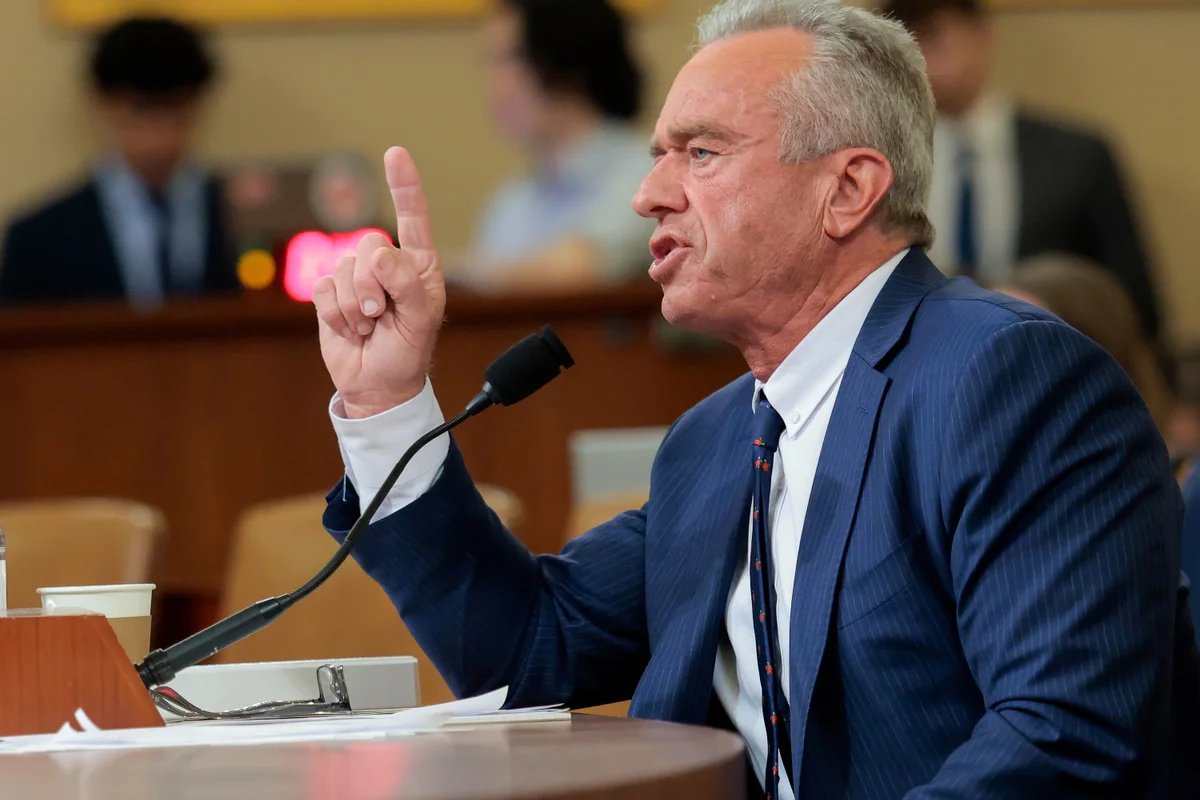
Congress grills RFK, Jr., about vaccines and cuts to health budget
The HHS secretary defended proposed budget cuts to science, his vaccine moves and health care costs on Capitol Hill on Thursday
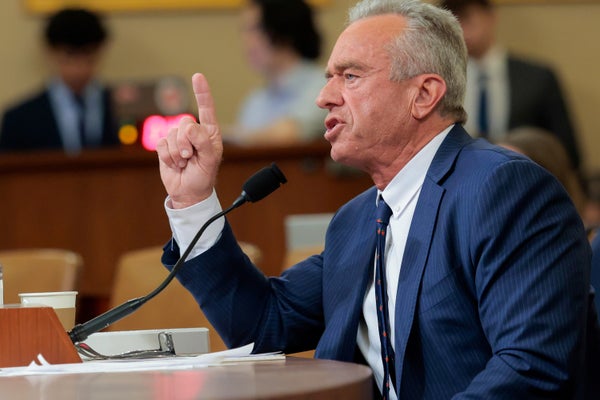
U.S. Secretary of Health and Human Services Robert F. Kennedy, Jr., testifies on April 16, 2026, in Washington, D.C.
Heather Diehl/Staff/Getty Images
Secretary of Health and Human Services Robert F. Kennedy, Jr., attended the first of a series of seven congressional hearings on Thursday morning. Through his remarks, the secretary aimed to turn the focus away from his controversial role in American health and vaccine policy and to instead highlight his efforts to fight chronic disease and promote healthy eating.
“We cannot hope to make America great again without first making Americans healthy again,” Kennedy wrote in a statement to the House Committee on Ways and Means, the chief tax-writing committee in Congress. “The bedrock of health—the key to reversing the chronic disease epidemic—is nutrition.”
But Democratic members of Congress grilled him on his record of vaccine opposition and handling of the resurgence of measles, which has mushroomed to thousands of cases in the past year.
On supporting science journalism
If you’re enjoying this article, consider supporting our award-winning journalism by subscribing. By purchasing a subscription you are helping to ensure the future of impactful stories about the discoveries and ideas shaping our world today.
The morning hearing offered a first chance for Congress to probe the administration’s 2027 presidential budget request, or PBR in Capitol Hill argot, for the divisions of the Department of Health and Human Services, which are under Kennedy’s purview, including the Centers for Medicare & Medicaid Services, as well as the Food and Drug Administration, the Centers for Disease Control and Prevention and National Institutes of Health. The PBR is an annual wish list that outlines presidential priorities. This year’s PBR called for a nearly 13 percent cut to the NIH and a 32 percent cut to the CDC.
The morning panel’s questions largely seesawed between the concerns of lawmakers in the Republican majority, who asked, for example, about insurance fraud and taxpayer support for rural hospitals, and those of members in the Democratic minority, who raised questions about cuts to health care, the secretary’s stance on vaccines and his 2024 comments about his intent to separate Black children on Adderall and other medications from their parents and “reparent” them.
Lawmakers in the Democratic minority frequently swept proposed science agency cuts into a larger series of hearing queries—often contentious—on Kennedy’s controversial vaccine policies, past statements about measles and autism and social media appearances.
“You’re spending taxpayer dollars to drink milk shirtless in a hot tub with Kid Rock,” said Representative Linda Sanchez of California, a Democrat. “Somehow you think that’s a better public health message than informing the public about the benefits of vaccines. Really?”
At the hearing, Kennedy touted new dietary guidelines, the removal of some dyes from food and shortened drug approval times as among his department’s achievements. In recent months the Trump administration has toned down RFK, Jr.’s opposition to vaccines, which has turned off voters. Instead the White House has put him on a “low-risk messaging diet ahead of midterm elections,” according to Bloomberg, with an emphasis on food safety, a more popular topic. The status of U.S. surgeon general nominee Casey Means, a wellness influencer and Kennedy ally, who sidestepped supporting vaccines in her Senate confirmation hearing in February, is still in limbo. Last week Kennedy announced he would start his own podcast “to name the names of the forces that obstruct the paths to public health,” according to a promotional video.
Kennedy frequently parried questions about significant cuts to scientific research at the NIH, the country’s $48-billion basic biomedical research colossus, with suggestions that the cuts did not meaningfully affect scientific outcomes and calls for an increased focus on disease prevention research. At the hearing’s outset, he called the U.S. Preventive Services Task Force, which recommends screenings for cancer and other diseases that are paid for by health insurers, “lackadaisical and negligent for 20 years.” He said he would install new members on the panel, which has cancelled three of its four scheduled meetings so far under the Trump administration’s second term. “If RFK, Jr thinks he can replace this respected committee with quacks and kooks, and that American physicians will simply fall in line, he is going to be disappointed,” wrote University of Washington School of Medicine microbiologist Ferric Fang on Bluesky during the hearing.
Overall, the presidential 2027 budget, released on April 3, called for a 10 percent cut in federal nondefense spending, including science, resulting in $660 billion, and a 40 percent increase in defense spending, resulting in $2.2 trillion. Last year Congress largely ignored the White House budget’s suggested cuts to science and kept spending numbers largely flat. Kennedy’s critics at the hearing nonetheless noted the Trump administration’s efforts to deport immigrants were harming American science, which has been heavily dependent on overseas talents since the end of World War II.
“The actions you and this administration are taking are chasing American scientists away from this country and fueling the research and development and drug commercialization in places like China,” said Representative Brad Schneider of Illinois, a member of the committee’s Democratic minority. “You are not making Americans healthier. You’re making Americans sicker, hurting our economy and making our children’s future less prosperous, less secure.”
In the afternoon Kennedy headed to the House Committee on Appropriations, which controls his department’s budget and will evaluate the latest proposed cuts to science agencies. Last year’s budget request called for slashing the federal science budget by 40 percent, which Congress rejected. “I was very pleasantly surprised” about resistance among Republicans in Congress on the appropriations committee to those proposed cuts last year, said Democratic representative Bill Foster of Illinois, a physicist, in an interview with Scientific American on Tuesday. “It will be interesting to see if that pattern persists.”
Editor’s Note (4/16/26): This story is in development and may be updated.
It’s Time to Stand Up for Science
If you enjoyed this article, I’d like to ask for your support. Scientific American has served as an advocate for science and industry for 180 years, and right now may be the most critical moment in that two-century history.
I’ve been a Scientific American subscriber since I was 12 years old, and it helped shape the way I look at the world. SciAm always educates and delights me, and inspires a sense of awe for our vast, beautiful universe. I hope it does that for you, too.
If you subscribe to Scientific American, you help ensure that our coverage is centered on meaningful research and discovery; that we have the resources to report on the decisions that threaten labs across the U.S.; and that we support both budding and working scientists at a time when the value of science itself too often goes unrecognized.
In return, you get essential news, captivating podcasts, brilliant infographics, can’t-miss newsletters, must-watch videos, challenging games, and the science world’s best writing and reporting. You can even gift someone a subscription.
There has never been a more important time for us to stand up and show why science matters. I hope you’ll support us in that mission.