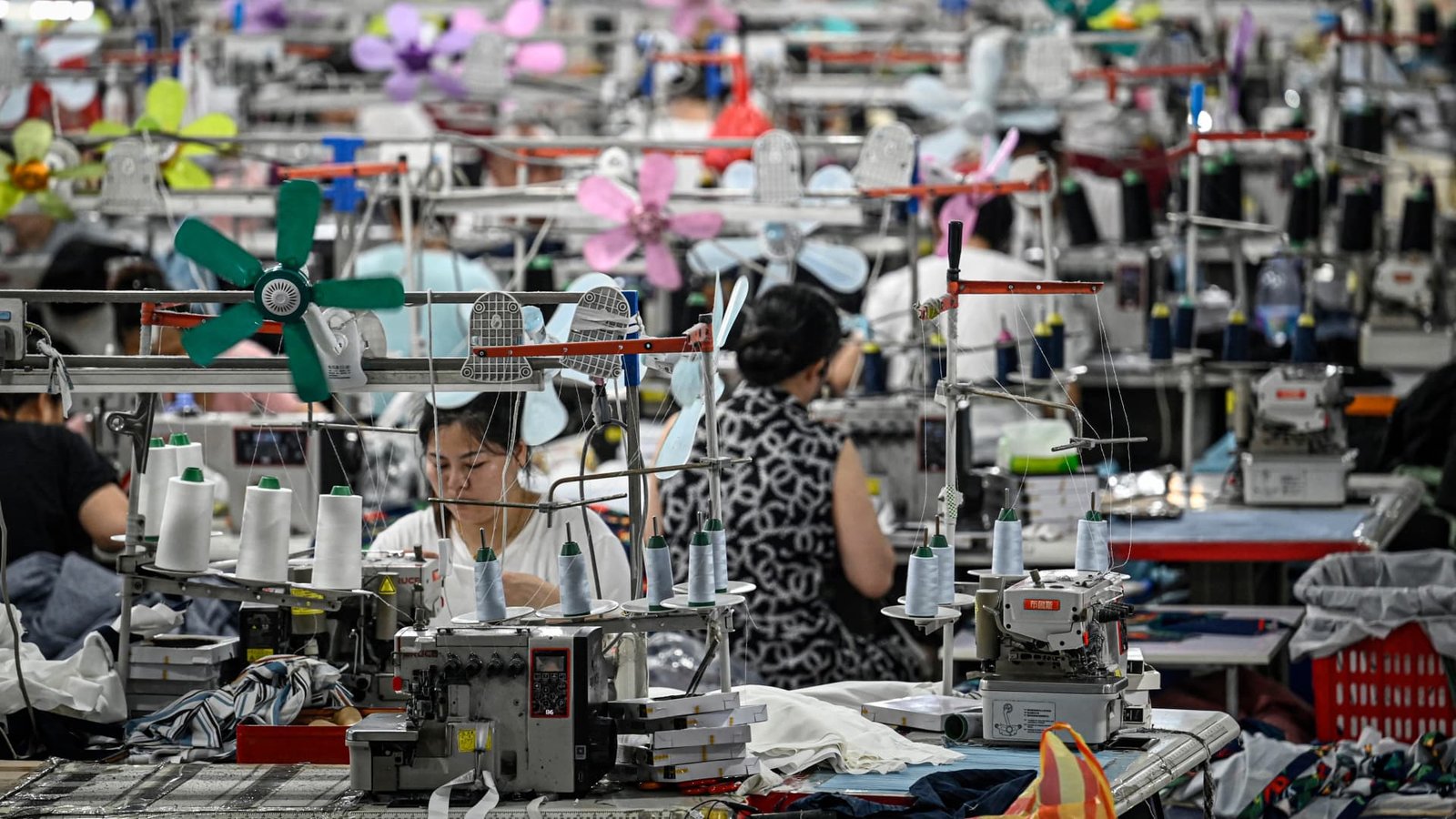
Workers producing garments at a textile factory that supplies clothes to fast fashion e-commerce company Shein in Guangzhou in southern China’s Guangdong province.
Jade Gao | Afp | Getty Images
China’s factory activity topped analysts’ expectations, although growth slowed from the prior month when it hit a year-high, as new orders saw a slowdown.
The official manufacturing purchasing managers’ index reading of 50.3 was higher than the the 50.1 expected by Reuters-polled economists. A figure above 50 indicates expansion, while below shows a contraction in activity.
Non-manufacturing PMI fell into contraction territory at 49.4, compared to the 50.1 seen in March, with activity in the services and construction sectors both shrinking.
China’s composite PMI dipped to 50.1 from March’s 50.5.
“Industry still looks comparatively firm, while services and domestic demand show some weakness, which keeps boosting internal demand high on the policy agenda,” said Hao Zhou, head of research and chief economist at Guotai Junan International Holdings.
While growth in new orders slowed, Zhou said that output and new orders remain key supports as both continue to be in expansion territory.
“On risks, input prices are running hot enough to watch: elevated raw-material costs, with oil still sensitive to Middle East tensions, could add reflation pressure at the margin,” Zhou adeed
The data comes as China is preparing for a summit between President Xi Jinping and U.S. President Donald Trump in May, where Beijing will likely be looking for clarity around the threat of Section 301 tariffs.
Trump’s Liberation Day tariffs had been struck down under a Supreme Court decision earlier in February, although the U.S. president had moved quickly to impose a global 10% on global imports to the U.S.
Trump and Xi met in Busan, South Korea last year and agreed to a trade truce that saw his administration reduce the overall tariff rate on Chinese goods to around 47%, while Beijing pledged to suspend sweeping export controls on rare earths.