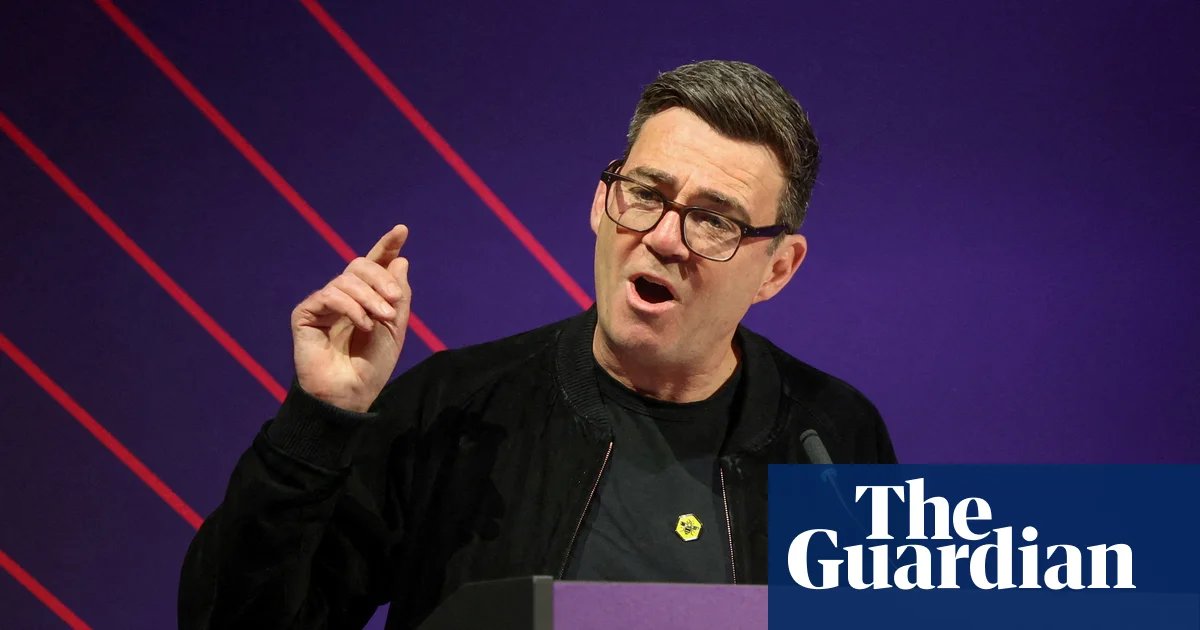
Manchesterism is “the end of neoliberalism”. That was the claim made by Andy Burnham in his campaign launch video this week – a film which made an audacious offer not just to his byelection constituents in Makerfield, but how he intended to change national politics and the economy.
But the 2026 doctrine of Manchesterism is very different to its 19th-century namesake, when it was a byword for free trade.
Now in the hands of the mayor of Greater Manchester, it means the national rollout of what he has achieved in the city – essential assets brought into greater public control such as the bus network, a closer partnership between the state and business to spread the proceeds of wealth, and a huge expansion of devolution.
However, the task of turning Manchesterism into a practical offer in government – potentially in a matter of weeks – is immense. It is a shoestring operation, with a considerable number of players vying for influence.
There is a determination among those backing Burnham to be bold and authentic, but it runs alongside a deep fear about spooking an already jittery bond market and causing the cost of borrowing to soar, as well as anything that might risk handing the seat to Reform UK.
Those constraints were evident in Burnham’s statement at the weekend that he will stick to Rachel Reeves’s fiscal rules – meaning any further expansion of public spending will have to be paid for with tax increases.
Investors had been fretting about an unfunded spending splurge in the event of a Burnham leadership, since he called for Labour to be less “in hock,” to the bond markets. The shadow chancellor, Mel Stride, has begun claiming the government is already paying a “Burnham penalty” in higher borrowing costs.
Burnham, according to his close adviser Neal Lawson, who founded the thinktank Compass, has developed his prognosis entirely through his work in Manchester, although the roots come from the much-praised civic leadership of Howard Bernstein, the chief executive of Manchester city council during the New Labour years.
“What is interesting about Andy is that he does not get his theory of change from books,” Lawson said. “He’s what Gramsci would call an organic intellectual, because it’s literally the practice of running Manchester.”
The intellectual work of Manchesterism that Burnham intends to make his framework for government has been taking place over many months – with different influences.
From the left is Common Wealth’s Mathew Lawrence and the economist Alex Williams, whose ideas will be fleshed out in an essay called The Productive State, although in practice the ideas are significantly more radical than what Burnham knows he can achieve in the short-term in government, and without his own electoral mandate.
It argues that privatisation is at the root of Britain’s problems, that essential services are run entirely for profit and that the welfare state has ballooned because ordinary people need state help just to afford the essentials.
Lawrence’s work argues that the state should not just regulate, but directly own and operate in essential sectors. It should provide services where profit is not the main incentive – seen in practice by Manchester’s Bee Network buses, where the city has control over the routes and the price.
But Burnham himself has never directly said he intends to nationalise those essential services such as energy and water, but rather that they should be brought into “public control” with more government involvement in the way they are run and paid for.
Those close to the mayor say the pragmatic version of Manchesterism shows a framework for a more productive relationship between the state and business – Burnham has been widely known as a business-friendly mayor. “You can be pro-business but want more of the proceeds of growth recycled back into our communities,” he has said.
The small team behind Burnham face an extraordinary challenge to win a tight byelection and potentially prepare for power – and are likely to face tough questions about how that framework can be applied in government via specific policy levers, and especially how to do so in such fiscally constrained circumstances.
Allies of Burnham say the first test of their theories on public ownership will be Thames Water, the stricken utility for which the government is trying to find a new buyer.
Many on the left of Labour want ministers to abandon attempts to negotiate a sale, and allow Thames to collapse into special administration, effectively putting the government in the driving seat.
Some advocate for public control of water companies rather than full nationalisation. This could involve setting up an independent company, perhaps with worker representation on the board, which would have some kind of accountability to government.
They cite Berlin as one example of this, where the local water company was brought back into municipal control in 2012. Berlin water company’s board is half elected by workers, and half appointed by the city council.
Some on the right of Labour fear Lawrence’s approach, set out in a long article in the New Statesman last week, is too theoretical and lacks a retail offer. The Labour Growth Group, which has discussed its recent publication An Honest Day with Burnham’s team, has called for more tangible, immediate action on the cost of living and harder messaging on extractive capitalism that rewards grifting.
The other key influence – although less likely to play a major part in the byelection – has been Lawson’s thinktank Compass; primarily its work on the need for constitutional reform, especially the electoral system. However, Burnham has indicated he does not expect this to be possible before the next election.
As well as Lawrence and Lawson, Makerfield’s outgoing MP, Josh Simons, is likely to be influential in the development of Burnham’s agenda – although his past at the Starmerite operation Labour Together and the fallout from the scandal over the investigation of journalists that led to him resigning from the government in February will mean an uneasy alliance with some of those on the left who have been longtime backers of Burnham.
Simons, and his wife, Leah, who is a Harvard-trained economist, grilled Burnham for two hours at their home in Makerfield on his economic agenda before Simons finally decided he would give up his seat to allow the mayor to run again for parliament.
But Simons said on Sunday he too was a believer in Burnham’s diagnosis about the selling off of national assets. “One of the things he’s really, really committed to is that the energy, water, social housing, those things that are the basics of our lives that we all depend on have gotten so expensive … we’ve privatised a lot of them and often the bills that we pay go to the shareholders of some private equity fund,” he said.
“It is for Andy to say whether he’s going to disaggregate neoliberalism but, you know, I don’t think he would entirely reject that … I basically agree that over the last 40 years the basic way that we’ve run our economy is shafting my constituents.”