
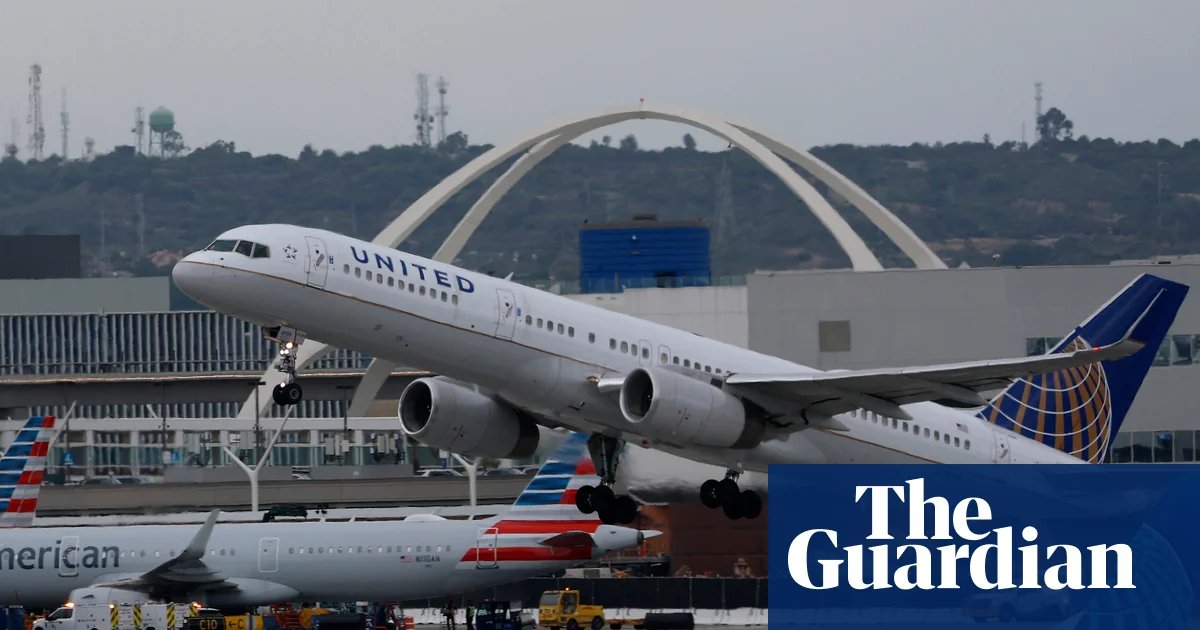
California’s jet fuel supply has dropped to a level not seen since 2023, as turmoil in the Middle East continues to squeeze the global oil market.
As of 17 April, the state’s jet fuel stock was just over 2.6m barrels, in comparison to 3.2m barrels two years prior, according to the California energy commission (CEC), which publishes a refinery stocks data dashboard.
California received 61.1% of its oil supply from foreign sources in 2025, according to the CEC – a majority of whom are Asian refiners. The foreign dependence is a shift from the early 1990s, when nearly half of its oil supply came from state-owned refineries, a change that some energy researchers attribute to air quality regulations.
That supply has been disrupted, however, by the US and Israel’s war with Iran. Asia imported more than 14m barrels a day of crude Middle Eastern oil in 2025. Traffic in the strait of Hormuz, a major waterway for oil vessels, has plunged.
Since the war’s outbreak, jet fuel prices have climbed.
For the first two months of 2026, in Chicago, Houston, Los Angeles and New York, prices hovered at about $2.30 a gallon, according to Argus Media, a site that tracks commodity prices. As of 24 April, jet fuel prices averaged $4.19 per gallon.
At the Los Angeles international airport, jet fuel costs were close to $15 a gallon recently, according to the Los Angeles Times.
“Jet fuel supply is tight globally,” said Sandy Louey, a spokesperson for the CEC. “California prices reflect that pressure, though the US is better positioned due to domestic refining infrastructure and crude supply that Europe lacks.”
“The CEC is closely monitoring fuel supply and price conditions resulting from the ongoing conflict in the Middle East and is actively coordinating with industry, fellow state agencies, and other stakeholders to assess near-term risks and options,” Louey said.
Consumers nationwide are beginning to absorb the financial shock from jet fuel supply changes.
Several airlines, including Delta, Southwest and JetBlue, have rolled out increased baggage fees. Other carriers have introduced fuel surcharges.
Clint Henderson, a travel expert with the Points Guy, said he does not expect the situation to be so dire that planes will not be able to be fueled.
But he does expect that, barring geopolitical changes, there will be an uptick in cancelled flight routes, which could snarl upcoming travel plans.
“Some of the shorter-haul flights that are not super profitable will likely be cut first,” he said. “We haven’t seen any letup in demand from passengers. So you’ve got the same amount of people wanting to travel, but you’ve got fewer seats available.”
He added: “That’s driving prices higher and prices are already higher.”


