California’s primary elections, including its fiercely fought gubernatorial contest, will be at the mercy of a notoriously slow vote-counting system after the polls close on Tuesday, and it could be days or even weeks before the outcomes of the tightest races become clear.
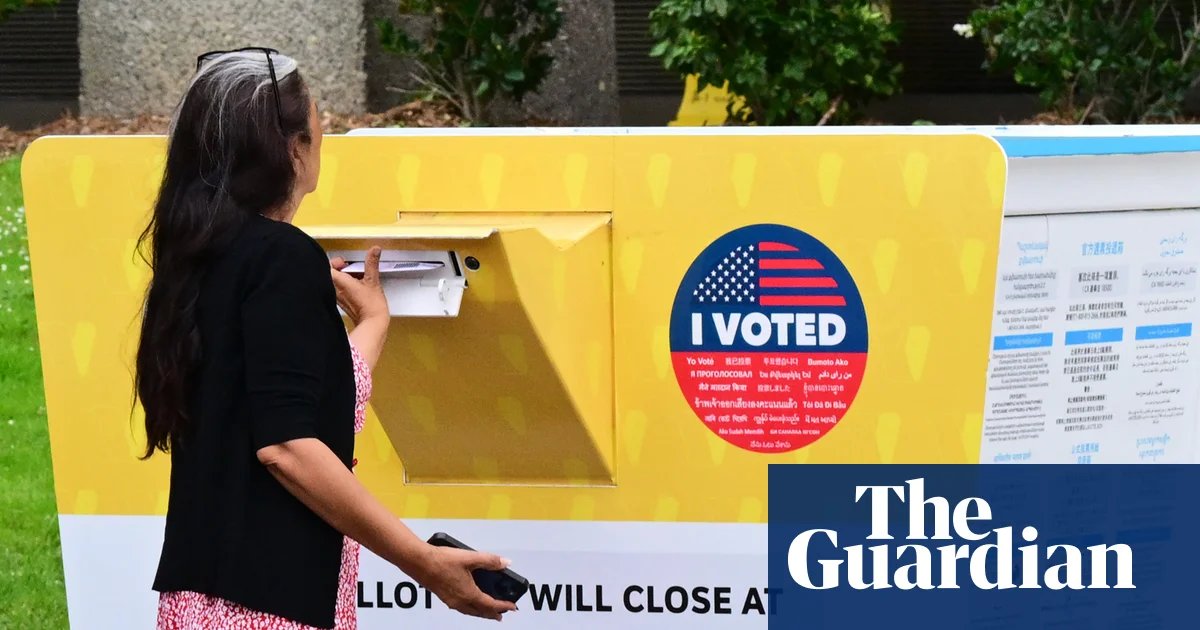
Voting experts expect the state’s 58 county elections offices to be deluged with last-minute absentee ballots, as they have been in the last few election cycles, and spend weeks undertaking a painstaking ballot-by-ballot verification process.
That presents a procedural problem whenever races are close, as they tend to be in the state’s most competitive congressional districts, and the whole country is left waiting – as it was in 2020, 2022 and 2024 – to find out which party controls the House of Representatives.
It is also a political headache worrying everyone from Gavin Newsom, the state’s outgoing Democratic governor, to an aggrieved Republican party that has not won statewide office for 20 years and has become increasingly bold about accusing its political opponents of playing dirty, even without evidence.
In the 2024 presidential election, more than 25% of California’s vote total arrived too late to be counted by election day. The percentage could be even higher this time, since many Californians made a strategic decision to postpone their vote until they had a clearer picture of who in the crowded governor’s race stood a chance of finishing in the top two and advancing to November’s general election. Final polls indicate it is a volatile three-way race between two Democrats, Xavier Becerra and Tom Steyer, and the Republican frontrunner, Steve Hilton.
In a state with more than 23 million registered voters, the volume can quickly overwhelm poll workers who, in the words of one voting expert, are already “overworked, under-appreciated and under attack”. Opinion polls and other data also show it is also a recipe for voter frustration across the political spectrum.
“Like it or not, the more time that passes between election day and when results are known, the more voter confidence erodes,” says Kim Alexander of the California Voter Foundation, a nonpartisan voting rights group that has been lobbying to speed up the process.
“It’s an invitation to false claims about the reliability of the voting process even though we have the most accessible, secure and verifiable election system in the country.”
For years now, the prime mover behind those false claims has been the Trump White House, which has placed electoral systems across the country under such relentless scrutiny that the integrity of the November midterms is open to question.
Donald Trump has been particularly scathing about absentee ballots, which he blames for his defeat in the 2020 presidential election, and he has repeatedly alleged, in the face of all evidence, that California’s election results are padded by millions of illegal votes cast by noncitizens.
California’s Republicans have taken up much the same theme, pointing to the slow vote count as a symptom of what they see as a broader vote-rigging conspiracy. One gubernatorial candidate, Riverside county sheriff Chad Bianco, attempted to seize 650,000 ballots earlier this year in a hunt for evidence of malfeasance by the Democrats. (He was slapped down in court.)
Hilton, meanwhile, has embraced a ballot initiative, due to appear before voters in November, that would impose a strict voter ID and proof-of-citizenship requirement. Critics point to states that have adopted similarly strict systems – Indiana, Ohio and others – and say it is a solution to a nonexistent problem that would have a significant chilling effect on lower-income and minority voters.
“Time is of the essence in preventing election lies from taking hold,” Newsom warned in a letter that he sent to county election offices last month, urging them to speed up their counts. “We face an assault on our democratic values unlike anything we have seen in our lifetimes, and it’s our job to safeguard those values.”
California’s procedures around absentee ballots are generally praised for the safeguards they provide against fraud. Poll workers are required to cross-check the signature on each envelope against registration records and verify that no voter has cast more than one ballot. If voters forget to sign the envelope or otherwise invalidate their ballot, as many do, they are offered a time window to rectify their mistakes so their votes can still be counted.
But the very thoroughness of the system also causes it to slow to a crawl. Alexander and other experts say most Californians are unaware of the headache they cause by submitting their absentee ballots less than three days before election day. They are often unaware, too, that in 26 counties they have the option of walking their absentee ballot into a polling station and having it processed and counted on the spot – an efficiency Alexander wants to see promoted and expanded to the whole state.
Elections specialists in the state legislature have sponsored a flurry of new laws, most of which have passed unanimously, to tighten the counties’ reporting deadlines so all non-problem ballots are counted within 13 days instead of 30, and to limit the window for correcting missing signatures and other mistakes.
These new rules, however, come with no funding attached, and county election officials have expressed frustration that they are expected to do more with the same limited resources. California’s elections chief, secretary of state Shirley Weber, opposed one of the new bills because she felt it put too much pressure on the counties.
At the same time, her critics say, she has done little to lobby for money to pay for more poll workers and more efficient workplace systems. Weber’s office said she had “emphasized” the need for significant resources for the counties to carry out new laws but did not respond directly to the criticism.
Some of the wealthier counties, including Los Angeles and Orange in southern California, have poured additional money of their own into elections infrastructure – and seen remarkable improvements as a result. Los Angeles, whose 10 million residents exceed the populations of 40 states, had counted just 77% of its ballots one week after election day in November 2022. But with a brand-new $10m ballot processing facility two years later, that mark increased to 96.9%.
Alexander said such developments proved that California could do better. “One of the challenges we face is the misconception that we have to trade speed for accuracy, or access, or security. I believe that’s a false choice,” she said. “We can have all of those things if we’re willing to pay for it and if we do the hard work to achieve it.”