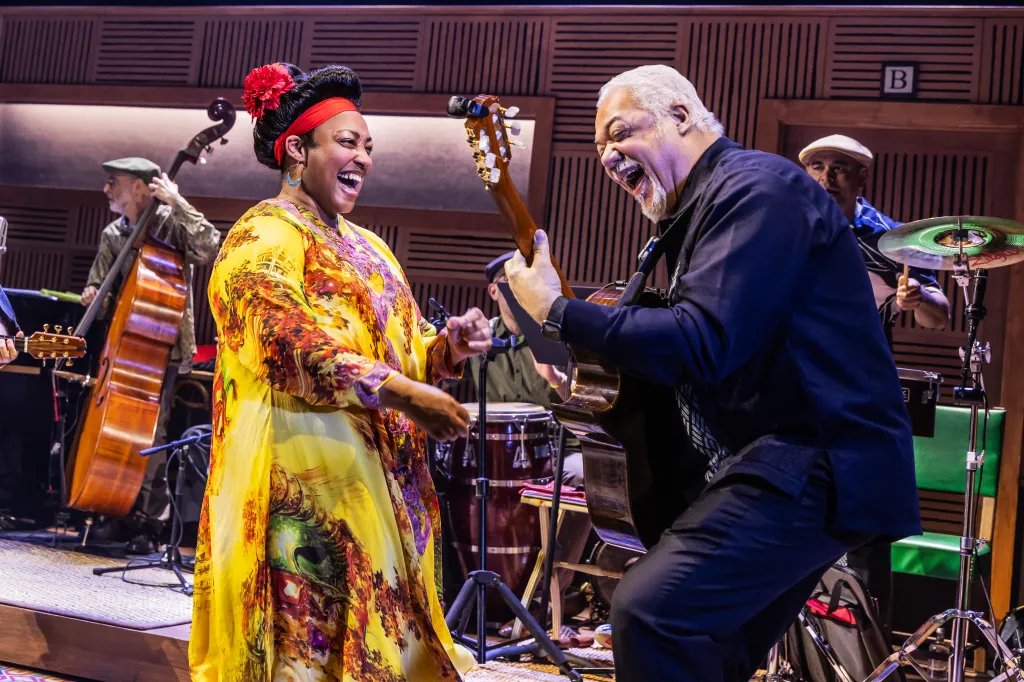
EXCLUSIVE: The Tony Award-winning Buena Vista Social Club musical kicking up a glorious storm on Broadway is heading to London’s West End in 2027, lead producer Orin Wolf tells Deadline.
The show won five Tony trophies last year, including a Special Award and a Best Featured Actress In A Musical honor for Natalie Venetia Belcon.
It imagines the origin story of the old-school Cuban musicians who assembled in Havana in 1996 to make what is now considered an historic recording session of their intoxicating music.
The resulting 1997 album was volcanic. Produced by Ry Cooder, who partnered with London-based music entrepreneur and producer Nick Gold, it taught the world once again how to rumba and do the mambo – that infectious blend of Afro-Cuban rhythm and Spanish melody that had us all shaking our bamba, hey.
The Broadway company of ‘Buena Vista Social Club.’ Photo by Matthew Murphy
Wolf says his show, directed by Saheem Ali, with Marco Ramirez’s book, Marco Paguia’s Tony Award-winning orchestrations and choreography by Patricia Delgado and Justin Peck (they won the Tony for their dance moves), is having the same hip-swivelling effect on Broadway audiences at the Gerald Schoenfeld Theatre.
Broadway’s Wolf is partnered with several producers, including Hamilton’s Lin-Manuel Miranda and Barbara Broccoli, who once ruled the kingdom of James Bond and is now laser-focused on her UK and U.S stage interests, as well as some movies.
Wolf says he’s eying a particular London venue that he hopes will be free next year. “It’s important we get the right space with the right vibe,” he tells us, well aware that musical houses in London are at a premium.
The producer, who had spent a decade developing David Yazbek’s award-winning musical The Band’s Visit, says that he often wondered about the troupe of elderly Cuban musicians who pulled off their momentous musical coup three decades ago.

Orin Wolf (center) with the ‘Buena Vista Social Club’ company. Photo by Andy Henderson
Along with the album, Wolf was a fan of Wim Wenders’ 1999 documentary of the same name. His Buena Vista Social Club premiered at the Berlin Film Festival and the courtly gents from Havana beat out their electrifying rhythms. They could be heard across the German city. It was a great night and I was able to spend time with them on and off through the rest of 1999 into early 2000, all the way through to that season’s Oscars, where it lost to Kevin Macdonald’s gripping One Day In September.
A friend of Wolf’s had just made the follow-up documentary to the Wim Wenders feature. “I kept wondering why it hadn’t ever been theatricalized,” and then he went in search of Gold because he controlled the Buena Vista Social Club stage rights.
“And he said no, which was, of course, something I was very used to hearing,” Wolf says with a wry smile.
Apparently, Gold had been wary of putting the rights in the hands of “western producers,” Wolf continues, because “he didn’t want it to become political bait.”
It was a view Wolf shared. “The good news is that this sort of political story would be very boring. So I’m not interested in telling that story.”
So he invited Gold to visit The Band’s Visit, which by then had transferred from the Atlantic Theater Company (where I remember sitting behind Sarah Jessica Parker at a preview and she leapt outta her seat at curtain call and gave an ovation that outshines the ones at Cannes) to Broadway, and explained how it’s about “a bunch of Egyptians and Israelis” reasoning that it would explain “what I mean when I say that I don’t really make theater about politics, even though these happen to be politically volatile parts of the world.”
(L-R) Music producer David Yazbeck, book writer Marco Ramirez and music consultant Juan de Marco. Photo by Andy Henderson
Gold and his daughter saw the show, “and we had dinner afterwards and he gave me the rights right away,” Wolf recalls.
Over the course of over two years, Wolf made half a dozen trips to Cuba, some accompanied by Yazbek, who was to become the show’s musical dramaturg. But, most of those visits were to assure the surviving musicians and their families that they would share in any financial success.
“When I made the deal with Nick, I said, ‘I really want to tell the story of these actual artists. And so if we can carve in room for them on the royalty…’ There was a lot of burnt bridges between the album and the documentary with a lot of the people in Cuba feeling left out or unloved,” Wolf explains.
I’m glad Wolf introduced this topic because it had been at the top of my mind to ask about whether compensation was due to the Cuban artists, who some felt had been, perhaps been taken for granted earlier on.
Gold had told Wolf that “a lot of things that were tricky” when they made the album.
“Obviously, a lot of that has to do just with Cuban-American relations and economics and law, but there is a trust concern. So I flew down and I started getting to know all of the musicians on the album who were alive and the ones who had passed, I started to get to know their families. And over the course of two and a half, three years really, I was able to hire a Cuban lawyer and I drafted a moral rights law, a contract that basically gave every single character on our show a direct agreement with me that allows them to participate in the royalties,” Wolf declares.
Justin Cunnigham and Marco Pagula at the piano with Renecita Avich, Natalie Venetia Belcon and Roman Diaz in ‘Buena Vista Social Club.’ Photo by Matthew Murphy
That includes, Wolf tells us, the legendary Cuban singer and actress Omara Portuondo. “I have one with her and her son,” he adds. Ibrahim Ferrer died so Wolf went to his son.
“Everyone who’s in our show, Rubén González’s family. I met his son in Miami. I had to go to Mexico City to meet Ibrahim’s son. Eliades Ochoa and his family we’ve had relations with for years,” he reports.
“It was unique in America because in London and in Europe and in the rest of the world, you guys have moral rights. And we don’t have that here in the U.S.,” he states.
Wolf stresses that he wasn’t obligated to go to such lengths, but he insists “it felt like the right thing to do. I felt like we could come up with a financial model that would allow for it. And also, I knew that eventually I would want this thing to go to Europe and to go to the UK and to have an international existence because this album does not belong to America at all. In fact, if anything, America’s sort of an afterthought. This album really belongs to the world. And so to serve the music, which I know is very meaningful to a lot of people, I felt like, well, I’ve got to come up with a system that’s going to allow me to do that.”
After its initial run at Atlantic Theater Company, representatives from many of the musicians’ families went to the Broadway opening in March last year.
“Obviously the ones that are in Cuba right now, it’s very, very difficult,” Wolf says in reference to the U.S. naval blockade disrupting Cuba’s fuel and other supplies.
The Broadway company of ‘Buena Vista Social Club’. Photo by Matthew Murphy
“It’s horrible. It’s a nightmare for them. And we’re trying obviously to be supportive and to do whatever we can do. But even since the last time I was there, it’s just gotten worse and worse. I mean, it’s really a sad state of affairs, like so many places in the world, but that was an extraordinary part of this process that I’m going to always feel very lucky to have gotten to experience,” Wolf says with gratitude.
The royalty split is a good thing to do. Others have done variations thereof on other shows, but the Cuban musicians, singers and their descendants are kinda owed this.
Wolf says that the contract negotiations with many of the original members of the Buena Vista Social Club were the first building blocks in building the production’s architecture.
“Here I am as an American, sort of a white Jewish guy coming in. But it’s bizarre because this album found its way into my life. When I was coming out of college and I had this album on all the time, and I’m not a fluent Spanish speaker, but this music, it just moves me. And then the documentary was able to give you a visual language for this music and introduce you to the world of Havana,” Wolf says.
Wolf had to answer an important question: “Can I do an American Broadway musical with a score in a foreign language and not use any subtitles?”
He believes that there’s a world where people can actually successfully communicate emotion even if you don’t understand the language. People have been doing it for eons. One of the greatest joys of my life was watching my favourite uncle, a big, mighty chieftain visiting from my family’s little kingdom in Nigeria, watching The Lion King at the Lyceum Theatre absolutely enraptured. He didn’t really understand any of it, probably thought it was about him. He talked about it until the day he died.
I digress. The Buena Vista Social Club films and album have always stayed with me. Recently, I saw a group of dancers on the Southbank boardwalk performing what seemed like an impromptu performance of the rumbustious ‘Chan Chan’ number, which is featured in the show. That to my way of thinking was a perfect example of sharing the joy.
It’s crazy, really, because I listen to the music of Israel ‘Cachao’Lopez, Celia Cruz and Johnny Pacheco, and I bow at the feet of Ramón ‘Mongo’ Santamaria and Juan Formell. I could lead a swell rumba through Ramsgate, echa!
Which leads me to dancing.
The Broadway company of ‘Buena Vista Social Club.’ Photo by Matthew Murphy
The Buena Vista Social Club features feet-twitching music and Wolf says that, obviously, people want to get up and dance but that’s just not allowed. Except there have been a couple of special performances at the Gerald Schoenfeld Theatre where they do the whole show but it’s a special, what they call The Buena Vista Dance Along Night -Lin-Manuel Miranda and John Leguizamo have each hosted one.
“But every time that we’re in the club in the show, and we just bring the house lights up just a little bit and let the audience just feel free to get up and dance…And people are dancing in the aisles, people are dancing in their seats, people went to the back of the theater to dance. It was really hilarious and funny and fun,” Wolf says cheerily.
He’d like to introduce an occasional Buena Vista Dance Along Night feature in London too. “I want to get the right theater. I want it to be a great experience because I know the musicianship that we have access to in London, and by the way, we can also bring Cubans to London the way we cannot do in the U.S. And there’s a lot of people in Cuba who want to be in the show who couldn’t do it on Broadway. But the opportunity in London,” Wolf suggests, ”is massive with the talent you have there.”
Actually, we both recognize that there’s a much larger Cuban and Afro-Cuban community in London than in New York, and they’re boisterous and fun to behold on the odd sunny Saturday afternoon on London Fields or way over in Margate, which, weirdly, reminds me a little of Cuba, with its crumbling charm and hint of danger.
I get why Wolf feels anxious about finding the right spot for Buena Vista Social Club.
But he’s in good hands because Broccoli knows London theaters like the back of her hand, and the good people at Playful Productions UK, who are also producing, are just as adept in the art of securing a theater.
(L-R) Michael G. Wilson, Barbara Broccoli and Daniel Craig
I love all the behind-the-scenes chess moves that are going on right now involving a dozen big shows with about two, possibly three theaters in play.
“As soon as that theater presents itself, we’re kind of raring to go. We really are hoping it’s in 2027. I mean, that would be ideal, but we are 1000 percent committed to this,” Wolf acclaims.
Give this man a theater, already.
Look, I could do with the dance exercise, so there’s that.