

John Davidson has given his first interview since the BAFTAs. Davidson, who has the coprolalia type of Tourette’s syndrome, produced the British film I Swear, which is based on his life, and the film was up for several BAFTA awards. Early in the ceremony, Davidson involuntarily screamed the n-word at Michael B. Jordan and Delroy Lindo as they tried to present an award on stage. Later in the evening, Davidson also shouted the same word at production designer Hannah Beachler. Throughout this days-long story, there’s been a widespread refusal by disability advocates and white people writ large to acknowledge that Jordan, Lindo and Beachler are worthy of compassion for how they were racially abused, and that they were harmed by racist language, even if that language was unintentional. In his first public statement, issued on Monday, Davidson also refused to actually say the words “I’m sorry” to Jordan, Beachler and Lindo, and instead his statement was mostly a promotion for his movie. It did not go over well, which is why Davidson came out on Tuesday and did an interview with Variety. Some highlights:
Davidson has reached out to Warner Bros, but not the Black artists directly: Since the fallout, Davidson’s team shares that he’s reached out to the studio handling “Sinners” in order to directly apologize to Jordan, Lindo and production designer Hannah Beacher.
Davidson on his Tourette’s: Very often, the media focuses on my particular type of Tourette’s, which is called coprolalia — the involuntary use of obscene or offensive language. This symptom affects 10% to 30% of people with the condition and is not a criterion for diagnosis. However, it is one of the hardest tics to manage and can be very distressing for those living with it. Many individuals report discrimination and isolation as a result. I have been physically beaten to within an inch of my life with an iron bar after ticking a comment to a young woman whose boyfriend and accomplice ambushed me one evening.
Guilt & shame: “The real challenge isn’t the tics themselves, but the misconceptions surrounding them. Understanding the full range of Tourette’s helps reduce stigma and supports everyone living with the condition. When socially unacceptable words come out, the guilt and shame on the part of the person with the condition is often unbearable and causes enormous distress. I can’t begin to explain how upset and distraught I have been as the impact from Sunday sinks in.
His tics are not his secret beliefs: “I want people to know and understand that my tics have absolutely nothing to do with what I think, feel or believe. It’s an involuntary neurological misfire. My tics are not an intention, not a choice and not a reflection of my values. Those who have seen “I Swear” will understand this. My tics have said and done things over the years that have caused huge pain and upset — punching Dottie [my second mother] in the face is a prime example. Dottie is someone I love dearly. I would never, ever want to hurt her. I have even punched her in the face when she was driving at speed, almost causing a head-on collision. Tourette’s can make my body or voice do things I don’t mean, and sometimes those tics land on the worst possible words. I want to be really clear that the intent behind them is zero. What you’re hearing is a symptom — not my character, not my thought, not my belief.
The n-word: “Tourette’s can feel spiteful and searches out the most upsetting tic for me personally and for those around me. What you hear me shouting is literally the last thing in the world I believe; it is the opposite of what I believe. The most offensive word that I ticked at the ceremony, for example, is a word I would never use and would completely condemn if I did not have Tourette’s.”
Ten offensive words: “I would appreciate reports of the event explaining that I ticked perhaps 10 different offensive words on the night of the awards. The N-word was one of these, and I completely understand its significance in history and in the modern world, but most articles are giving the impression I shouted one single slur on Sunday.
How he & BAFTA organizers prepared his attendance: StudioCanal were working closely with BAFTA, and BAFTA had made us all aware that any swearing would be edited out of the broadcast. I have made four documentaries with the BBC in the past, and feel that they should have been aware of what to expect from Tourette’s and worked harder to prevent anything that I said — which, after all, was some 40 rows back from the stage — from being included in the broadcast. As I reflect on the auditorium, I remember there was a microphone just in front of me, and with hindsight I have to question whether this was wise, so close to where I was seated, knowing I would tic.
When he realized that people could hear him: “Initially, my tics were noises and movements, but the more nervous I got, the more my tics ramped up. When my coprolalia tics came out, my stomach just dropped. As always, I felt a wave of shame and embarrassment hit me all at once. You want the floor to swallow you up. I wanted to disappear. I wanted to hide — just get away from all the eyes. I was hoping people would understand. My mind was saying: These people have seen the film. They will know I can’t help this. They will know it’s not me. This is exactly why we are here. I was saying in my head, “Please don’t judge me. Please understand this isn’t who I am.” I was trying to calm myself down, to breathe, but ultimately, I made the decision to leave to not cause any more upset. BAFTA found a private room with a monitor where I watched the rest of the awards.
He’s not going to be the fall guy for this: “I had an expectation that the BBC would physically control the sound at the awards on Sunday. I was so far from the stage. From the lack of response from the early presenters to my tics, and with no one turning around to look at me, I assumed, like everyone else, that I could not be heard on the stage. The only time I became aware that my tic had reached the stage was when Delroy and Michael B. Jordan appeared to look up from their role as presenters, and soon after that I decided to leave the auditorium.
A lot of this was educational and informative, which I appreciate and I wish this was his first statement on the incident (rather than the clean-up on his first statement). What strikes me most of all is that Davidson had faith that BAFTA and the BBC would protect him and protect the other guests from his tics, and he’s pretty clearly saying that they did not. Seating him close to a microphone was dirty work. Refusing to edit out the n-word was dirty work. Editing out his other tics but leaving the worst one in the broadcast was seemingly the whole point, the whole message for BAFTA and the BBC. It feels like BAFTA weaponized him and used him, then tried to hang the whole thing around his neck.
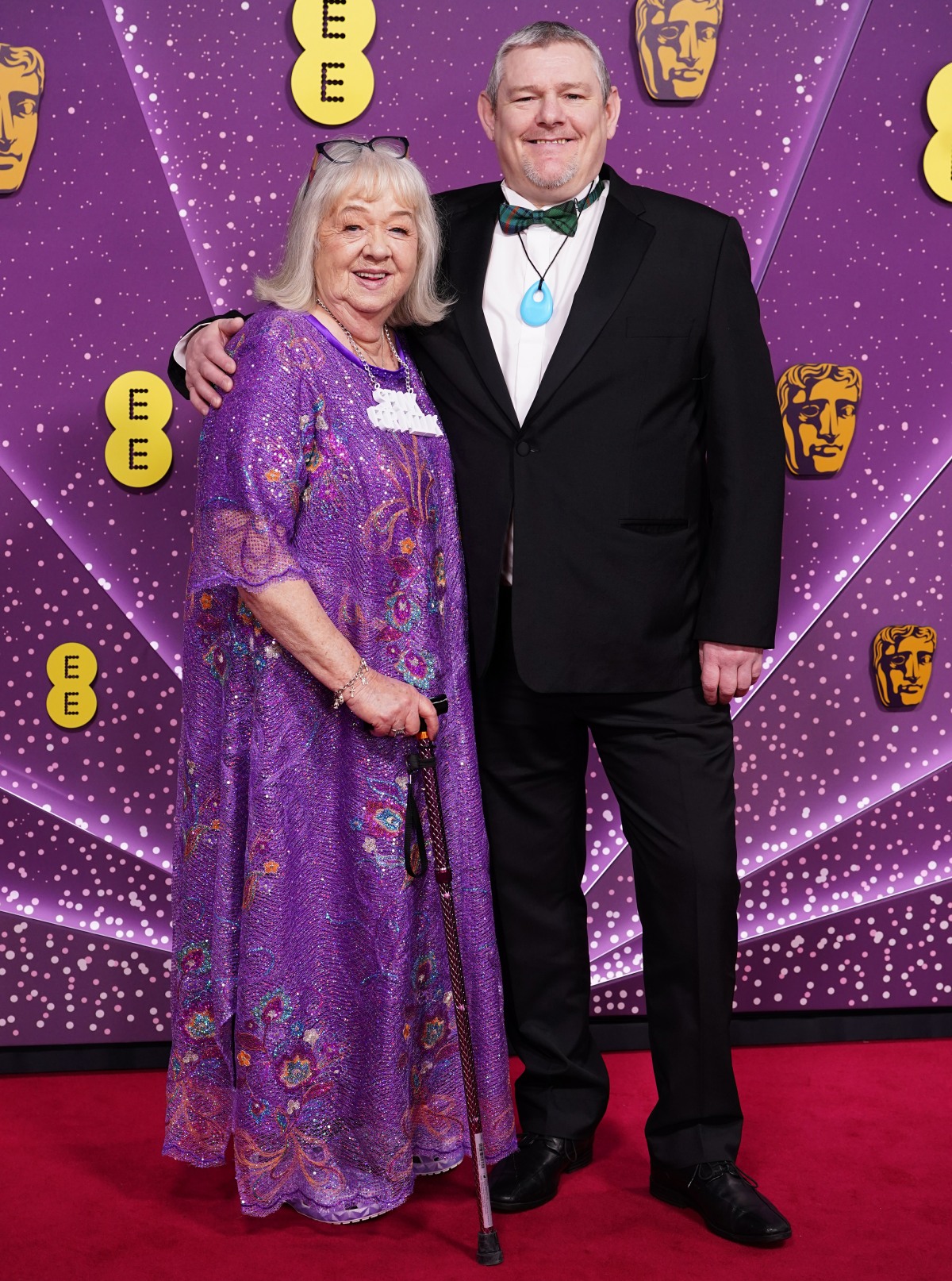
Photos courtesy of Avalon Red, Cover Images.
-
- Dottie Achenbach and John Davidson attends the EE BAFTA Film Awards 2026 at Royal Festival Hall, Southbank in London, England, UK on Sunday 22 February, 2026.,Image: 1077651864, License: Rights-managed, Restrictions: Please credit photographer and agency when publishing as Justin Ng/Retna/Avalon., Model Release: no, Credit line: Justin Ng/Avalon
-
-
Celebrities arrive at the 2026 BAFTA Film Awards at Royal Festival Hall, London
Featuring: Murray Gladstone, Dottie Achenbach, Chris Achenbach and John Davidson
Where: London, United Kingdom
When: 22 Feb 2026
Credit: PA Images/INSTARimages**NORTH AMERICA RIGHTS ONLY**
-
-
Celebrities arrive at the 2026 BAFTA Film Awards at Royal Festival Hall, London
Featuring: John Davidson
Where: London, United Kingdom
When: 22 Feb 2026
Credit: PA Images/INSTARimages**NORTH AMERICA RIGHTS ONLY**


