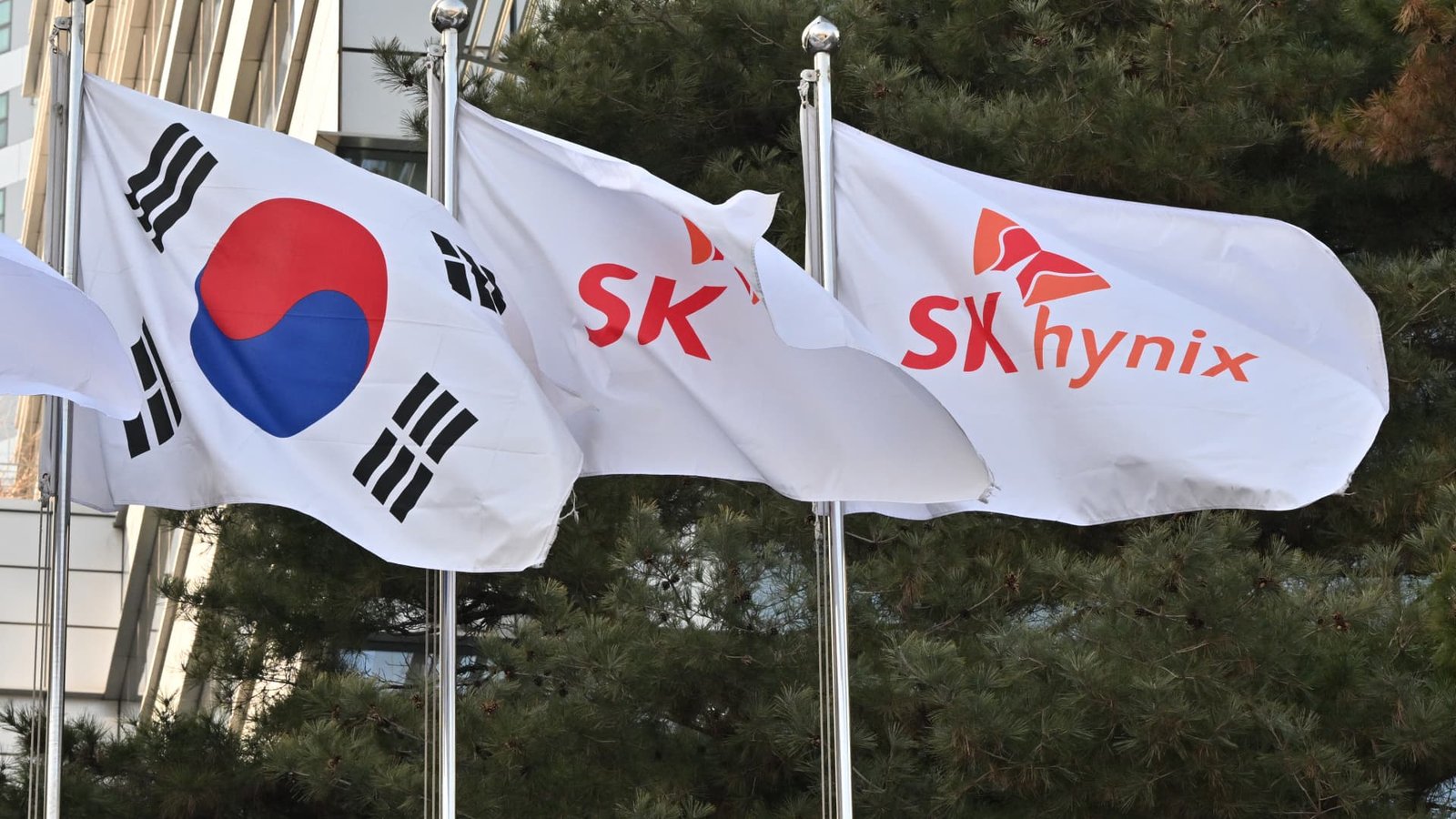
A SK Hynix flag (R) and a South Korean national flag (L) flutter outside the company’s Bundang office in Seongnam on Jan. 26, 2024.
Jung Yeon-je | Afp | Getty Images
London — Outsized returns for memory-related stocks have helped fuel substantial gains in U.S. and South Korean equity markets in recent years — but market watchers warn investors forget the market’s cyclicality at their own risk.
The memory industry has been in a period of sustained growth since the launch of ChatGPT in December 2022, which triggered huge demand for high-bandwidth memory, or HBM.
Samsung and SK Hynix are among the largest producers of HBM chips, and their stock prices have soared 114% and 186% higher year-to-date, respectively. US-based Micron Technology and SanDisk have each advanced 141% and 156% in 2026.
Central to the thesis underpinning the bull run in memory stocks is the belief that the industry has shaken off its past cyclicality, whereby demand for storage fluctuates significantly while supply remains largely fixed.
Executives have argued that AI has upended the industry’s history of boom and bust, and a structural supply shortage means that prices could stay high for years.
William de Gale, portfolio manager at BlueBox Asset Management, told CNBC’s Europe Early Edition on Wednesday that the industry tends to have “enormous ups and downs”.
“In the long run it’s a pretty dreadful industry,” he said.
“I suspect that’s still the case every time people make an argument that the memory cycle is gone, and it’s now a long-term value-creating industry – just before it all goes horribly wrong.”

New innovations
Though memory chip supply is extremely constrained at present, Alphabet’s Google on March 24 unveiled TurboQuant, a new compression method, which it says could reduce the amount of memory required to run large language models by six times.
It is designed to make AI models more efficient, a major goal of the leading labs.
Such developments have the potential to slash demand for AI memory chips, which have been a critical component to train up huge LLMs from companies like Google, OpenAI and Anthropic.
Deutsche Bank wrote in a Tuesday note that investors should “continue to brace themselves for continuous AI-related disruption”, as evidenced by TurboQuant, which caused a sharp decline in the share price of the biggest memory providers upon its release.
The analysts added, however, that it “remains to be seen” whether the TurboQuant technique will create a structural shift in demand.
Jon Cunliffe, head of investment office at wealth manager JM Finn, told CNBC that there is scope for production to increase meaningfully over the next three years, easing supply constraints, “especially if AI demand grows at a more normal pace.”
“Today’s share prices assume that prices stay high for a long time, companies stay very disciplined about not over‑investing, and profit margins remain much better than in the past,” he added.
“We’d also highlight that the sector has experienced a high degree of momentum crowding in recent weeks, which has made it vulnerable to a shakeout.”
Though forecasting when memory supply could exceed demand is an impossible task, investors must exercise caution when investing in an industry with “historically average returns on capital that is priced to make very high returns in future”, according to Andrew Lapping, chief investment officer at Ranmore Fund Management.
“A leopard does not often change its spots,” Lapping said of the potential for a structural shift in the memory sector.
South Korean concentration risk
Samsung and SK Hynix are responsible for sending South Korea’s Kospi to stratospheric heights across 2025 and 2026. Together, the stocks comprise over 50% of the entire index.
Steve Brice, global chief investment officer at Standard Chartered, told CNBC’s Squawk Box Asia on May 13 that he believes peak optimism around Korean equities is “not too far around the corner”.
“I was in Korea last week and we were advising clients to take profits on parts of their portfolio and rotate into a globally diversified portfolio,” he said.
That would imply an advance in Samsung’s share price of 20% and see SK Hynix double, based on current prices.

— CNBC’s Arjun Kharpal also contributed to this report.