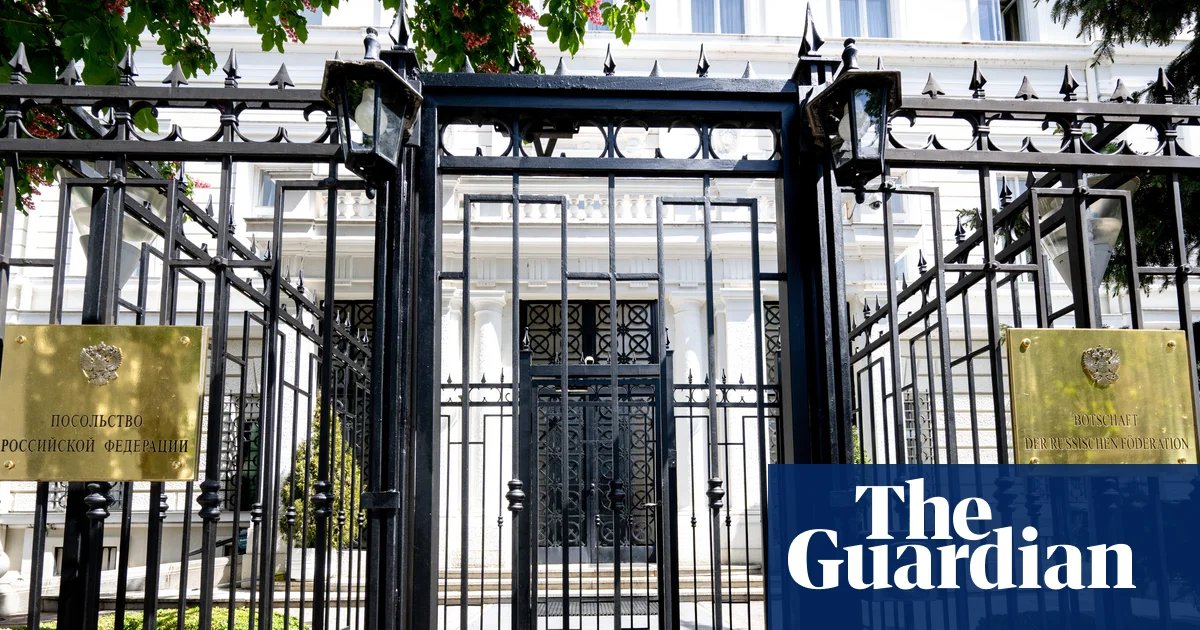
Austria has expelled three Russian embassy staff on suspicion of spying after determining that a “forest of antennae” on the diplomatic mission in Vienna, Europe’s espionage capital since the cold war, was being be used for illicit data collection.
“It is unacceptable that diplomatic immunity be used to commit espionage,” Austria’s foreign minister, Beate Meinl-Reisinger, said on Monday. She added that the three embassy staff – whose expulsions bring the number of Russian diplomats sent home by Vienna to 14 since 2020 – had already left the country.
“We have communicated this to the Russian side in no uncertain terms, including as regards the forest of antennae at the Russian mission,” Meinl-Reisinger said. Spying was a problem for Austria, she continued, but the government had embarked on a “change of course” and was “taking consistent action”.
The Russian embassy in Vienna described the decision as “outrageous”, “unjustified”, “politically motivated” and “categorically unacceptable”. It promised “harsh” retaliation in return.
According to a report by the Austrian public broadcaster ORF, data from international and national organisations using satellite internet was being systematically siphoned off by equipment installed on the roofs of the embassy and diplomatic compound.
Leading multilateral institutions hosted by Vienna include the Organization of the Petroleum Exporting Countries, the International Atomic Energy Agency, and the Organization for Security and Co-operation in Europe).
The Austrian government has promised to take steps to tackle its longstanding espionage problem by closing a loophole in Austria’s criminal code that in effect allows spies to operate freely in the country as long as their activities are not directly targeting Austria’s interests.
The criminal code has made Vienna an international espionage hub, with estimates putting the number of secret agents among the city’s 17,000 accredited diplomats as high as 7,000 and many foreign embassies believed to base their European undercover activities in the Austrian capital.
“The very limited legal options available to counter espionage lead to an extremely high incidence of foreign intelligence and secret services in the country,” the now former Austrian domestic intelligence agency the BVT acknowledged in one of its annual reports.
Pressure has been growing for a crackdown since the arrest in 2024 of Egisto Ott, a former Austrian counter-espionage official who went on trial last January accused of having handed information to Russian intelligence officers in one of the country’s biggest spy cases in decades.
Austria’s three-party coalition government of the conservative People’s party (ÖVP), Social Democrats (SPÖ), and the Meinl-Reisinger’s liberals (Neos) has reportedly drafted legislation that would make it illegal to spy against the EU and Vienna-based international organisations and expands the list of activities characterised as espionage against Austria.
Ott, 63, who ran multiple undercover agents, is accused of helping Russia hunt down opponents of Vladimir Putin and selling government phones and secure laptops to Moscow at the behest of Jan Marsalek, the fugitive Austrian-born former chief operating officer of Wirecard, a collapsed German payments firm.
Marsalek, who is thought to have fled Germany via Austria to Moscow, is believed to have been secretly working for Russian military intelligence for a decade. His alleged spying operations include running a ring of Bulgarians in London – three of whom were convicted by a UK court last year.
Prosecutors accuse Ott, who worked for the BVT until its dissolution in 2021, of making unauthorised searches in police and other databases to locate people Moscow was hunting for, as well as handing over mobile phones and a laptop containing sensitive government and personal data to Russian intelligence. He has denied all charges.