Over a decade ago, Amazon and Google taught the world how to speak to AI. Through Amazon Alexa and Google Assistant, wake words were learned and natural language prompts were practiced, all in the name of setting timers, asking for music, controlling your smart home and plumbing search results for information. Things are a bit different in 2026. If there is a theme at this year’s Google I/O outside of AI agents, it’s that the way Google imagines we’ll speak to AI is changing. Multiple new features the company showed off featured voice input — but in an unpolished form, where the onus fell on Gemini to interpret intent and act accordingly. The change could have unintended effects: Google wants users to ramble to AI to get things done, but in the process they might do a lot less thinking in general.
Take for example, Rambler, an updated version of Gboard’s speech-to-text feature that Google demoed during The Android Show: Google I/O 2026 Edition on May 12. “With Rambler, you don’t have to worry about getting your words exactly right before you start,” Google writes. “You can speak naturally and it will take the important parts, then fit them all together into a concise message.” The on-device model Rambler uses can strip out ums and ahs, and captures the gist of a message without transcribing your ramble verbatim. Importantly, it can also accommodate switching languages mid-flow, the way many bilingual people speak with family and friends. The feature offers at least one clear accessibility benefit in the sense that both the transcribing and editing of a message can happen at the same time, without having to touch a keyboard. The ability to send a long text while one or both hands are occupied could theoretically be helpful to anyone.
The task-tracking app Todoist has explored similar ideas via a feature called Ramble, which lets you rattle off things you need to do to the app, and leaves the creation and sorting of tasks up to AI. In Silicon Valley at large, The Wall Street Journal has already documented a turn towards voice dictation in corporate workspaces. Apps like Wispr Flow and Monologue let you talk or whisper to your computer and convert your speech into text, automatically editing for tone and style depending on what app you’re using. In the healthcare industry, many doctors quickly adopted AI transcription tools as a way to take notes during appointments. What Google is offering is the benefits of those tools without the need for a third-party subscription or an extra app. You can use it on anything that runs Android 17.
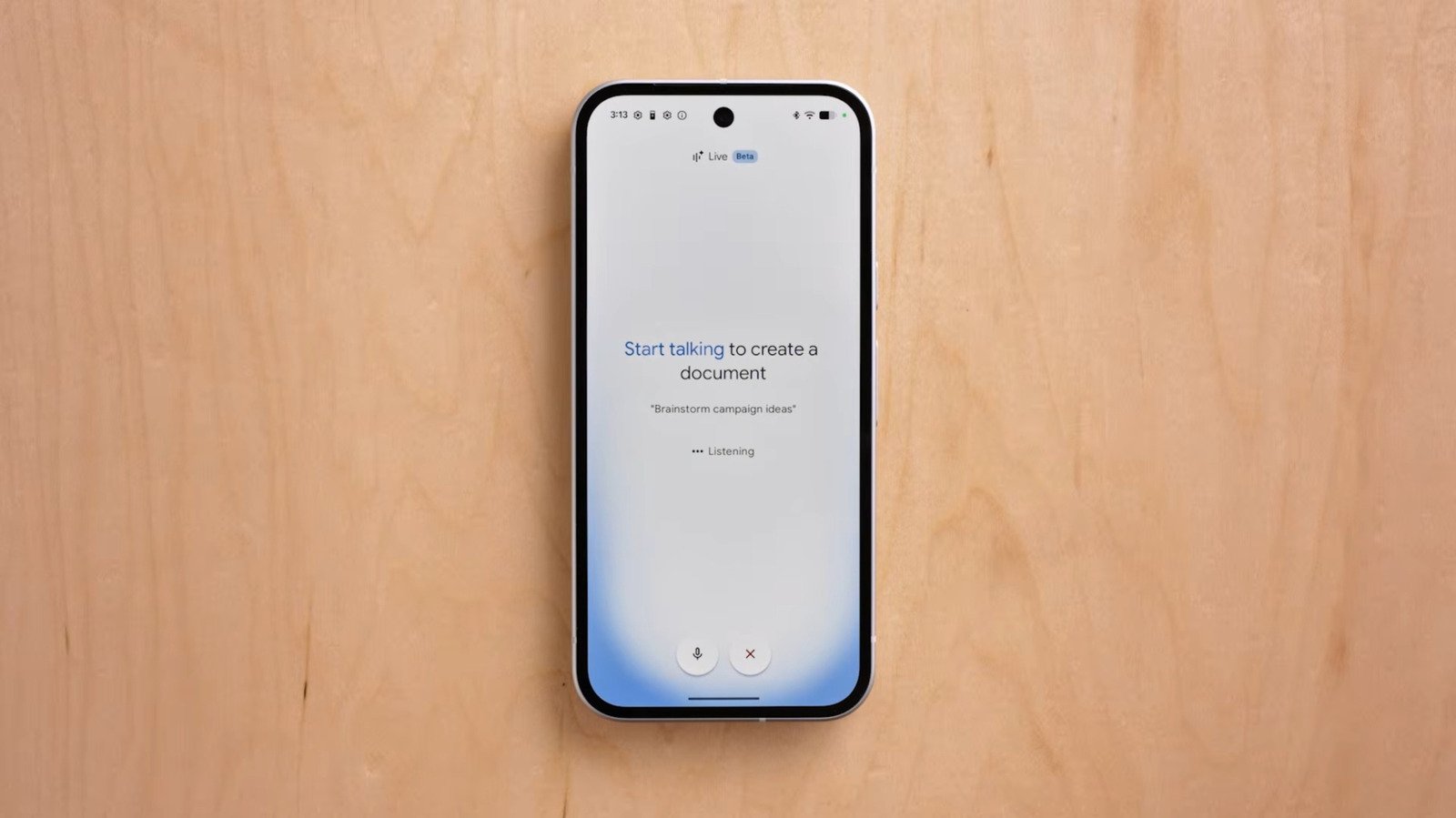
Docs Live, on the other hand, is one of several examples of Google integrating the experience of using Gemini Live — live voice chats with Gemini — into its other apps. With Docs Live you can spout off at an AI model and it will make a Google Doc based on what you share. “Just talk, and Docs Live handles the heavy lifting — organizing your thoughts, structuring your document, and, with your permission, pulling relevant details from your Gmail, Drive, Chat and the web,” Google writes. In Google’s own demo, this prompting is much more along the lines of dictating an outline, but Docs Live is supposed to be equally capable of turning a stream of consciousness rant into a draft. Keep Live will bring a similar experience to Google’s notetaking app, while Gmail Live will transform AI voice chats into a faster way to find emails.
What goes unremarked on in the use-cases of these new features is what they eliminate. Google’s video demo for Docs Live features a software engineer who’s been asked to return to his alma mater to talk to students about his career. That’s an experience that, at least hypothetically, would be meaningful enough that you might want to write your own speech, but instead the demo user offloads the task to Docs Live. Not everyone is a born writer — it seems intentional that Google specified this person is a software engineer — but being able to think clearly and communicate your own thoughts and feelings transcends career path. Rambler, too, seems to skip over the rewarding part of communication. Most everyone labors over the meaning or intent of a text message at some point in their life, but Rambler lets you hand off some of that stressful (but rewarding) work to AI.
No one is required to use these tools, and in the case of Docs Live, Keep Live and Gmail Live, they’ll be limited to paying AI Pro, AI Ultra and business Workspace subscribers to start. What the preponderance of AI voice features does make me wonder is what they’ll teach frequent users about AI. Google Assistant and Amazon Alexa got better at understanding the weirdness of human speech over time, but the structure of most interactions with those voice assistants still defaulted to a robotic call-and-response because it was the best way to make sure you got what you wanted. You had to think about what lightbulb you wanted Google Assistant to turn on or Alexa skill you wanted to invoke, and speak accordingly. Google now seems less interested in the quality or clarity of what you input, provided it can produce a result you’ll leave satisfied with, which in the age of AI seems like an easier bar to clear than before.
What is Google Docs when you don’t need to think very hard about what you want to write? Or Google Messages when you leave the delivery of a text up to AI? Google’s new features could very well be useful to millions, but by demanding less actual thought, they may end up altogether changing how people think.