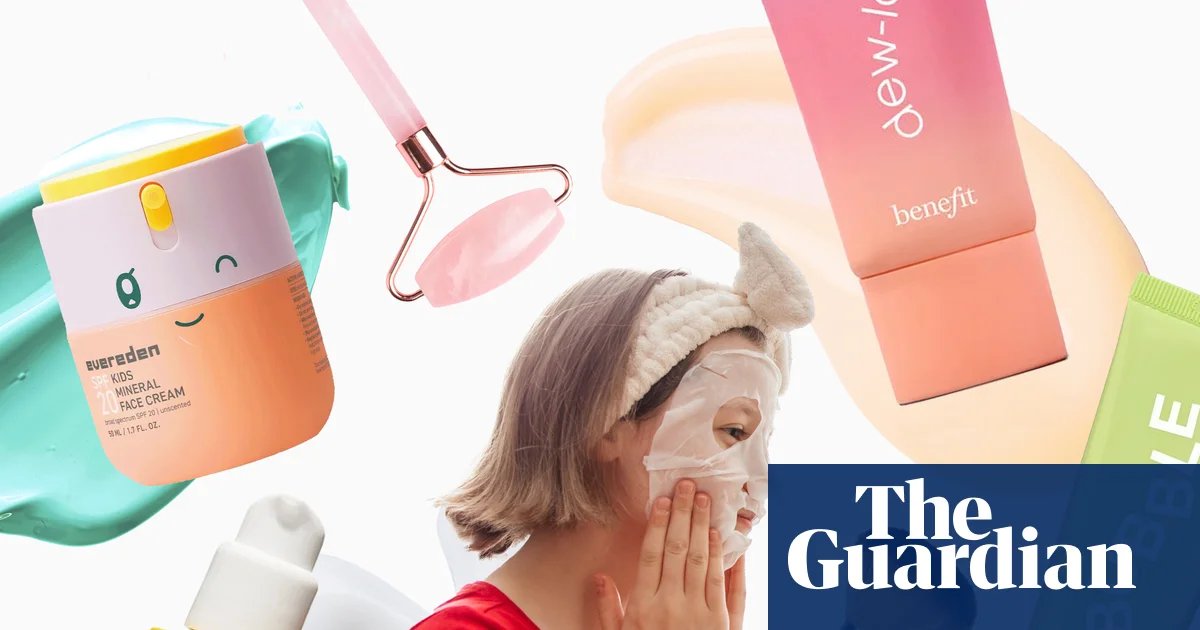
In a TikTok video a young girl – her age anywhere between 10 and 15 – sits unboxing package after package of products she says were sent to her by skincare brands. She calls it a “PR haul”.
In another video, a 16-year-old opens a box of products she received from a well known brand. She says: “I know I have younger people watching,” before reading out a note from the brand that says: “Can’t wait for you to share your thoughts.”
This is the rapidly growing world of children’s skincare, in which online influencers as young as 13 accept free products from brands and promote them to their followers. This is despite warnings from dermatologists that children don’t need most skincare products and concern from regulators that the practice exists in a legal grey area.
The Italian Competition Authority (AGCM) is investigating the beauty brands Benefit and Sephora after they appeared to adopt a “particularly insidious” strategy of using young influencers to market skincare to children.
The AGCM launched an investigation into the brands’ owner, the luxury goods company LVMH, for possibly attempting to sell anti-ageing treatments to children younger than 10.
It said the companies “may have failed to make clear” the cosmetics they sold were not intended for children, while “appearing instead to have encouraged their purchase through covert marketing strategies involving young micro-influencers”.
LVMH said that it, Sephora and Benefit would “fully cooperate with the authorities” but declined to comment further. “All the companies reaffirm their strict compliance with applicable Italian regulations,” it added.
An investigation by the Guardian found numerous videos of young people thanking brands for products they had received. It identified ambassador programmes open to children as young as 13, offering free products in exchange for promotional content online. However, the terms of these arrangements sit in a murky legal area.
The US skincare brand Evereden, for example, runs a scheme with no official age limit given, simply saying it loves “all ages and all stages” and promising those who are accepted early access to new products. Some of the influencers the Guardian found linked to the brand appeared to be aged 12.
Those under 18 have to get parental permission to join. The brand says young “aspiring influencers” can get free monthly PR and event invites. Ambassadors receive free products and get early access to new launches. In another Evereden video on TikTok, viewers are told they can play games with the brand, answer questions and earn coins that can be spent on “goodies” sold in its shop.
Evereden did not respond to attempts to contact it for a comment. It did not clarify the age at which people can be accepted on to its ambassador programme.
On its website, asked whether it works with influencers under 18, it says: “Yes! As a kids’ brand, we want to partner with our actual audience, as well as their parents and guardians. We think it’s important for kids to see people like them taking care of their skin and being empowered by age-appropriate self-care routines. However, we are committed to engaging with young creators in a responsible and ethical manner, and we require parental or guardian consent in all collaborations.”
The youth skincare brand Bubble calls for ambassadors who are aged 16 or over in a similar scheme, which previously accepted children as young as 13.
One girl the Guardian spoke to, who has a few thousand followers, said she was recruited when she was under 16. “In September 2025 Bubble changed their policy for the programme,” she said. “The reason why I’m still part of the programme is because I became an ambassador before the policy was put into place … because of this Bubble has made my parents aware of the changes but I am still part of the programme.”
Once accepted on to Bubble’s ambassador scheme, participants are set tasks from liking and sharing content to producing videos about products in return for points that are redeemable against purchases.
A spokesperson for Bubble said: “We do not partner with or pay children to promote our products. Our ambassador programme requires participants to be 16 or older, and parental consent is required for anyone under 18.”
They added: “Clinical safety is foundational to how we operate. As far as we are aware, we are one of the only brands that conducts clinical safety testing on consumers aged eight and up on the products we would recommend for younger users. If younger consumers are using skincare, there should be real clinical validation behind its safety. We also have a paediatric dermatologist as a part of our robust dermatologists’ advisory board.”
The teenager said she had seen girls as young as 10 using retinols online, “which is really bad for your skin, especially when you are under 25”. She added that, while she had not used such a strong product, one brand did send her retinols and she had to explain to the company that she could not use it.
Experts say these programmes sit in a regulatory grey area. While strict rules govern the employment of child actors and models, including limits on working hours, those safeguards do not extend to child influencers.
Another teenager the Guardian spoke to, who has thousands of followers on TikTok and applied to represent a brand online, said: “I’ve always had an interest in makeup and skincare.”
She said for her, content creation was about self-expression as much as promotion. Talking about skincare had helped her to build confidence and find her voice, she said.
Her mother agreed and said her daughter did not grow up with much representation, adding: “Her online presence has become a space where she can be visible and confident in who she is.”
Her daughter, aged 16, had been invited to attend events for skincare brands. “I usually pay for her train tickets upfront and then get reimbursed later, sometimes only partially,” she said. She recalled one event where attenders were instructed to wear black T-shirts and jeans. “We hadn’t packed those, so I remember running around … in winter trying to find clothes.”
At events, the 16-year-old’s tasks have included handing out samples, answering questions from attenders and creating content for her TikTok page. She said: “I’ve also done street interviews where I ask members of the public questions for content posted on the brand’s social media.”
Since her daughter turned 16, they have become more selective in the jobs they accept. “As she starts her A-levels and thinks about university, she has to recognise there can be an element of exploitation,” her mother said. She declined one recent invitation. “They wanted her there for three hours just handing out samples. That’s time she should be spending on homework or revision.”
Dr Francis Rees, a law lecturer at the University of Essex and a coordinator of the Child Influencer Project, said the legal lines were very blurred. “A lot of protections focus on consumers under advertising law, not on the child creating the content,” she said.
Children appearing in online content were not afforded protections under the Online Safety Act or child performance legislation, Rees said, unless criminal thresholds were crossed. “Brands and agencies don’t have a duty of care to the child in these situations,” she said. “They contract with the parent, who is expected to safeguard the child.”
Christopher Gabbitas, a partner at Keystone Law, said although English law provided heightened protections for children around work and commercial activity, influencer arrangements needed to be assessed on a case-by-case basis. “If a role involves regular and structured work, it can amount to employment regardless of whether payment is in cash,” he said. “Points, gifts or products still count as remuneration.”
He added that cross-border schemes, including those governed by US law, such as the Bubble one, operate in a “wild west”.
The Advertising Standards Authority also requires influencer content to be clearly labelled as advertising, warning that simply declaring an ambassador relationship in a bio is insufficient. This risks leaving young people in breach of advertising rules without understanding their obligations.
The 16-year-old said she was paid £100 for one video but said that was unusual and most of the other work was done in exchange for products rather than payment.
“The questions around unpaid youth labour are valid,” her mother said, but she stressed it was important to reflect both the risks and the benefits. “[My child’s] experience has also given her confidence, communication skills and a deeper understanding of how brands operate.”
She added: “Through content creation, she’s learned to articulate her views, reflect on her identity and engage with diverse audiences: skills that extend far beyond social media. Managing her platform has also taught her organisation, time management and media literacy that many adults don’t have.”
Crucially, she said, parental involvement had shaped how those lessons were absorbed. “By staying closely involved, I’ve helped her contextualise these experiences rather than accept them uncritically.
“Taken together, [my daughter’s] experience shows how complex young people’s digital lives are,” she added. “Unpaid or underpaid creative labour shouldn’t be normalised, but the skills and awareness she’s developing help explain why so many teenagers engage in these spaces. The challenge isn’t just protection, it’s making sure young people’s work is recognised and fairly compensated.”