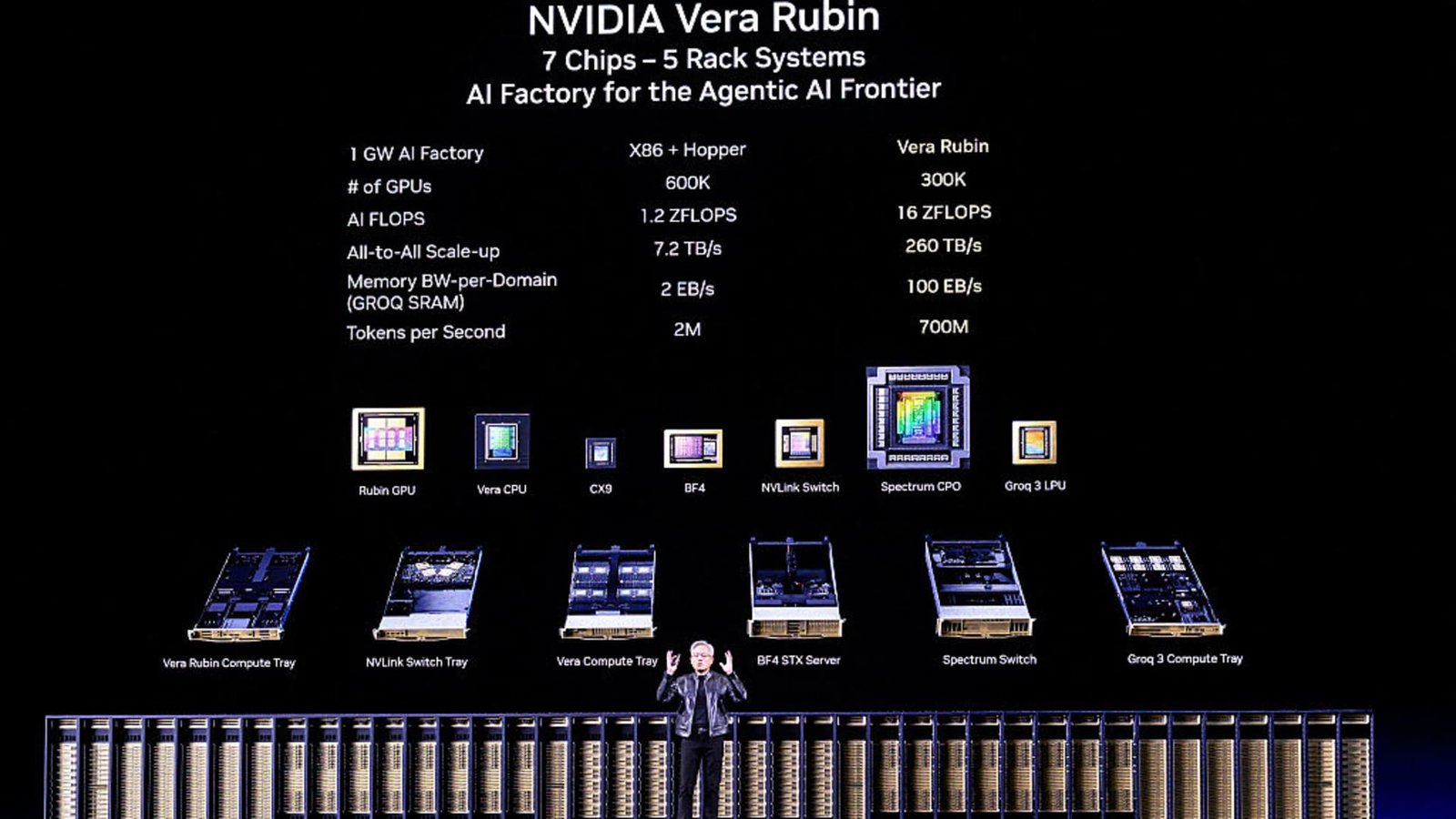
Nvidia CEO Jensen Huang introduces Vera Rubin, a next-generation AI data center platform, and Rubin Ultra, a next-generation AI GPU architecture, during the keynote address at the company’s annual GTC developers conference in San Jose, California, on March 16, 2026.
Josh Edelson | AFP | Getty Images
Nvidia CEO Jensen Huang is way ahead of estimates on the amount of spending that’s coming for AI – even the most optimistic ones.
During Wednesday evening’s earnings call, Huang said he thought AI capital expenditures could get up to $4 trillion.
“The capex is at a trillion dollars, and it’s growing toward the three to four [trillion-dollar mark],” he said, speaking only of capex for hyperscalers like Alphabet and Amazon, which excludes other segments of the supercomputing market such as neoclouds.
Nvidia’s chief financial officer Colette Kress was even more specific on the call.
“With analysts now forecasting hyperscale capex to exceed $1 trillion in 2027 and agentic AI beginning to proliferate [across] all industries, AI infrastructure spending is on track to reach $3 to $4 trillion annually by the end of this decade,” she said.
There’s just one thing: That’s way ahead of Wall Street’s estimate trajectories.
One analysis by Laura Martin at Needham shows the consensus estimate of hyperscaler capex hitting $1.03 trillion in 2028 – a third to a quarter of what it will be just two years later, if Huang’s prediction is correct.
“If Jensen Huang’s prediction is correct … then the consensus estimates included in the chart below will be revised upwards, we believe,” she wrote on Thursday with her colleague Dan Medina. “[His] vision for the hyperscalers is different from what the hyperscalers are saying on their earnings calls, and more interesting.”
Some on Wall Street have been predicting capex to hit $1 trillion by the end of next year, faster than the consensus, but they’re still substantially behind Huang’s forecast, which would see the number quadruple over the subsequent three years.
Undoubtedly, more infrastructure investment from hyperscalers and others would benefit Nvidia’s business as the dominant AI chipmaker. But growing cloud revenues, along with continuing advances in frontier algorithms, seem to be undergirding Huang’s optimism so far.
Quarterly revenues came in above expectations for all the big clouds, with Alphabet jumping by 63%, AWS by 28% and Microsoft by 40%.
“The world has a billion users – human users. My sense is that the world is going to have billions of agents … and every one of those agents is going to spin off subagents,” Huang said.
Too early for a productivity consensus
Despite the advances, increasing revenue and the frequent historical comparisons to railroads and other capital-intensive phases of industrial development, serious doubts remain about AI’s long-term impact on profitability, productivity and ultimate viability.
JPMorgan estimated in November that a 10% return on AI investments through 2030 would need about $650 billion in annual revenue in perpetuity, a number they called “astonishingly large,” equating to 0.58 percentage point “of global GDP, or $34.72/month from every current iPhone user, or $180/month from every Netflix subscriber.”
For comparison, cloud revenue in the trailing 12 months from April reached $455 billion, according to Synergy Research Group.
“If the efficiency gains materialize, there will be no problem; flourishing businesses will have plenty of resources to pay the bill,” University of Geneva economist Cédric Durand wrote in January. “In a couple of years, when AI has infiltrated work processes to the point that exit costs are prohibitive, the customer base will be unable to escape.”
However, AI productivity gains have yet to arrive in force — let alone produce a consensus among economists.
“Could this be the beginnings of an AI productivity boom? Maybe!” economist Martha Gimbel at the Yale Budget Lab wrote in February. “Until we get a clear signal one way or the other—we shouldn’t put all our eggs in the productivity data release basket.
Federal Reserve economists in March found “substantial heterogeneity in AI adoption across firms,” describing a mismatch between perception and reality on the effects of AI.
“Perceived productivity gains are larger than measured productivity gains, likely reflecting a delay in revenue realizations,” they wrote.