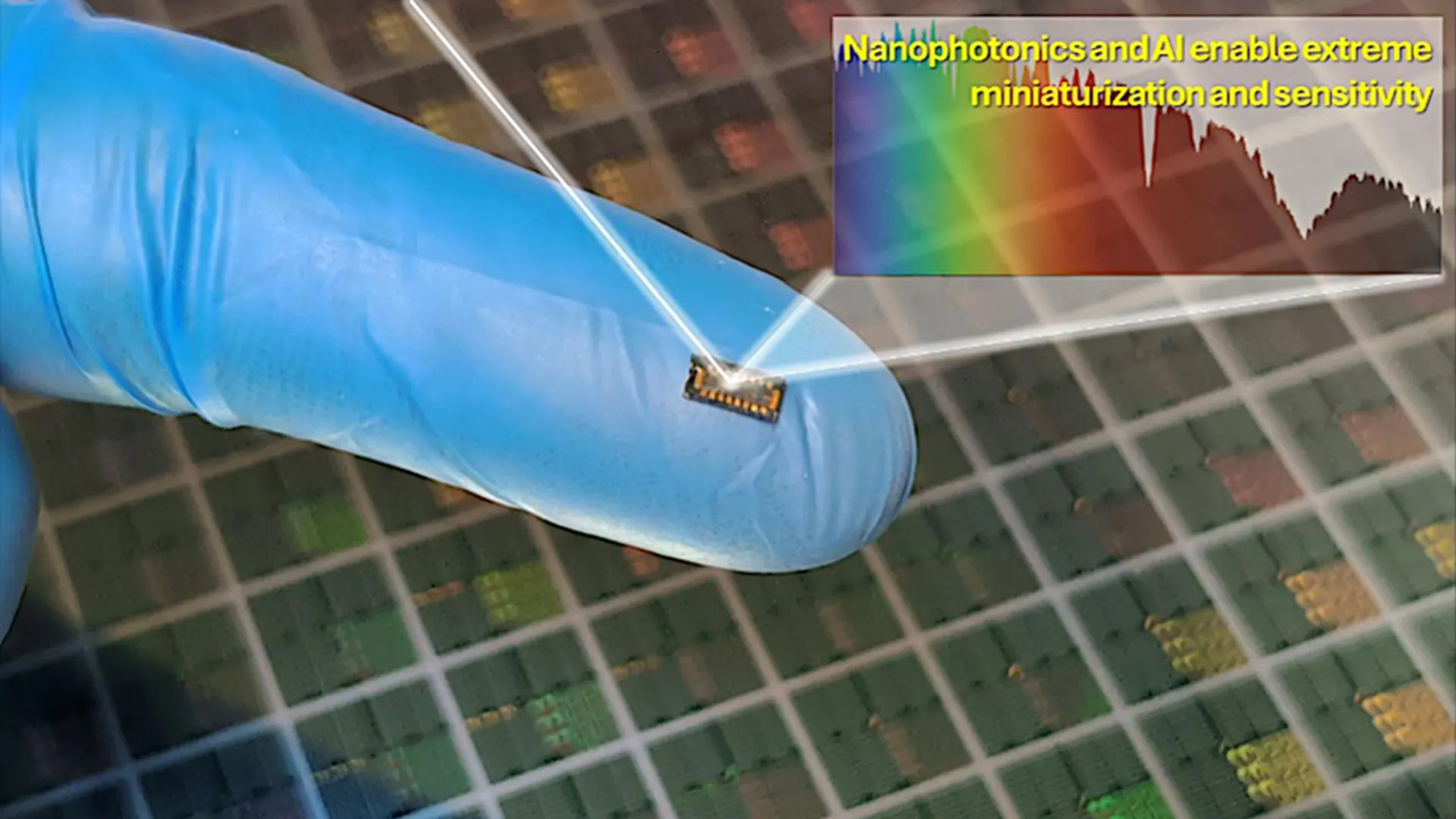
For years, analyzing the chemical makeup of materials has required large and costly laboratory instruments known as spectrometers. These systems are used in everything from disease diagnosis and food inspection to pollution monitoring. Traditional spectrometers work by splitting light into its component colors using prisms or gratings, then measuring the intensity of each wavelength. Because this process requires light to travel across a relatively long distance, the instruments are often bulky and difficult to miniaturize.
Now, researchers at the University of California Davis (UC Davis) have developed a dramatically smaller alternative. Writing in Advanced Photonics, the team describes a spectrometer-on-a-chip so tiny it approaches the size of a grain of sand. Instead of relying on large optical components to separate light physically, the new system uses artificial intelligence (AI) and a small array of specially engineered sensors to reconstruct the spectrum computationally.
Replacing Bulky Optics With AI
The chip abandons the standard method of spreading light into a rainbow. Instead, it relies on 16 unique silicon detectors, each designed to react slightly differently to incoming light. Rather than isolating individual colors directly, the detectors collect encoded signals that contain hidden spectral information.
One way to think about the system is as a group of specialized tasters sampling different aspects of the same complex mixture. Individually, each detector only captures part of the picture. Together, however, they generate enough information for AI to reconstruct the original light spectrum.
The second key component is a fully connected neural network trained on thousands of examples. Because the detector signals are noisy and highly encoded, the AI learns the complicated relationship between those signals and the actual spectrum of light. This approach solves what researchers call an “inverse problem,” allowing the system to reproduce spectral data with an accuracy of roughly 8 nm resolution without using bulky optical hardware.
Expanding Silicon Into the Infrared Range
A major breakthrough came from modifying the surface of standard silicon photodiodes with specialized photon-trapping surface textures (PTSTs). Silicon normally works well for visible light detection but struggles to capture near-infrared (NIR) light (wavelengths up to 1100 nm). NIR light is especially important for applications such as biomedical imaging because it can travel deeper into human tissue than visible light.
The engineered PTST surfaces change how light behaves inside the chip. Instead of allowing NIR photons to pass straight through the thin silicon layer, the textured surface scatters the light repeatedly, increasing the likelihood that the silicon absorbs it. As a result, the chip becomes sensitive across a much wider spectral range than standard silicon sensors.
Capturing Ultrafast Light Interactions
The new architecture offers more than simple color detection. The chip also incorporates high-speed sensors capable of measuring photon lifetime with extremely high temporal precision. This allows the device to detect ultrafast interactions between light and matter that traditional spectrometers may miss entirely.
Researchers say this capability could open the door to advanced forms of sensing and imaging that previously required far larger and more expensive systems.
Tiny Footprint With Big Potential
The completed system occupies just 0.4 square mm while maintaining high sensitivity and strong resistance to electrical noise, which is a major challenge for portable, low-cost electronics. Even in noisy environments, the AI-assisted design can preserve clear signal quality.
By combining machine learning with enhanced silicon light detection, the technology could pave the way for compact real-time hyperspectral sensing devices. Potential applications range from portable medical diagnostics and wearable health monitors to environmental remote sensing and food quality analysis.