Recently premiered in the Un Certain Regard section at Cannes, “Ulya” is a biopic of Latvian-born basketball phenomenon Ulyana Semjonova, who played and won many medals and championships for the Soviet Union from the late 1960s until well into the 1980s. Yet her tragedy, as director Viesturs Kairišs‘ film presents it, is her height: At about 6 feet 5 inches, she never felt comfortable in her skin. That physical attribute is the only thing about her that everyone in her life cared about, worried about or wanted to exploit.
“Ulya” concentrates on a few years in Semjonova’s life, starting in 1964, when she’s an awkward teenager whose family wonders if she will ever stop growing. Living in a small village and belonging to the ancient Christian sect Old Believers, she leads a quiet and conservative life, helping on the family farm while trying to avoid everyone’s curiosity about her size. After her sister’s fiancé sends her picture to a basketball coach in Riga, however, she must decide between an athletic career in the big city and the quiet village life she knows.
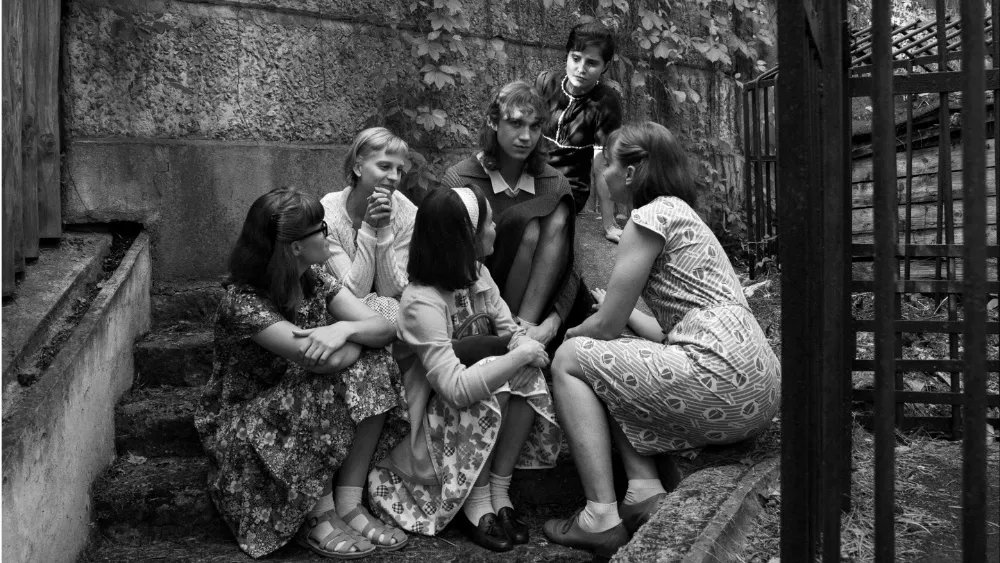
Kairišs and DP Wojciech Staron use haunting black-and-white cinematography, sometimes unfocused to signify our heroine’s feelings of confusion and alienation. On the soundtrack, mournful wailing music presents her as a tragic character. The screenplay — written by Livia Ulman, Andris Feldmanis and lead actor Arnolds Karlis Avots — portrays her as a figure of utmost innocence and naivete, with almost every scene about her height, as she’s ridiculed by people in the streets of Riga, gossiped about by her teammates and humiliated by soldiers on the border who want to check her genitals. There’s even a rather obvious scene where Semjonova connects with a giraffe caged in a zoo. Throughout it all, she appears pained but passive: Unable to make decisions about her life, she lets everyone else push her around.
Avots, a male actor, plays the female lead here; he also wrote the first few drafts of the script and was heavily involved in the film’s development and production. Discussion about representation and opportunities for female actors aside, he doesn’t bring much nuance to the role. It’s a fine enough performance and he’s obviously committed, but there is a certain unnatural quality to it. That could be explained somewhat because Semjonova doesn’t feel comfortable in her skin.
But while the film’s thesis is that no one saw beyond her height to find the real person, Avots’ all-surface performance mirrors that error. Avots nails the physical awkwardness of Semjonova’s frame, playing her as uncomfortable even on the basketball court. At the beginning, she appears unable to control her limbs, but there’s a marked change as she learns how to play and forms a camaraderie with her teammates. Much effort goes into capturing that person’s physicality but the actor’s homework shows on screen, and the character’s inner life never materializes.
The screenplay fails to make anything specific out of the other characters. No wonder the parents are credited only as “mother” and “father,” while her mentors might as well be billed as “nice coach” and “mean coach”. All are stock stereotypes whose function in the drama is to react to Semjonova without actually being anything near a fully drawn character.
“Ulya” ends with a picture of Avots hugging the real Semjonova, obviously intended to underline the subject’s blessing of the project, and allay any concerns the audience might have about the performance. The filmmakers may have good intentions, and their portrayal of Semjonova is mostly positive. But they also portray her as a victim of her size and society, and that does not give this woman the graceful tribute she deserves.