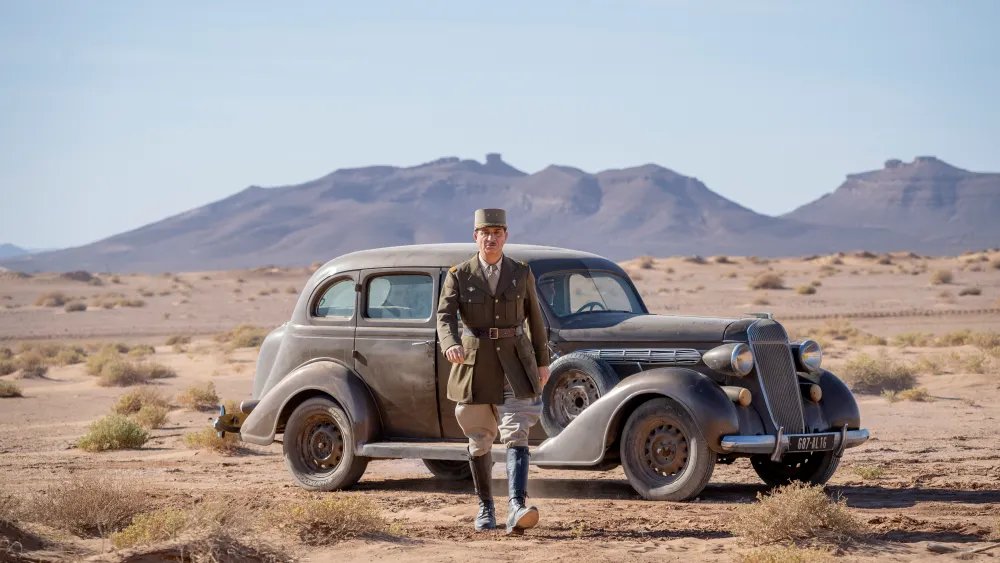
Every Cannes Film Festival needs a film like “De Gaulle: Résistance,” a proudly French and massively scaled production with the energy of a vintage Hollywood blockbuster. Indeed, Antonin Baudry’s old-fashioned epic flaunts all these big-screen qualities in delicious excess, dispensing a traditionally entertaining biopic on France’s eponymous Great Man and his consequential years in the early 1940s as an exiled general with a romantic vision of his country that has just capitulated to Germany.
It takes bravery and uncommon intelligence to see beyond the immediate reality of defeat. In 160 minutes — a runtime that isn’t entirely earned, though the film is flashy and inspiring — “De Gaulle: Résistance” enthusiastically engages with both the heroism and strategic acumen of this former French president. A very likely hit in France, Baudry’s movie also has enough conventional ingredients for widespread theatrical appeal internationally.
It’s worthwhile to mention early on that “Résistance” isn’t solely a portrait of De Gaulle, but also of the anti-Vichy monarchist Fernand Bonnier de La Chapelle, a fiery member of the French resistance. Bonnier de La Chapelle was only 20 years old when he assassinated Vichy French Admiral François Darlan in Algiers, when Darlan, largely seen as a Nazi collaborator, signed a controversial deal with Eisenhower. The young man was promptly executed by firing squad days later, the events leading up to which Baudry smartly braids into the main narrative of the film, written by the director with Julian T. Jackson and Bérénice Vila.
The opening is especially smart in its early introduction of Bonnier de La Chapelle, shown distressed and listening closely to the radio as the outside world, with a defeated France, looms large. Katie Mcquerrey’s elegant editing marries the unparallel fates of the duo, guiding us into the kind of dual-perspective film that we’re about to see. As De Gaulle and Bonnier de La Chapelle, respectively, actors Simon Abkarian and Florian Lesieur give spirited and physical performances, cleverly juxtaposing the dissimilar qualities of the two central figures of the story who otherwise share ideals.
In addition to a surprising physical resemblance, Abkarian brings out a firmness and concealed reluctance in the middle-aged De Gaulle, who stubbornly (and thankfully) insists on the correctness of his vision even when he isn’t all that sure of himself. His unbending poise, perennial straight face and mustachioed stiff upper lip also exude some comic qualities, especially when he goes toe-to-toe with Winston Churchill (Simon Russell Beale, terrific), both his closest ally and a frisky challenger. In contrast, Lesieur underscores the boundless agility and fragile idealism of Bonnier de La Chapelle. Alongside fellow fighter Livia (Anamaria Vartolomei), he passionately leads and participates in the counterculture and uprising, energizing the narrative whenever his point of view takes over.
As such, “Résistance” feels like two distinct films stitched together, with its disparate parts still adding up to a cohesive whole. The segments that follow Bonnier de La Chapelle are admittedly more successful and sophisticated, bringing to mind the heart-pounding essence of a Costa-Gavras political thriller. Still, much of the film traces De Gaulle’s journey and his love-hate relationship with Churchill, so full of fondness and wit that it’s almost as if the two men accidentally found themselves in a war movie while actually making a bromance. We follow the dynamic of the duo, with Churchill being both De Gaulle’s fierce defender and adversary on occasion, especially when surrounded by other leading political figures of the era. These personalities make up an impressive ensemble, played by the likes of Niels Schneider, Campbell Scott, Karim Leklou, Félix Kysyl, Benoît Magimel and Mathieu Kassovitz.
Unapologetically big and loud and scored to some explosive Volker Bertelmann tunes (this is one of the “All Quiet on the Western Front” composer’s less lyrical works), “Résistance” has all that we expect from a war epic in the form of tanks, well-orchestrated battle sequences and ties to today’s troubles unsubtly accentuated in its rearview. It does occasionally fall into the same trap that many historical pictures can’t avoid — in various instances, these political figures talk and act like they know exactly what the future results of their actions will be. Another debit in this otherwise accomplished film is occasionally expositional dialogue that over-spells what we have just witnessed. (When De Gaulle makes his famous June 18 appeal, for example, and refuses to surrender to the Nazis, it is arguably unnecessary for a character to sum up the essence of the speech in his own bloated words.)
Still, “De Gaulle: Résistance” delivers exactly what it promises: a polished wartime movie that interrogates the past and sheds some light on the present, where fascism is once again a threat. Baudry flexes the taut thriller muscles that made his 2019 submarine thriller “The Wolf’s Call” a nail-biter. There is also enough cheese and schmaltz to go around, enlivening the more straightforward parts of the film. Let’s hope international audiences won’t have to wait too long for it, as well as “De Gaulle: Liberté” — the second installment of Baudry’s two-part project, opening in France this summer. The world can surely use some reminders these days about the true meaning of patriotism.