The team carried lists of people who had signaled that they were ready, at last, to evacuate a place so ravaged by Russian bombardment that it had no power, gas, heat or running water, and little food or intact shelter.
The rescuers also called up to windows and balconies, shouting “evacuation,” as they tried to convince other stragglers, most of them old and infirm, that their lives here were finished, that they should grab their essentials and leave, too. They carried a disabled woman and her wheelchair to a waiting van.
Driving into Kostiantynivka “is like Russian roulette,” said Evgeny Tkachev, a worker with a U.N.-supported humanitarian group, Proliska. Rubble chokes the streets, which are pocked by craters, and drones are always overhead.
Kostiantynivka had about 67,000 residents before the war. By January, there were about 2,000. The city had become a prime target of the Russian offensive, a strategic node the Ukrainians were determined to defend.
Last fall, as Russian forces blasted their way ever closer, a police team called the White Angels and civilian groups like Proliska evacuated as many of the remaining residents as they could. For some, it was too late. The parents of Evdokimov Andriy, 44, watched as two officers carried away his remains, zipped into a body bag, a day after a strike killed him.
The rescuers have seen the unspeakable, the anguish of the living and the remains of the dead, which they also retrieve.
“People said my car stank, but I couldn’t smell it,” said one, Bogdan Zuyakov. “That scared me. I don’t smell the bodies anymore.”
Evacuees bid tearful goodbyes to friends, knowing they were unlikely ever to return. The report of an explosion, the constant crack of gunfire, were so familiar that no one flinched.
A few weeks later, Proliska’s rescue van was attacked.
“A fiber optic drone hit us even though they could see clearly that we were a humanitarian team,” said Oleg Tkachenko, the founder of Breath of Hope, a group that works with Proliska. “Thank God we are alive. But we were supposed to rescue an injured person, and we couldn’t reach him, so he died. Simply because a Russian pilot decided to go on a human safari.”
Kostiantynivka lies in the kill zone, a 20-mile-wide strip of front line ruled by drones. Ukrainian troops hold the ruined city, but the Russians are edging their way in.
In blasted and charred buildings, evacuation workers knocked on doors in darkened hallways and helped residents, some bedridden, pack up their things and leave, even if they had to be carried.
“I try not to dwell on stories. I help, save lives, and try to forget — these things happen every day, and my psyche must cope,” said Mr. Tkachev of Proliska, who said he had evacuated thousands of people from Kostiantynivka.
As the city grew steadily more dangerous, aid groups left the civilian holdouts supplies, but those are running out. People collect what scraps they can for fires.
“People live in basements, burn wood, and scavenge garbage, like in the Middle Ages,” said Capt. Yevhen Alkhimov, 33, spokesman for the Ukrainian Army’s 28th Mechanized Infantry Brigade.
Mr. Zuyakov, one of the rescuers, recalled what he said was the last evacuation mission by vehicle from the city to be organized by the military administration. It was for a family of seven, including a 2-year-old, who insisted on leaving together. But they came under attack, with three people injured, including a woman who lost a leg. Vadym Filashkin, head of Ukraine’s Donetsk regional administration, said the drones “are effectively hunting the population down.”
Ukrainians on the front lines say the growing number of drone strikes on civilians is intentional. “Today, drone operators can see everything while flying and know exactly what they are hitting,” Mr. Tkachenko of Breath of Hope said.
The dangers, for evacuees as well as evacuators, reached a point where missions had to be suspended. A trickle of people continued to make their way out on foot, or riding in hand carts pulled by others. The evacuation work went on for some months elsewhere, including in the nearby city of Druzhkivka, another bombardment target where drones fill the skies.
Much of Kostiantynivka’s city center is unrecognizable, flattened by relentless bombing. Coils of razor wire and “dragon’s teeth” anti-tank obstacles poke up from the wreckage.
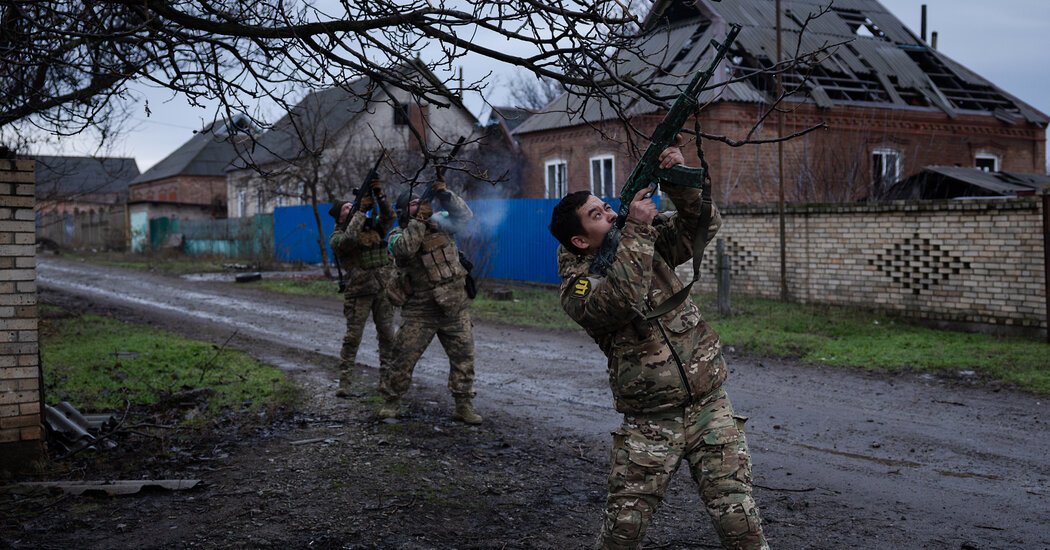
The sky above buzzes like a swarm of bees, every moving thing filmed and targeted by drones. Ukrainian troops take what limited concealment is offered by doorways, courtyards, awnings and tree canopies, running from one to another. They fight to hold back the Russian advance while also trying to shoot down the menace overhead. But there are always more drones.
The 28th Brigade alone says it neutralizes 150 drones daily, “but those are only the ones we destroy,” Captain Alkhimov said. More than 1,000 drones fly daily above the city and its outskirts. Fires from recent strikes are a constant.
“Everything is controlled by drones. It’s a mix of Middle Ages siege with modern technologies,” Captain Alkhimov said.
The part of the Donetsk region that remains under Ukrainian control is a focal point for Moscow, which demands full Ukrainian withdrawal. A Russian breakthrough in Kostiantynivka would deal Ukraine a major blow: The city blocks a route to Kramatorsk, one of Ukraine’s key last strongholds in the Donbas.
The terrain changes hands slowly but the bloodshed is constant.
“They are constantly attacking with columns. Losing men and machines for this small part of the territory,” said Junior Lt. Oleg Petrasiuk, a spokesman for the 24th Mechanized Brigade. “Even if Russian drones control 100 percent of the sky, as long as our infantry stands in the trenches, it’s not enemy territory,” he added.
Ukrainian artillery teams in and around the city stand ready to arm and fire their howitzers when a Russian target is identified. Ukraine’s own drone teams and spotters send them coordinates, hoping to slow the onslaught.
Similar dramas are playing out all along the 800-mile front line. Kostianynivka is the latest in a series of Ukrainian cities like Mariupol and Bakhmut that have been turned into ghost towns, mostly uninhabitable, in more than four years of war. President Vladimir V. Putin of Russia seems determined to grind on with his invasion, no matter the material or human cost.
“You survive. You don’t live!” said a 75-year-old resident named Anatoly. He stood beside the makeshift grave of his neighbor in their courtyard. Like many of those killed, the neighbor was buried where he fell: getting to a cemetery would be too dangerous.
For the evacuation crews who have tried to move civilians to relative safety, a sort of numbness sets in to the horrors they witnessed again and again. But some emotions do bubble up, like frustration — that the determination of Ukraine’s allies has waned, that President Trump still insists that an end to the war can be negotiated with the Kremlin.
“I see destroyed houses, broken lives, people killed. I see the pain of someone who has lost everything,” Mr. Tkachenko said. “Who are you trying to negotiate with?”