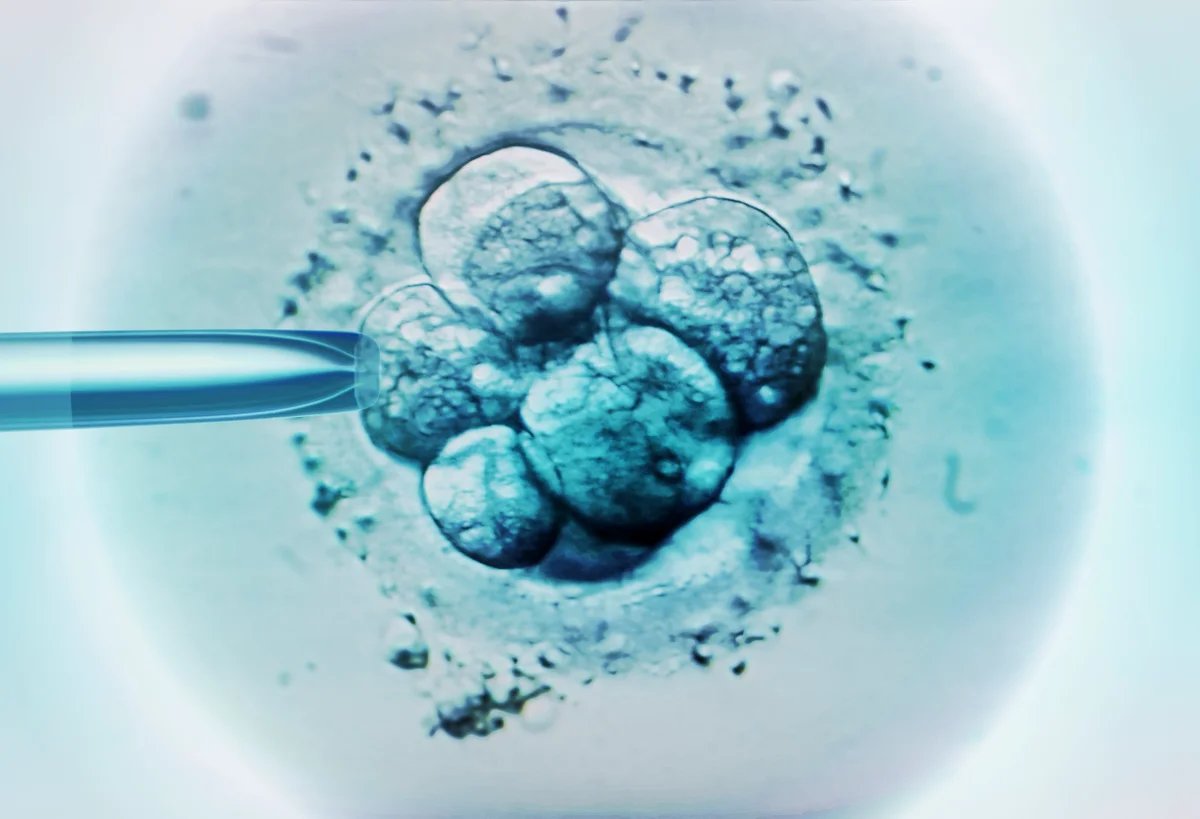
China just launched fake human embryos to their space station for a new research mission
China’s artificial embryos are part of an experiment to learn more about how human pregnancies could develop under microgravity conditions
Science Photo Library – ZEPHYR/Getty Images
A clutch of artificial human embryos on China’s Tiangong space station could help researchers better understand whether human pregnancies in space are possible and safe.
The Chinese Academy of Sciences says the experiment marks the first on human artificial embryos in space. The artificial embryos are actually structures derived from stem cells, and mimic how embryos form during the early days of pregnancy; they can’t develop into humans, even if they were implanted into a uterus. Researchers originally conceived these artificial embryo-like structures as a model to study the earliest moments of development because of widespread international rules banning research on real human embryos older than two weeks after fertilization.
“The human artificial embryo is made of human stem cells as raw materials,” said project leader and University of Hong Kong assistant professor Yu Leqian in a statement. “This is not a real human embryo and does not have the ability to develop into an individual. However, it can serve as a model for studying early human development.”
On supporting science journalism
If you’re enjoying this article, consider supporting our award-winning journalism by subscribing. By purchasing a subscription you are helping to ensure the future of impactful stories about the discoveries and ideas shaping our world today.
The artificial embryos were launched to the Tiangong space station earlier this month, while a control group are being examined in an Earth-based lab. The experiment was designed to last for five days, after which the samples on board the space station were frozen and will eventually be returned to Earth for analysis, Yu said.
“We hope that by comparing the development of space and ground samples, we can identify the factors affecting early human embryonic growth in the space environment, and address the risks and challenges humans may face during long-term space habitation,” Yu said.
Fertility in space has long been an object of study, and the results so far have been mixed. In 1994, NASA astronauts were successful in mating Japanese rice fish aboard a space shuttle. Yet several other experiments conducted on fruit flies in low-Earth orbit suggest their larva have a higher death rate than on Earth. A past effort to raise mice embryos in space didn’t succeed, too, and attempts at mating rats also failed to result in pregnancies. And another mating experiment involving geckos almost ended in disaster in 2014, after the Russian satellite they were on lost contact with ground control—while contact with the spacecraft was reestablished, the geckos perished before they could possibly make more geckos.
The science of human reproduction in microgravity is sparser, for perhaps obvious reasons. But as NASA and lprivate space companies such as Elon Musk’s SpaceX have begun exploring long-term bases on the moon and Mars, the field has drawn more interest, even if not success. Earlier this year, Australian scientists put human sperm into a microgravity simulation chamber to see if they could navigate an artificial female reproductive system. The sperm, seemingly confused by the low gravity, tended to get lost on their way to their final destination.
It’s Time to Stand Up for Science
If you enjoyed this article, I’d like to ask for your support. Scientific American has served as an advocate for science and industry for 180 years, and right now may be the most critical moment in that two-century history.
I’ve been a Scientific American subscriber since I was 12 years old, and it helped shape the way I look at the world. SciAm always educates and delights me, and inspires a sense of awe for our vast, beautiful universe. I hope it does that for you, too.
If you subscribe to Scientific American, you help ensure that our coverage is centered on meaningful research and discovery; that we have the resources to report on the decisions that threaten labs across the U.S.; and that we support both budding and working scientists at a time when the value of science itself too often goes unrecognized.
In return, you get essential news, captivating podcasts, brilliant infographics, can’t-miss newsletters, must-watch videos, challenging games, and the science world’s best writing and reporting. You can even gift someone a subscription.
There has never been a more important time for us to stand up and show why science matters. I hope you’ll support us in that mission.