
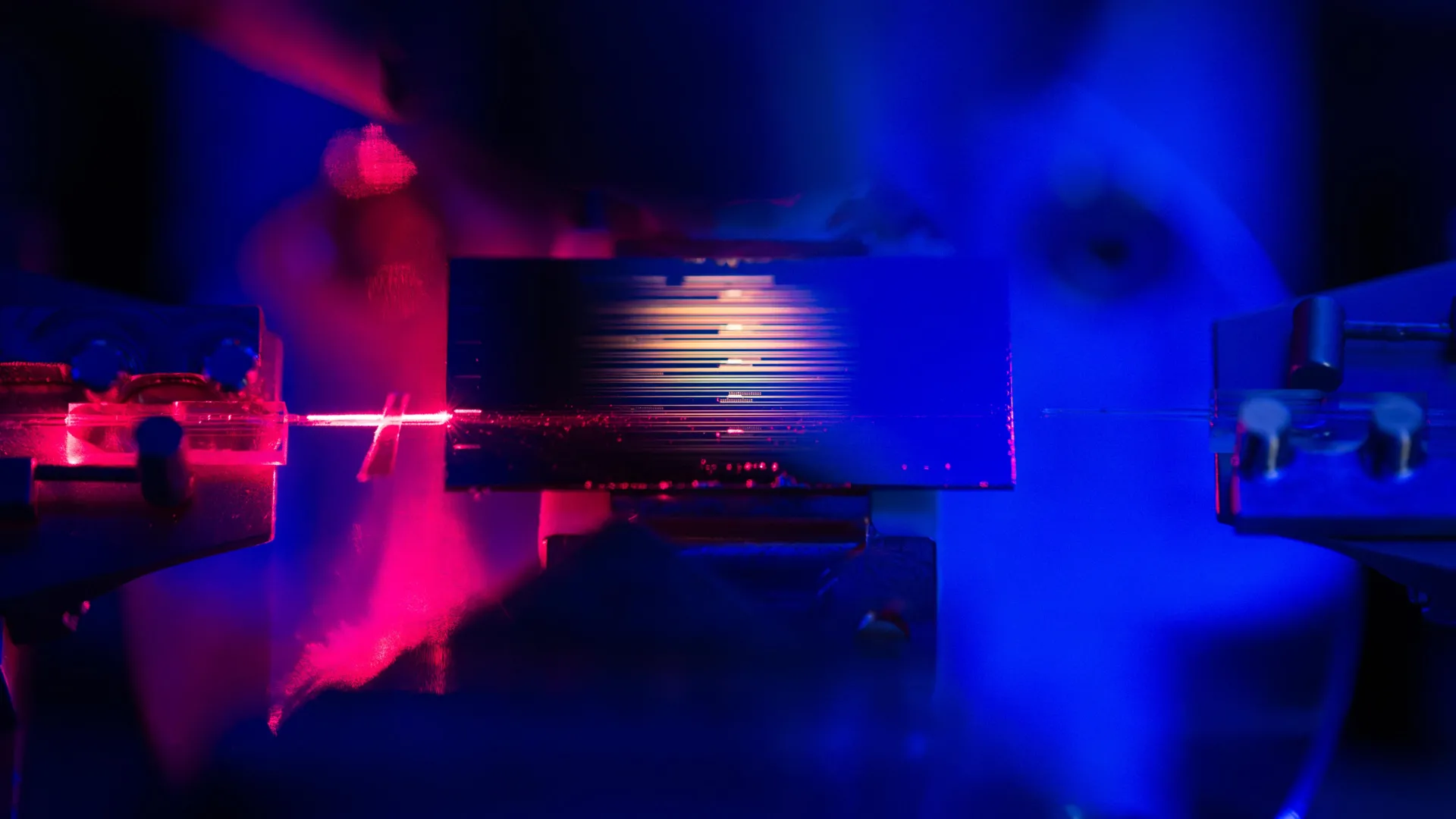
Light plays a central role in modern technology, powering everything from televisions and satellites to the fiber optic cables that carry internet data across the globe. Now, physicists at Stanford have developed a way to push light even further. They created a compact optical amplifier, about the size of a fingertip, that can strengthen light signals while using very little energy and maintaining full bandwidth.
Optical amplifiers work much like audio amplifiers, except they boost light instead of sound. Traditional compact versions require significant power to operate, which limits their efficiency. The new device, described in the journal Nature, overcomes this challenge by reusing much of the energy needed to run it.
“We’ve demonstrated, for the first time, a truly versatile, low-power optical amplifier, one that can operate across the optical spectrum and is efficient enough that it can be integrated on a chip,” said Amir Safavi-Naeini, the study’s senior author and associate professor of physics in Stanford’s School of Humanities and Sciences. “That means we can now build much more complex optical systems than were possible before.”
The amplifier developed at Stanford can increase the intensity of a light signal by about 100 times while using only a few hundred milliwatts of power. That is far less energy than similar devices typically require. Because it is both efficient and small, it could run on a battery and be built into devices such as laptops or smartphones.
Reduced Noise and Greater Bandwidth
Like their audio counterparts, optical amplifiers can introduce unwanted noise when boosting signals. The researchers showed that their design keeps this noise to a minimum. It also operates across a wider range of wavelengths than existing amplifiers, which means it can carry more data with less interference.
This type of amplifier relies on energy stored in a light beam that acts as a “pump.” Its performance depends on how intense that pump light is.
“By recycling the energy of the pump that powers this amplifier, we made it more efficient, and this doesn’t come at a cost to its other properties,” said Devin Dean, co-first author on the study and a doctoral student in Safavi-Naeini’s lab.
Recycling Light Energy for Stronger Signals
The team achieved this efficiency using a resonant design similar to methods already used in lasers. Dean described it as an “energy recycling trick.” In simple terms, the system sends light back on itself, allowing it to build strength over time, much like light bouncing between two mirrors.
Inside this amplifier, the pump light is generated within a resonator where it travels in a continuous circular path, similar to a racetrack. As it loops, the light grows more intense, which allows it to more effectively amplify the target signal. This approach produces stronger output while requiring less input energy.
Because the device is both compact and energy efficient, it could operate on battery power and be incorporated into small electronics.
“When you can do that, then the possibilities are really quite broad because they are so small that you can mass produce them and power them with batteries,” Dean said. “They could be used potentially for data communications, biosensing, making new light sources, or a host of different things.”
Potential Applications and Research Support
Additional Stanford co-authors include co-first author Taewon Park, a doctoral student in Safavi-Naeini’s lab; Professor of Applied Physics Martin Fejer; postdoctoral fellow Hubert Stokowski; and doctoral students Sam Robison, Alexander Hwang, Luke Qi, and Jason Herrmann.
Dean, Park, Safavi-Naeini, and Stokowski are inventors on a patent application that covers methods for achieving quantum advantage in power-constrained photonic sensors.
This work was supported in part by the Defense Advanced Research Projects Agency, NTT Research, and the National Science Foundation.


