‘Jaw-dropping’ fossils reset the clock on when complex animals evolved
A treasure trove of fossils from China shows that the Cambrian explosion may have been less explosive than scientists once believed
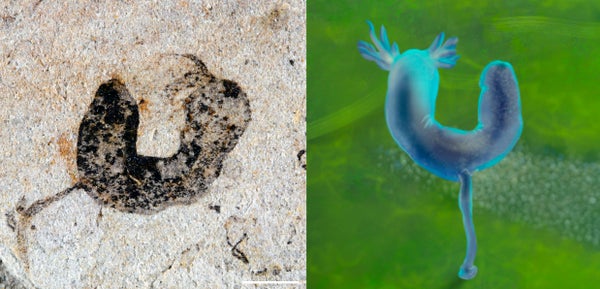
A deuterostome cambroernid fossil and an artist’s reconstruction of it. (The scale bar is two millimeters.)
Around 540 million years ago, the ocean erupted with complex life: Creatures rapidly transformed from simple, soft-bodied, ocean-floor-dwelling animals into bodies we might recognize today—animals with, say, a shell or cartilage, a mouth and anus, and the ability to swim, burrow or hunt.
Scientists call this short, sharp burst of evolutionary activity the Cambrian explosion, and it has informed the way we think about how life as we know it evolved on our planet. But the discovery of a trove of bizarre fossils in China is challenging that consensus—the Cambrian explosion may have been less explosive than we thought.
Hundreds of fossils uncovered in southern China’s province of Yunnan reveal that at least some of the life-forms scientists had thought arose in the Cambrian period were alive and thriving millions of years earlier, in an era known as the Ediacaran period. Many of the fossils look alien, from wormlike creatures tethered to the ground to a “sausage-shaped” animal and a fingerlike organism with tentacles. The findings were published in the journal Science on Thursday.
On supporting science journalism
If you’re enjoying this article, consider supporting our award-winning journalism by subscribing. By purchasing a subscription you are helping to ensure the future of impactful stories about the discoveries and ideas shaping our world today.
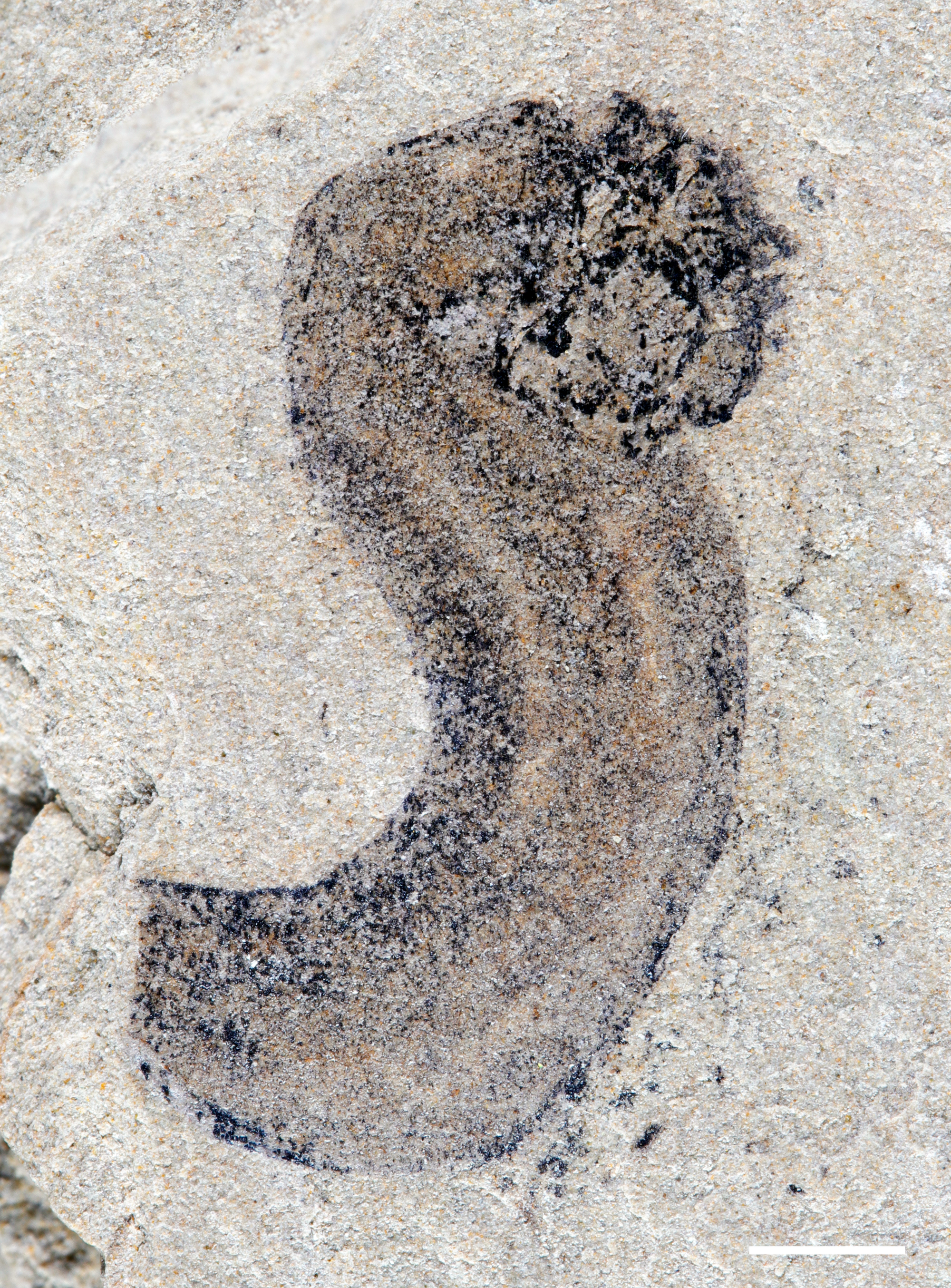
A newly discovered fossil of a sausage-shaped animal with an end-positioned mouth. (The scale bar is 2 mm.)
The discovery was something of an accident, says Frances Dunn, a senior researcher of natural history at the Oxford University Museum of Natural History and a co-author of the paper. Her colleagues at Yunnan University in China found the trove while looking for algal fossils in the region’s cliff faces—its rocks are famous for their ability to preserve ancient life.
This chance finding, Dunn says, turned out to hold “some of the most significant early animal fossils” found in decades. More than 700 specimens from the Ediacaran period were there. Some were mere algae, but hundreds more were animals that appeared in “a variety of different forms,” she says.
The most common animal the team found was an organism about the size of a human adult index finger that had a wormlike body and a disk that kept it rooted to the seafloor. Its frequency—more than 100 of the new specimens were examples of this unnamed creature—suggests it once densely populated the ocean floor, Dunn says.
“It was unlike anything I’ve ever seen,” Dunn says.
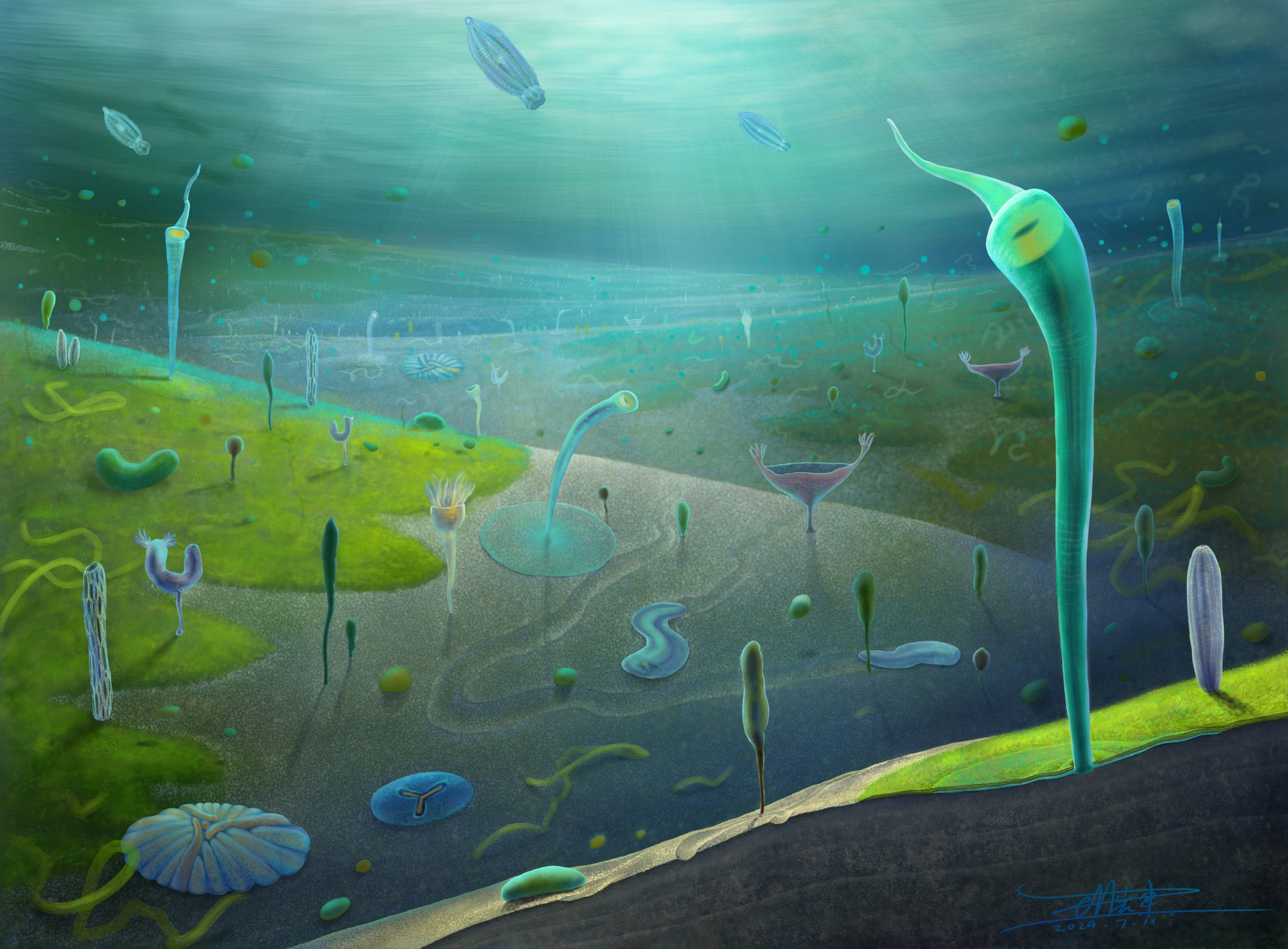
A reconstruction of life based on fossils found in the Chinese province of Yunnan dating to about 554 million to 539 million years ago.
What was most jaw-dropping, however, was that so many of the found fossils looked uncannily like they belonged to the Cambrian period rather than the Ediacaran, she says. Some, including the abundant worm, were “bilaterians.” This term refers to animals with bilateral symmetry, or a body plan where one side mirrors the other. This critical evolutionary adaptation helped early life to move through sediment or the water column, develop a nervous system and eventually “dominate” the animal kingdom, Dunn says. Most animals today are bilaterians—including humans.
Before, scientists thought bilaterians primarily arose during the Cambrian period and were rare—certainly not diverse and flourishing—in the Ediacaran.
The new fossils offer a glimpse into a “transitional world,” where simple, soft-bodied life-forms lived alongside complex bilaterians. Some of the specimens look highly similar to cambroernids—animals that looked vaguely similar to modern-day sea cucumbers—which have previously only been dated to the Cambrian.
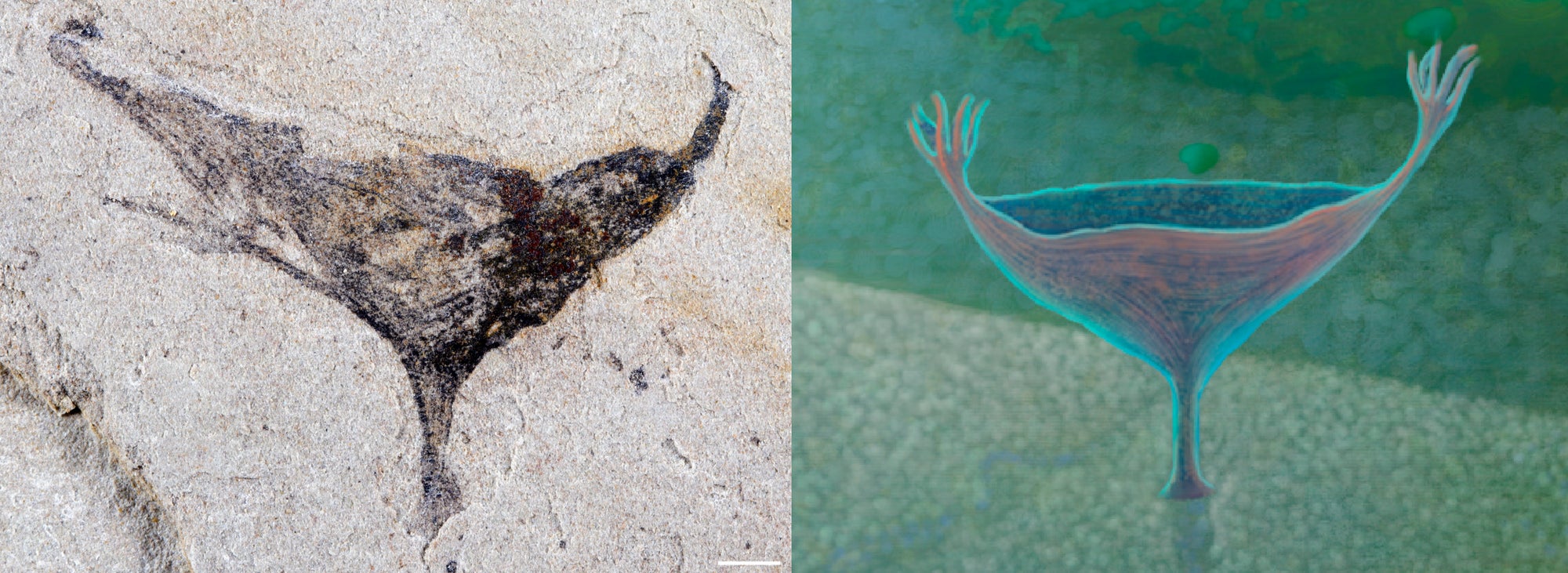
A nonbilaterian fossil (with a scale bar of 2 mm) and an artist’s reconstruction of it.
This is a once-in-a-lifetime find, Dunn says. “People have been on the hunt for a fossil site like this but not found it until now,” she adds. It indicates that the Cambrian “explosion” may have been more gradual. Or, as Dunn puts it, the finding “defuses the Cambrian explosion.”
Now Dunn and her colleagues are working to formally describe all of the fossils and name any new creatures. Once everything has been cataloged, scientists can study where these animals fit on the tree of life.
“The fossils from this site are going to keep us busy for like 10 years, easily,” she says.
It’s Time to Stand Up for Science
If you enjoyed this article, I’d like to ask for your support. Scientific American has served as an advocate for science and industry for 180 years, and right now may be the most critical moment in that two-century history.
I’ve been a Scientific American subscriber since I was 12 years old, and it helped shape the way I look at the world. SciAm always educates and delights me, and inspires a sense of awe for our vast, beautiful universe. I hope it does that for you, too.
If you subscribe to Scientific American, you help ensure that our coverage is centered on meaningful research and discovery; that we have the resources to report on the decisions that threaten labs across the U.S.; and that we support both budding and working scientists at a time when the value of science itself too often goes unrecognized.
In return, you get essential news, captivating podcasts, brilliant infographics, can’t-miss newsletters, must-watch videos, challenging games, and the science world’s best writing and reporting. You can even gift someone a subscription.
There has never been a more important time for us to stand up and show why science matters. I hope you’ll support us in that mission.