-
Kristen Shilton
-
Greg Wyshynski


Multiple Authors
The 2026 NHL trade deadline had an unusual cadence. There was a week of interesting deals and genuine surprises; a deadline day where nothing of consequence happened; and then absolutely chaos as a flurry of trades was completed before the timer ticked down to zero.
Overall, NHL teams made 20 trades involving 33 players on Friday. Some teams and players did quite well for themselves. Others did not.
Here are some winners and losers of a peculiar NHL trade deadline, from ESPN reporters Ryan C. Clark, Kristen Shilton and Greg Wyshynski.

WINNERS

The Avalanche might be the best team in the NHL, and they are the odds-on favorites to win the Stanley Cup. Part of the reason is their addition of Brock Nelson at last season’s trade deadline. He is a proven second-line center behind Nathan MacKinnon, the kind of player they’d sought since Nazem Kadri left in 2022 after winning the Stanley Cup.
Adding Nicolas Roy on Thursday gave the Avs another proven two-way option down the middle, and someone who can provide secondary offense. Then they got Kadri back in a trade Friday, giving them the most dangerous center group in the NHL.
Obviously, MacKinnon will remain at first-line center, and Kadri and Nelson will split up second- and third-line duties. That then leaves Roy as Colorado’s fourth-line center. The Avs are now in a stronger position to win the fourth Stanley Cup in franchise history. If they do, March 6 could be the day that changed everything.
And if not, they can run it back again in 2026-27 because all four will still be under contract. — Clark
The Foligno family
Imagine growing up playing mini sticks with your brother, both of you dreaming that one day you’ll be suiting up for real in the NHL. Well, Marcus and Nick Foligno both achieved that goal — and now, they’re going to chase a Stanley Cup championship together in Minnesota.
The Wild brought in Chicago’s captain for “future considerations” — basically, the Blackhawks did right by their veteran leader by sending him to skate alongside family for a team with legitimate Cup contention aspirations.
Unsurprisingly, the Foligno wives were ecstatic to learn they’d be reunited for the rest of this season, and Nick couldn’t help but mention their departed mother looking down and smiling at her boys getting such a unique opportunity. Yes, the trade deadline is about making hockey deals, but there is also room for some wholesome, heartwarming content when the sport is more than just a game. — Shilton
Player empowerment
One of the defining trends of the deadline was having trades leak to the media before the focal point of said trade had agreed to waive his trade protection. It happened no less than five times, in deals involving Colton Parayko, Tyler Myers, Brayden Schenn, Jason Dickinson and MacKenzie Weegar. In most cases, the player involved eventually waived his no-trade or no-movement clause to facilitate the move. In two cases, the player did not.
Reports said that Myers was presented with a trade by the Vancouver Canucks to move to the Detroit Red Wings. He declined and eventually ended up being traded to the Dallas Stars, which was one of his preferred destinations. Meanwhile, media reports not only had the St. Louis Blues coming to Parayko with a trade to the Buffalo Sabres, they had the return on that trade reported out, too. Parayko refused to leave St. Louis for Buffalo, and the trade was dead.
Blues general manager Doug Armstrong said on Friday that the Blues checked phone records, texts and emails of staff members to find who leaked the trade. Perhaps it was the person who did the exact same thing in 2023, when the Blues were trying to compel defenseman Torey Krug to waive his trade protection.
Trade protection is a negotiated right in a player’s contract, usually at the cost of money or term. Clearly, something might have shifted at this deadline where public pressure is perceived to force a player’s hand. Good on Myers and Parayko for exercising their rights. — Wyshynski

Not that the Ducks necessarily needed to react to what the Edmonton Oilers and Vegas Golden Knights did ahead of the deadline. But the Ducks are in the three-team race for the top spot in the Pacific Division, so they did two things:
-
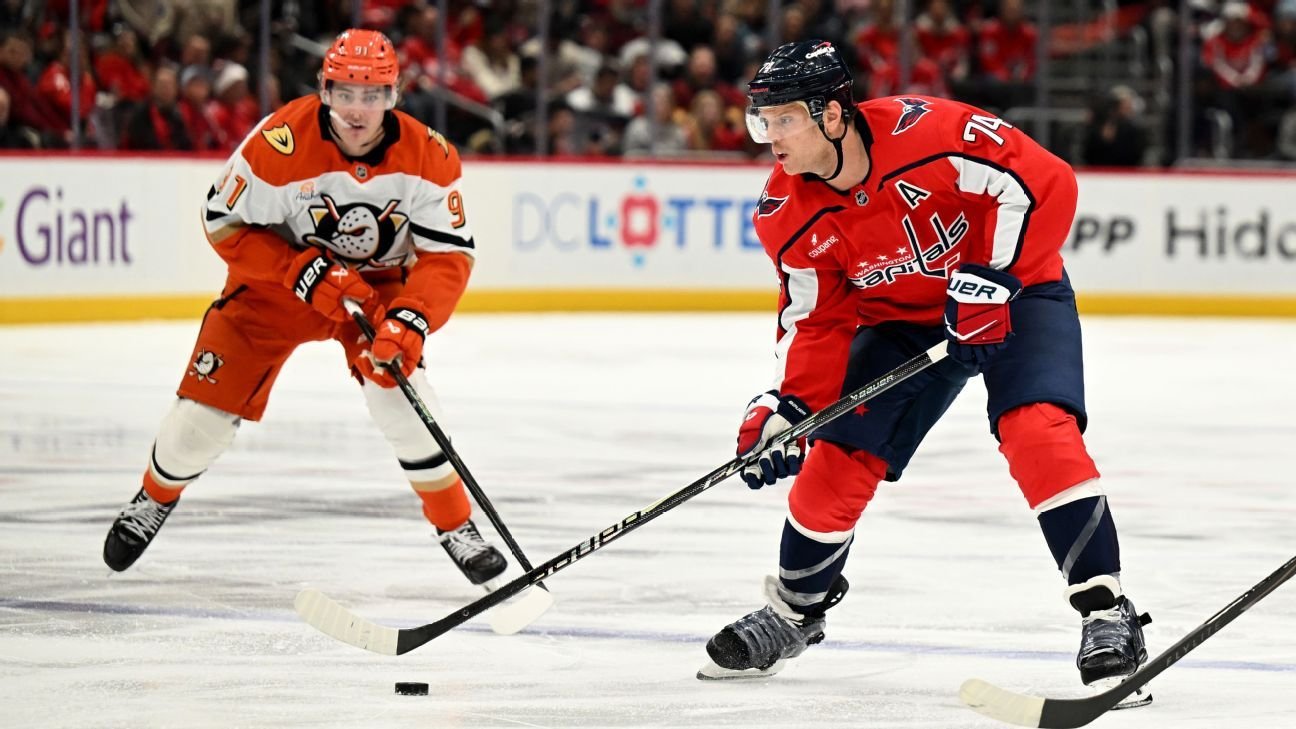
They made one of the most stunning moves of the deadline to get John Carlson from the Capitals.
-
They also traded Ryan Strome away, in a decision that will have a greater impact this summer.
Anaheim has added veterans with extensive playoff experience in order to establish a culture that its young players will eventually call their own. Carlson is a Stanley Cup winner who fits within that part of the Ducks’ plan. He also gives them a right-handed puck mover who is also one more weapon in the offensive zone; he will come in handy come playoff time.
But what makes trading Strome just as important is that he had one more year left on his contract worth $5 million annually. Shedding that salary will help in the offseason, when the Ducks must sign new contracts for their restricted free agent class that includes Leo Carlsson, Cutter Gauthier, Pavel Mintyukov and Olen Zellweger. — Clark

Stick taps to GM Doug Armstrong for (a) actually making trades and (b) negotiating some serious returns.
Armstrong reeled in two first-round draft choices, two third-round selections, an NHL-ready player in Jonathan Drouin, one with potential to return to an NHL lineup in defenseman Justin Holl and goalie prospect Marcus Gidlof — all for veterans Brayden Schenn and Justin Faulk.
It fits perfectly with the Blues accepting that a rebuild/retool/re-whateveryouwantocallit is happening, and it’s the right time to cash in on creating a hopeful future. Armstrong also didn’t make any rash decisions on Robert Thomas or Jordan Kyrou just for the sake of it.
Now there is time to determine where St. Louis is going and how — or if — those players fit into the new direction before the offseason hits. Armstrong turned this lemon season for the Blues into a refreshing lemonade. — Shilton

Has another general manager had a better 2026 than Craig Conroy of the Flames?
It started with the Rasmus Andersson trade with Vegas, getting a first-round pick, conditional second-rounder and defenseman Zach Whitecloud in a package for a pending unrestricted free agent. He then traded the remaining five years of MacKenzie Weegar’s contract to the Utah Mammoth in a deal that included three second-round picks and college prospect Jonathan Castagna.
On deadline day, he made two change-of-scenery trades, acquiring forward Brennan Othmann from the Rangers and center Ryan Strome from the Ducks. Then, as the timer ticked down on the deadline, Calgary sent Nazem Kadri to Colorado for a conditional first, conditional second and an intriguing prospect in forward Max Curran for a 35-year-old center signed through 2028-29.
Conroy’s commitment to rebuilding is admirable in a league where teams are frightened by the teardown. Although it all comes down to drafting and development, Conroy has done a fantastic job of setting his team up for potential success. — Wyshynski
LOSERS
Goalie trade hype
The trade deadline is not the ideal time to acquire a goaltender. General managers have said in the past that it doesn’t give netminders enough time to get acclimated to new teammates and new systems before the playoffs arrive.
Perhaps that’s one reason not a single NHL goaltender was traded this week. Which is a shame. There were some contenders that could have used reinforcement in the crease, such as the Carolina Hurricanes, Montreal Canadiens and Vegas Golden Knights. There were several tantalizing names assumed to be available: Sergei Bobrovsky of the Panthers, Jordan Binnington of the Blues, Stuart Skinner of the Penguins, Anthony Stolarz of the Maple Leafs and Jesper Wallstadt of the Wild, according to ESPN’s Kevin Weekes.
But in the end, the only goalie news was one choosing to stay rather than move: Alex Nedeljkovic, signing a two-year contract extension with the Sharks. — Wyshynski

Just when Buffalo is actually winning on the ice — it’s also losing. The Sabres haven’t made the playoff in 14 years, and unless they perform a massive slide in the next month, that drought will finally end by April. New GM Jarmo Kekalainen attempted to make his team better by trying to acquire Colton Parayko from the Blues. But despite Buffalo’s uptick, despite it change of direction, despite its excellent young core … Parayko gave a hard pass on becoming a Sabre, invoking his no-trade clause.
Parayko’s presence would likely have been that missing piece to put Buffalo over the top as a true contender. Instead, Kekalainen settled for adding Logan Stanley and Luke Schenn from Winnipeg. Fine players, sure, but they are depth contributors, not difference-makers. And their playoff résumés aren’t exactly sparkling (Schenn, for instance, was a team-worst minus-8 for the Jets last postseason).
Sam Carrick and Tanner Pearson can fill in around the edges for Buffalo, of course. It’s just a shame for the Sabres that when they try to go big, and finally do the right things, there are still obstacles standing in their way. — Shilton

The Capitals enter Friday’s game slate four points out of the final Eastern Conference wild-card spot. They’ve played two more games than the Boston Bruins, who control that final playoff berth. It left the Capitals’ front office facing a dilemma about what it deemed was the best course of action for the remainder of the season.
This week, they traded forward Nic Dowd — which suggested they could be open for business in both directions. But in trading John Carlson, who might be the greatest defenseman in franchise history, it was a reality check on the present and the future.
Carlson’s departure means that captain Alex Ovechkin and winger Tom Wilson are the only players still on the roster from that 2018 Stanley Cup team. Ovechkin spoke with reporters Friday and said “it’s obviously a sad day. Probably the toughest day of my career, talking about personal-wise.”
The Capitals knew there would come a day when they would move on from Carlson and Ovechkin. Both players are in the final year of their respective contracts. But now that Carlson is gone, what does that mean for Ovechkin’s future? As he said, “I don’t know. I’m still here, so we’ll see what’s going to happen. It’s a hard one.” — Clark

Last summer, Connor McDavid gave the Oilers this season and two additional ones to build a winner around him before he can leave as an unrestricted free agent. GM Stan Bowman addressed the team’s goaltending by acquiring Tristan Jarry of the Penguins … who hasn’t necessarily been a solution for the Oilers’ biggest problem.
The trade deadline afforded Bowman another chance at dramatically improving the roster. Instead, he made two middling trades with his former team, the Chicago Blackhawks: acquiring defensive defenseman Connor Murphy and depth centers Jason Dickinson and Colton Dach. The Dickinson trade saw Edmonton give up a conditional first-rounder in 2027 to get rid of Andrew Mangiapane’s contract, i.e. make one of Bowman’s mistakes go away.
There’s a finite amount of time the Oilers have left with McDavid, and a finite amount of resources they have through which to build him a Stanley Cup winner. This deadline was a waste of both of them. — Wyshynski
Whoever finishes fifth and sixth in the Pacific Division
Having six teams separated by eight points in the Pacific Division is going to make for amazing theater. It’s also going to make those teams that miss the playoffs feel a certain type of way. Especially when each team made at least one move ahead of the deadline — though each faces its unique set of circumstances:
-
The Golden Knights are trying to win a second Cup but must try to find consistency amid the injuries they continue to battle.
-
The Ducks believe they now have everything in place to make the playoffs for the first time in seven years.
-
The Oilers are trying to return to a third consecutive Stanley Cup Final — and actually win this time.
-
The Sharks are ahead of schedule, with the idea that a playoff berth could change their current trajectory.
-
The Kraken missed out on Artemi Panarin but added help as they seek to make the playoffs for the second time in franchise history.
-
The Kings are trying to win a playoff series for the first time since 2014, and are trying to do it in captain Anze Kopitar’s final season.
Again … someone is going to be left feeling a certain kind of way in the Pacific in mid-April. — Clark

The Bruins bodied their way back into the playoff picture this season, but GM Don Sweeney didn’t share his team’s tenacity at the deadline.
Boston seemed poised to add depth and give itself a real chance to not just reach the postseason but excel in it. The Bruins have earned, as they say, the right to reinforcements. What’s more, Sweeney had the draft capital (including multiple first-round choices), and yet he completed only minor transactions.
First, he acquired forwards Alexis Gendron and Massimo Rizzo from Philadelphia in exchange for forward Brett Harrison and defenseman Jackson Edward. Zero NHL games on their résumés. Then he got Lukas Reichel from Vancouver, who has played most of his season in the AHL.
It just feels like a missed opportunity for Boston to not add a single skater to help the team right now. Jeremy Swayman is back in form in the crease. The offense is rolling. There is so much potential for the Bruins and, well, it doesn’t seem like they’re taking advantage. — Shilton