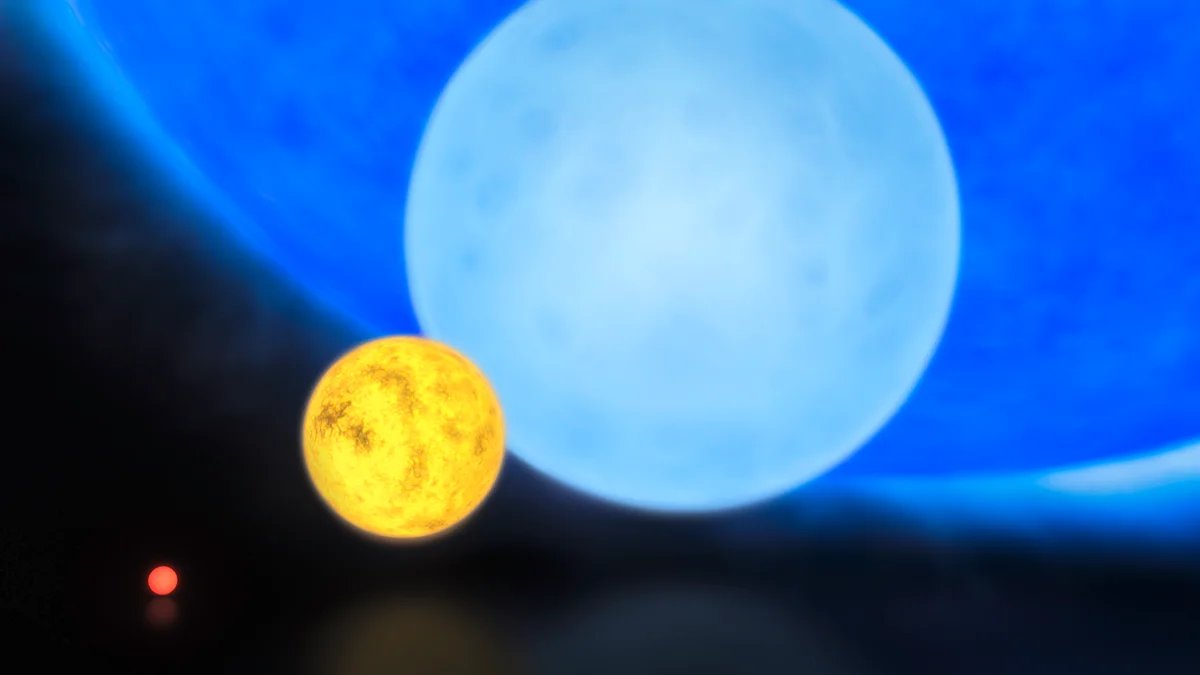
It’s “common knowledge”—and the scare quotes should be a warning—that the sun is an average star.
But it’s not, and in fact it’s not even close: The sun is in the top 90th percentile of stars by mass. That’s because well more than half of the universe’s stars are tiny, cool red dwarfs, dim bulbs with half to less than 10 percent of the sun’s mass. The lower limit is around 7 to 8 percent of the sun’s mass; any less than that, and there isn’t enough pressure in the core to sustain nuclear fusion, which is the prime characteristic of what makes a star a star.
But what about the other end? There are stars far beefier than our own. Is there an upper limit to how massive a star can be?
On supporting science journalism
If you’re enjoying this article, consider supporting our award-winning journalism by subscribing. By purchasing a subscription you are helping to ensure the future of impactful stories about the discoveries and ideas shaping our world today.
Yes, there is, and we do see some stars edging close to it. If they get too close, however, they produce so much energy that they tear themselves apart. One reason this “too close” region isn’t itself the hard limit on stellar mass is because its value has changed over time!
Before we dive into the fun science of all this, let’s remember the reasons why mass is what’s important here rather than size or weight. Size is a problem because stars lack well-defined surfaces, and this problem gets worse the larger a star gets—the biggest ones are so bloated that they just fade away with distance from their respective centers like clouds of fog. Weight won’t work because it’s just a second-order measure of mass—or rather how strong the gravitational force is on an object with mass. You have the same mass on Earth as you do on the moon, though you weigh differently because the moon’s gravity is weaker.
Mass is critical because it dictates the delicate equilibrium that defines a star, a balance between the inward pull of gravity and the outward push of light emanating from the star’s core. Gravity is a direct result of mass, but the amount of energy generated in a star’s core comes from mass as well. The more massive the star is, the more pressure there is in the star’s center and the hotter it gets.
A star’s radiance comes from nuclear fusion—specifically, squeezing hydrogen atoms together hard enough to create helium (though the actual process is a bit more complicated). This releases energy mostly in the form of gamma rays, which are absorbed by the surrounding material, heating it up. The rate of fusion depends on the star’s core temperature, which depends on, yup, its mass. The rate depends very strongly on the core temperature, in fact: in a star like the sun, the fusion rate scales as the fourth power of the temperature, so a small change in temperature hugely affects how rapidly the core generates energy.
Higher-mass stars use a different fusion process that is ridiculously dependent on temperature; the fusion rate can scale with temperature to about the 20th power! This coupling is so strong that doubling the temperature in a massive star’s core increases the energy generation rate by a factor of a million.
You might see now why stars can only get so big. If you pile on too much mass, the star’s gravity strengthens, the pressure in the core rises, the temperature increases, and then the fusion rate skyrockets. If too much energy is dumped into the star’s upper layers, they get so hot that they don’t just expand; they also blast away material, thus losing mass. This forms a negative feedback loop that limits how massive a star can be. Also, stars in this frenzied state aren’t terribly stable; the fusion rate can be tempestuous, and the star undergoes incredibly violent paroxysms.
The theoretical upper limit on stellar mass depends on other factors, too, but is probably around 300 times the sun’s mass. Stars this bulky are incredibly rare, and only a few with more than 200 solar masses are known. The most massive star we know of is R136a1, a beast in the Large Magellanic Cloud, a satellite galaxy of the Milky Way. It’s about 160,000 light-years away—which is fine by me! It blasts out seven million times as much energy as the sun, so keeping it in a different galaxy is a pretty good idea.
R136a1 is part of a stellar cluster called R136, which was thought to be a single star when it was first discovered. That was a problem because R136 is so luminous that it would need thousands of times the sun’s mass to be so bright. Hubble Space Telescope observations, however, confirmed it was in fact a small cluster of stars. The brightest member, R136a1, is still a monster, though: it’s estimated to have about 290 times the sun’s mass—close to the theoretical limit. It’s probably only about a million years old and will last roughly another two million before exploding as a supernova.
Because R136a1 is so near the top of the mass scale, we’re unlikely to find another star that’s so massive. But that hasn’t always been the case.
Another factor in how massive a star can become is the abundance of heavy elements in its outer layers. Many of these are very good at absorbing the energy coming up from the star’s interior, which makes the star hotter. If the star gets too hot, it blows away those outer layers. So, much like spicy seasoning, even a pinch of heavy elements can have an outsize effect.
In the very young universe, though, those elements didn’t yet exist! Early on, matter in the cosmos was almost entirely hydrogen and helium (with only a soupçon of heavier elements such as lithium). Massive stars eventually churned out heavier elements later, first cooking these elements up in their cores via fusion and then making more when they inevitably exploded as supernovas, seeding gas clouds for the next generation of stars. Today those elements are relatively common, but that wasn’t the case when the first generation of stars arose. Because of this, those earliest stars could become incredibly massive: some models show they could have had many thousands of times the sun’s mass!
These genesis stars all lived and died early on in time line of the universe’s existence, and their light would have traveled so far to reach us that, despite their immense luminosity, they would appear very faint if we were to spot them; no confirmed first-generation star has yet been seen (though there is at least one candidate).
Astronomers are vigorously searching for them, of course. Once confirmed, we’ll have to greatly increase our estimate of how big a star could get—maybe not today but once upon a time. And when we do, we’ll have learned another key factor in how stars are born, how they live and how they die—and how all that depends on what they’re made of and when in the history of the cosmos we see them.