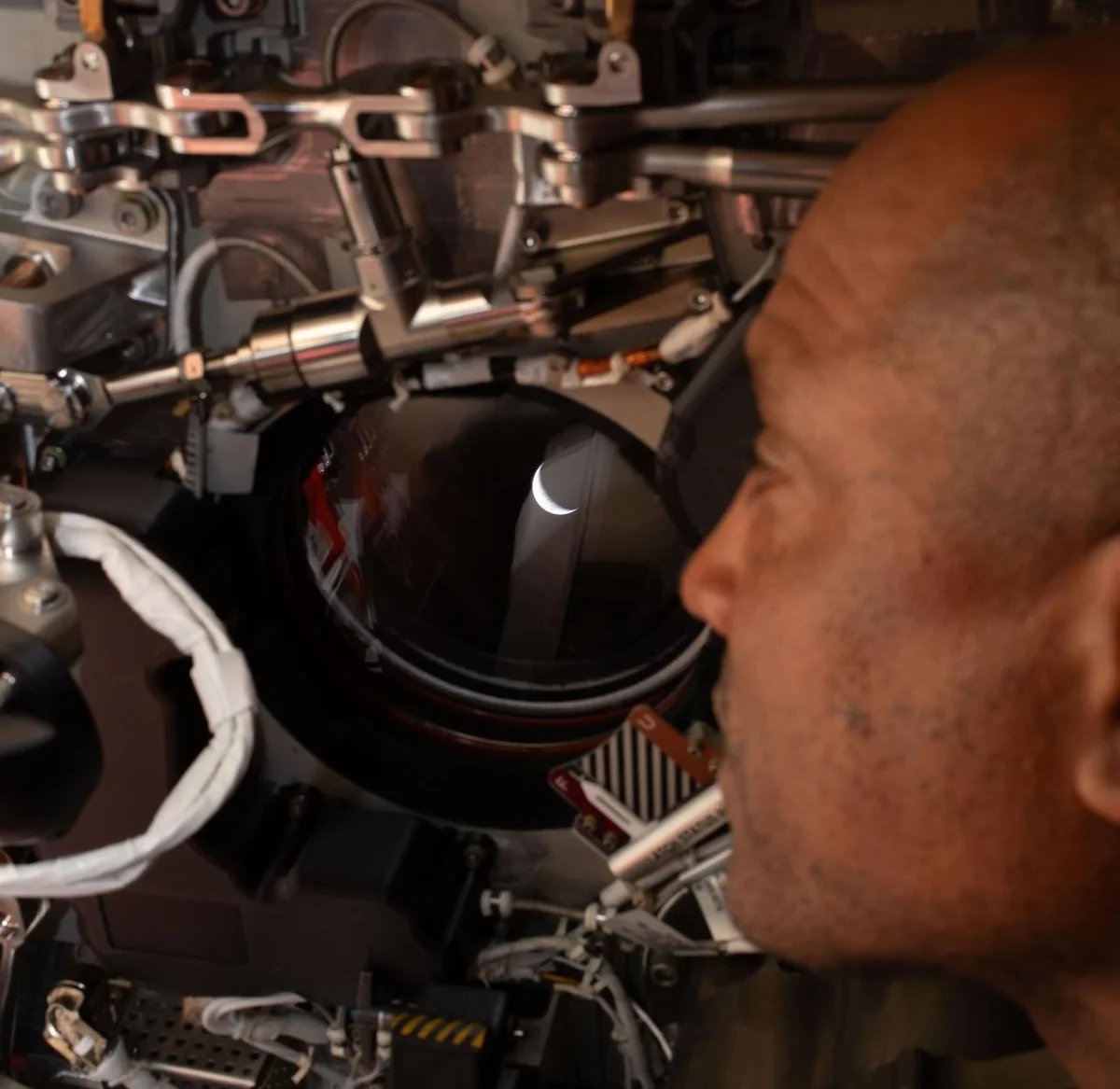
Watch live: NASA’s Artemis II’s moon flyby is underway
Today the four astronauts of Artemis II are observing the far side of the moon, setting distance records and experiencing a solar eclipse
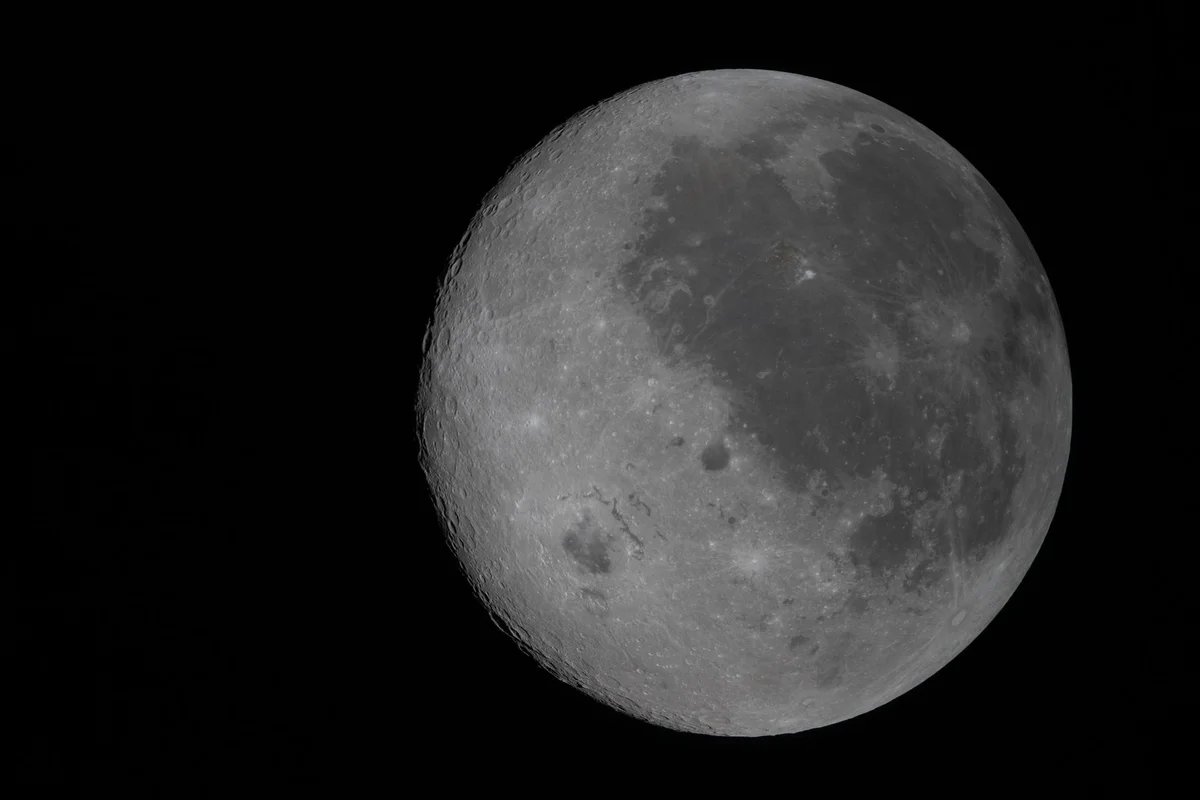
The moon’s near side is seen, as is the Orientale Basin, a massive impact crater that is generally not visible from Earth. The Orientale Basin is the large crater west of the lava flows.
NASA has launched four astronauts on a pioneering journey around the moon—the Artemis II mission. Follow our coverage here.
The Artemis II Orion spacecraft is at the peak of its trip around the moon—the first time humans have passed near our natural satellite in more than 50 years. As they made the flyby, the four astronauts onboard traveled farther in space than any human before them.
The crew exceeded the distance record set by the 1970 Apollo 13 mission just before 2 P.M. EDT. Shortly after that, starting around 2:45 P.M., they had at least five critical hours to observe the far side of the moon as parts of it were illuminated by the sun. Throughout the study period, astronauts Reid Wiseman, Victor Glover, Christina Koch and Jeremy Hansen took turns making observations at Orion’s windows, as well as offering one another technological support and taking quick breaks to eat.
Shortly after passing the Apollo distance record, Hansen offered suggested appellations for two previously unnamed lunar features: a crater to be called Integrity after the name the crew gave to the Orion spacecraft and a bright spot on the near-far-side boundary to be named Carroll in memory of Wiseman’s late wife, Carroll Taylor Wiseman, Hansen said.
On supporting science journalism
If you’re enjoying this article, consider supporting our award-winning journalism by subscribing. By purchasing a subscription you are helping to ensure the future of impactful stories about the discoveries and ideas shaping our world today.
NASA’s Artemis II live mission coverage.
As the crew rounded the moon, they were on track to make several key observations, including of the moon’s color, texture and “albedo” (brightness and darkness), as well as structures such as the massive Orientale Basin. This nearly 600-mile-wide impact crater has never been directly seen by human eyes before this mission. Over the course of the flyby, the Orion spacecraft will came within about 4,070 miles of the lunar surface.
“It’s very apparent, all the really bright new craters,” Koch said in her observations, noting they were something she had “never seen” in photographs. “Some of them are super tiny. Most of them are pretty small. There’s a couple that really stand out, obviously. And what it really looks like is like a lampshade with tiny [prick] holes and the light shining through. They are so bright, compared to the rest of the moon.”

Just northwest of the Orientale Basin (marked above) is a crater that the Artemis II crew would like to name Integrity, after their spacecraft and this historic mission. Just northeast of the proposed Integrity crater, on the moon’s near and far side boundary, which is sometimes visible from Earth, is an unnamed crater that the crew suggested be designated Carroll in honor of crew member Reid Wiseman’s late wife, Carroll Taylor Wiseman, who passed away on May 17, 2020.
On Earth, NASA’s lunar science team was on deck to monitor the crew’s observations.
“I know that the live broadcast tomorrow will flash to them occasionally throughout the broadcast. You’re going to see some very excited scientists. They’re going to be absolutely buzzing up there,” said Kelsey Young, lunar science lead for the Artemis II mission at NASA’s Science Mission Directorate, at a press conference on Sunday night.
At around 6:44 P.M., the crew lost communication with Earth. This period lasted for about 40 minutes—they reemerged around 7:25 P.M. “I said that we do not leave Earth, but we choose it,” Koch said as the crew came back into range. “And that is true, we will explore. We will build. We will build ships, we will visit again. We will construct science outposts. We will drive rovers. We will do radio astronomy. We will found companies. We will bolster industry. We will inspire.”
“But ultimately, we will always choose Earth,” she added. “We will always choose each other.”
The crew is also expected to see a solar eclipse, when the moon will block out the sun. Lunar observations will end at about 9:20 P.M., marking the point at which the astronauts will transition to focus on the journey back to Earth; they’re set to splash down on April 10.
Editor’s Note (4/6/26): This is a developing news story and will be updated.
It’s Time to Stand Up for Science
If you enjoyed this article, I’d like to ask for your support. Scientific American has served as an advocate for science and industry for 180 years, and right now may be the most critical moment in that two-century history.
I’ve been a Scientific American subscriber since I was 12 years old, and it helped shape the way I look at the world. SciAm always educates and delights me, and inspires a sense of awe for our vast, beautiful universe. I hope it does that for you, too.
If you subscribe to Scientific American, you help ensure that our coverage is centered on meaningful research and discovery; that we have the resources to report on the decisions that threaten labs across the U.S.; and that we support both budding and working scientists at a time when the value of science itself too often goes unrecognized.
In return, you get essential news, captivating podcasts, brilliant infographics, can’t-miss newsletters, must-watch videos, challenging games, and the science world’s best writing and reporting. You can even gift someone a subscription.
There has never been a more important time for us to stand up and show why science matters. I hope you’ll support us in that mission.