Trump’s new science panel includes 9 tech billionaires—and just one scientist
There’s a glaring hole in the president’s new science and tech council
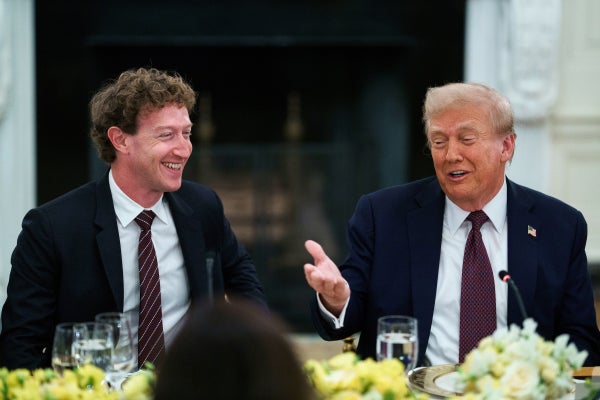
Facebook co-founder Mark Zuckerberg (left) has been named to President Trump’s science and technology advisory council.
Will Oliver/EPA/Bloomberg via Getty
U.S. President Donald Trump has named 13 people to his panel of science advisers — and all but one is a leading technology executive. The President’s Council of Advisors on Science and Technology (PCAST) now includes a single university researcher and at least nine billionaires.
Among the new members are Mark Zuckerberg, the chief executive of Meta, the parent company of Facebook; Larry Ellison, the executive chairman of software giant Oracle; and Sergey Brin, the co-founder of Google. There are also chief executives of tech hardware companies — Jensen Huang of NVIDIA, Lisa Su of Advanced Microdevices and Michael Dell of Dell Technologies. The corporate chiefs have a combined wealth in excess of US$900 billion.
Three of the chief executives have earned PhDs from the Massachusetts Institute of Technology (MIT) in Cambridge. Su’s degree is in electrical engineering. Jacob DeWitte and Bob Mumgaard, who both head nuclear-energy start-up firms, have degrees in nuclear engineering and applied plasma physics, respectively.
On supporting science journalism
If you’re enjoying this article, consider supporting our award-winning journalism by subscribing. By purchasing a subscription you are helping to ensure the future of impactful stories about the discoveries and ideas shaping our world today.
The sole academic researcher is John Martinis, a quantum physicist at the University of California, Santa Barbara, who shared the Nobel Prize in Physics last year for observations of macroscopic quantum phenomena. “I am honoured to be on the committee,” Martinis told Nature.
Laura Greene, a physicist at Florida State University in Tallahassee and a member of PCAST during the administration of president Joseph Biden, praised Martinis and Su as being “outstanding, both in science and technology”.
But others are critical of the committee’s make-up. “Not a single biologist and only one university researcher on PCAST,” Vaughan Cooper, an evolutionary biologist at the University of Pittsburgh in Pennsylvania, said in a post on Bluesky. “This leaves the country unbelievably ill prepared for an age of biotechnology, a race we are already beginning to lose.”
The balance could yet change: under the terms of a presidential order Trump issued in 2025, he could name as many as 11 more members to the committee, says Kenny Evans at Rice University in Houston, Texas, who is a specialist in science policy and co-founder of the White House Scientists Archive.
The White House did not immediately respond to a request for comment.
Gather the council
PCAST makes science-policy recommendations to the White House on topics such as improving nutrition science and bolstering the scientific workforce. It also reviews cross-agency programmes that are already under way, such as the Networking and Information Technology Research and Development initiative. Most of PCAST’s work is done by subcommittees, and its reports are largely prepared by staff from the Science and Technology Policy Institute, a federally funded research and development centre in Washington DC.
During Trump’s first term, from 2017 to 2021, PCAST had 13 members excluding the chair — 7 academic scientists and 6 people from industry. Under Biden, whose term ran from 2021 to 2024, it had 28 members (not counting chairs), 19 of whom were academic researchers, with the remaining 9 from industry and the government. Aside from the PCASTs appointed by Trump, every PCAST since 2001 has had at least 10 members who were academic researchers.
The new PCAST members’ backgrounds are no surprise, says Evans. “Historically, PCAST’s membership reflects the president’s science and tech priorities,” he says. “This group is about what you would expect from the Trump administration — a handful of billionaires and tech executives with expertise narrowly focused on AI, quantum and nuclear fusion.”
Artificial intelligence and quantum information are the first and second entries on the Trump administration’s list of research and development priorities. The Trump administration aims to quadruple US commercial nuclear power by 2050, and a merger was announced in December between nuclear-fusion company TAE Technologies and a firm co-owned by Trump.
The committee will be co-chaired by Trump’s AI czar, venture capitalist David Sacks, and the director of White House’s Office of Science and Technology Policy, Michael Kratsios. On the social-media platform X, Kratsios announced the new council, saying that “PCAST unites America’s brightest minds to advise the President on the most pressing national issues in science and technology” and that it will “focus on the opportunities and challenges that emerging technologies present to the American worker and how to best ensure the U.S. continues to lead in the Golden Age of Innovation.”
This article is reproduced with permission and was first published on March 26, 2026.
It’s Time to Stand Up for Science
If you enjoyed this article, I’d like to ask for your support. Scientific American has served as an advocate for science and industry for 180 years, and right now may be the most critical moment in that two-century history.
I’ve been a Scientific American subscriber since I was 12 years old, and it helped shape the way I look at the world. SciAm always educates and delights me, and inspires a sense of awe for our vast, beautiful universe. I hope it does that for you, too.
If you subscribe to Scientific American, you help ensure that our coverage is centered on meaningful research and discovery; that we have the resources to report on the decisions that threaten labs across the U.S.; and that we support both budding and working scientists at a time when the value of science itself too often goes unrecognized.
In return, you get essential news, captivating podcasts, brilliant infographics, can’t-miss newsletters, must-watch videos, challenging games, and the science world’s best writing and reporting. You can even gift someone a subscription.
There has never been a more important time for us to stand up and show why science matters. I hope you’ll support us in that mission.