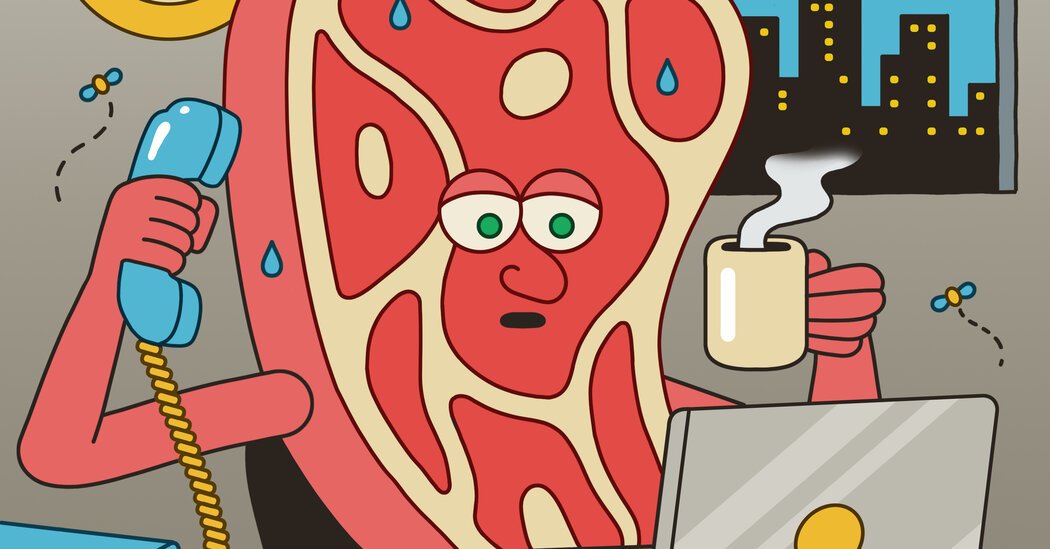
The relationship between mind and machine has long fascinated philosophers and scientists, who have likened the human brain to clocks, chronometers and, in more recent decades, computers. In the early days of artificial intelligence, academics referred cheekily to humans as “meat machines.”
Lately this framing has trickled into the vernacular of tech executives. Elon Musk posted on social media last summer, “We are all dumb meat computers compared to digital superintelligence.”
Andrej Karpathy, an A.I. executive and a founder of OpenAI, wrote in a widely read post that “A.I. research used to be done by meat computers in between eating, sleeping, having other fun, and synchronizing once in a while using sound wave interconnect in the ritual of ‘group meeting.’
“That era is long gone.”
Larry Ellison, a co-founder and the executive chairman of Oracle, said in a 2025 event: “The brain is very specialized. So are the A.I. models. But we’re not building a 20-watt meat computer. We’re building a 1.2 billion-watt A.I. brain.”
How it’s pronounced
/mēt kəm-pyü-tər/
This comparison of human and machine — and the suggestion that non-meat computers are superior — has not landed well with a public anxious about the A.I. future. It fits into a broader trend in which executives pit humans against robots and conclude that humans don’t quite measure up. When Sam Altman, the chief executive of OpenAI, said in February that, while it takes electricity to train chatbots, “it also takes a lot of energy to train a human,” media outlets and social media users jumped on the comments as misanthropic and even dystopian.
People have long sought to “explain the mind through the most powerful technology we have,” said Raphaël Millière, an associate professor at the University of Oxford and affiliate of its Institute for Ethics in A.I. But lately, the meat computer metaphor has gone from an explanatory analogy to marketing language that aims to “move the public perception on how humanlike and intelligent frontier models are,” he said. Such comparisons can be disquieting for people, he added, partly because thinking of ourselves as meat is “grim” and dehumanizing.
Likening A.I. systems to human ones suggests that “if artificial systems are now as good as brains or better, then we should treat them with the same respect” as humans, said Rosa Cao, a philosopher at Stanford studying the relationship between natural and artificial intelligence — and that would imply that the creators of the technology should get major admiration, too.
“The brain,” said Josh Redstone, a philosopher at Carleton University, “is probably one of the most, if not the most, complicated objects in the known universe.” Any analogy to machines fails to capture how sophisticated our brains are. And though some philosophers (including him) find the meat analogy helpful, many members of the general public don’t like to think of humankind in this way: The analogy, he said, “misses what we think is special about ourselves.”
In 2022, in response to another executive’s posts about humans and A.I., Mr. Musk invoked meat in a more oblique way. “Our computer is made of meat!” he posted, and linked to a 1991 short story, “They’re Made Out of Meat,” by Terry Bisson.
In the story, two interplanetary visitors are shocked to find that humans can use their meaty brains to think: “Thinking meat! You’re asking me to believe in thinking meat!” one says to another. “Yes, thinking meat! Conscious meat!” the other alien responds, adding: “The meat is the whole deal! Are you getting the picture?”