NASA’s Artemis II mission’s return to Earth, hour by hour
On Friday, the four astronauts on board the Orion space capsule will begin their final descent to Earth. Here’s the plan, including the final, most nail-biting 13 minutes of the journey
NASA has launched four astronauts on a pioneering journey around the moon—the Artemis II mission. Follow our coverage here.
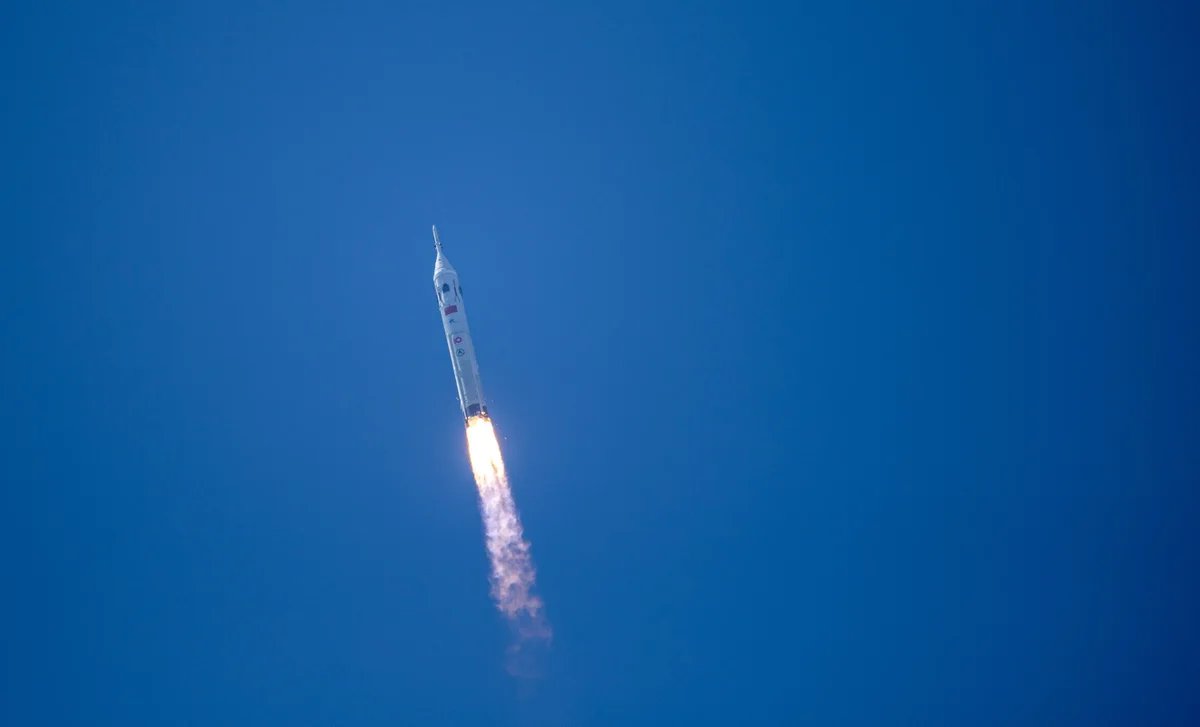
After a record-breaking trip around the moon and back, the Artemis II mission is on its way home to Earth, and preparations are in full swing for its final descent. NASA is targeting splashdown—the moment that the capsule holding the crew will hit the Pacific Ocean—for Friday at 8:07 P.M. EDT. But the hours and minutes leading up to that moment are all critical.
The four Artemis II astronauts—Reid Wiseman, Victor Glover, Christina Koch and Jeremy Hansen—will begin their day at 11:35 A.M. Shortly after that, at approximately 1:50 P.M., they will be working to configure the capsule’s cramped cabin for reentry, stowing away baggage and making sure that everything they need for their journey through the Earth’s atmosphere is ready to go.
Next, NASA has scheduled a final trajectory-course-correction burn for 2:53 P.M. if needed to keep the mission’s Orion capsule, named Integrity by the crew, on track for its final target—Earth.
On supporting science journalism
If you’re enjoying this article, consider supporting our award-winning journalism by subscribing. By purchasing a subscription you are helping to ensure the future of impactful stories about the discoveries and ideas shaping our world today.
The astronauts will also review their reentry checklist to make sure that they are each properly in their space suit, which will help protect them on the potentially bumpy ride down, and clear on their responsibilities during the fall.
NASA will livestream the entire process, with the space agency’s own broadcast coverage beginning at around 6:30 P.M.—a little more than an hour before the capsule is due to reenter Earth’s atmosphere.
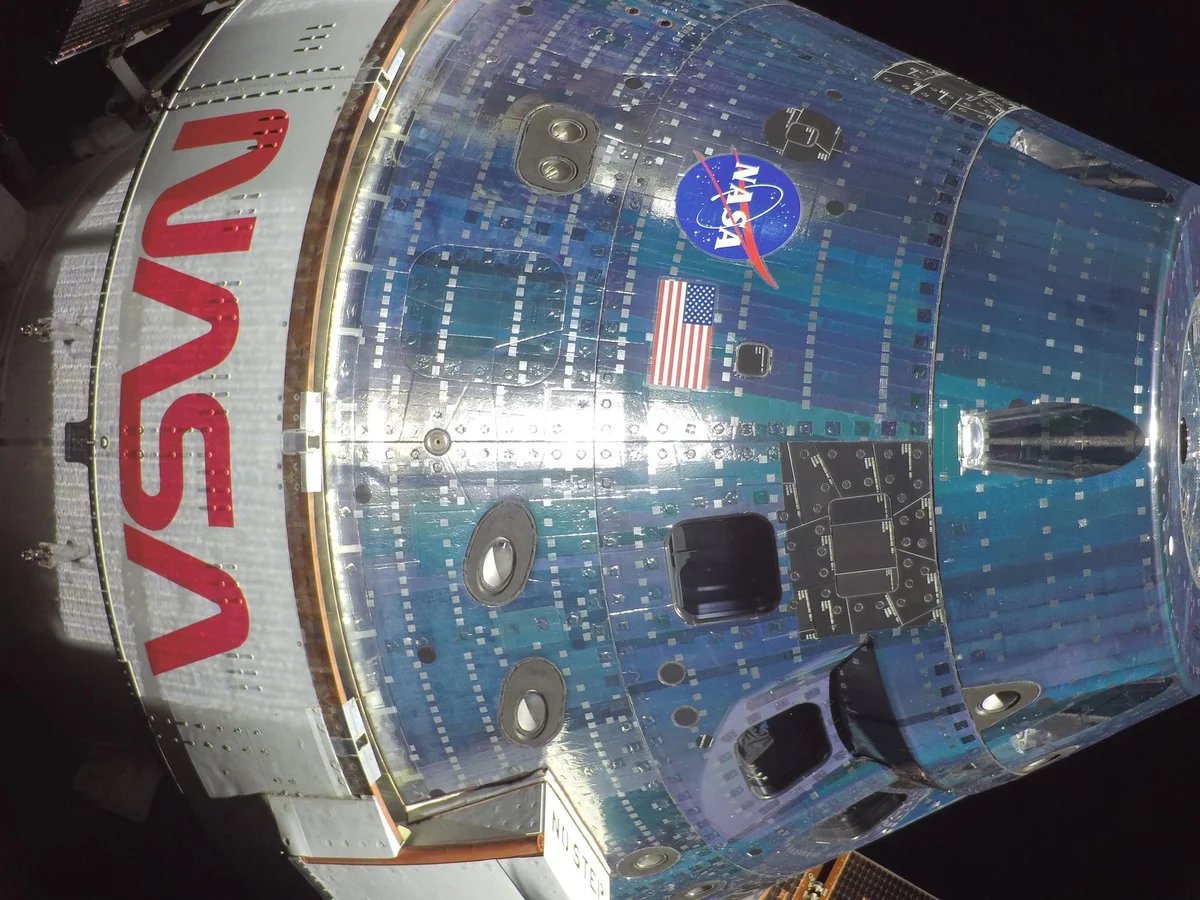
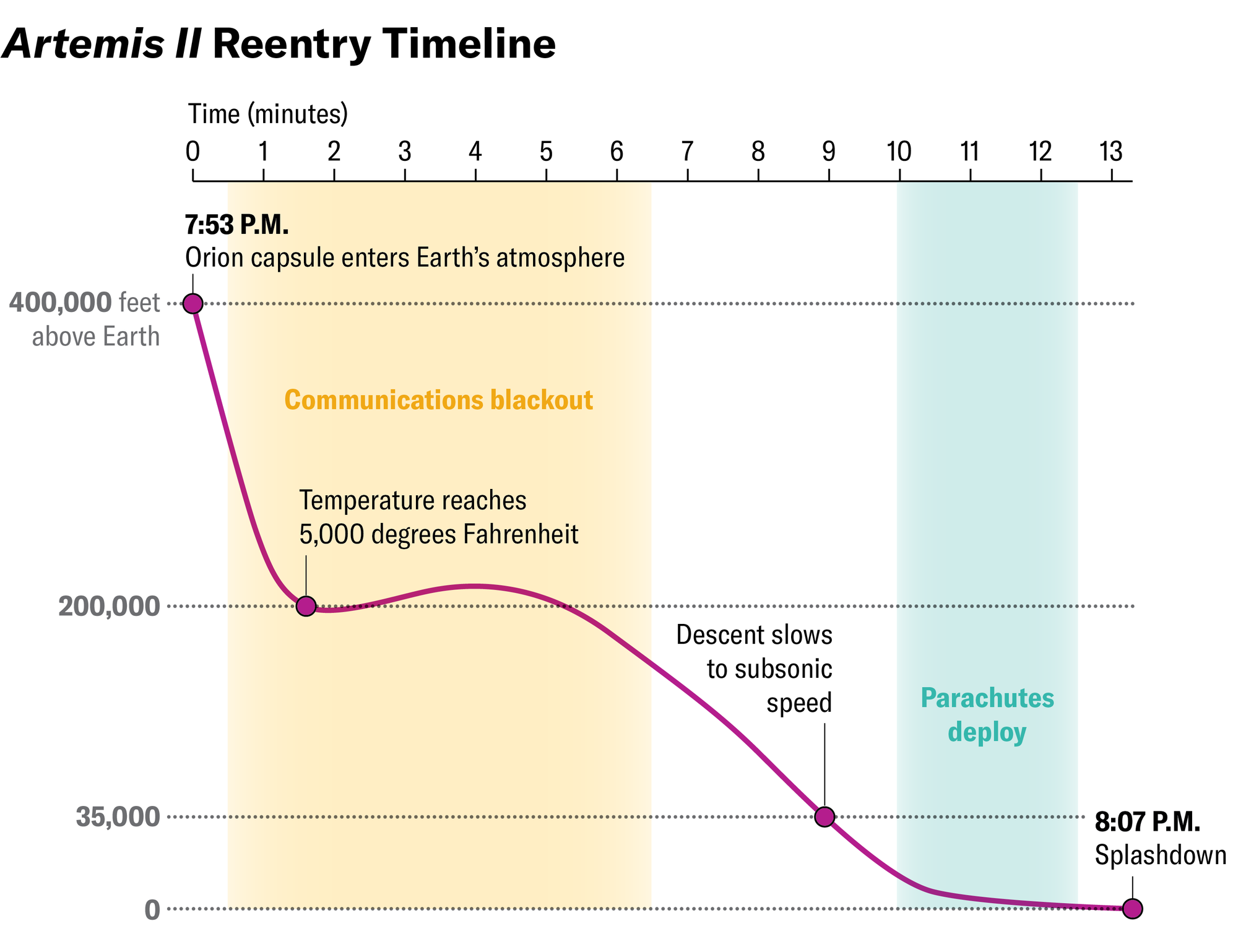
Moments before it does, the capsule will ditch its bulky service module at about 42 minutes before splashdown. Then, at approximately 7:37 P.M., the Orion capsule will perform a quick burn to maneuver into the right position and attitude for reentry and splashdown. Subsequently, at around 7:53 P.M., Orion will reenter Earth’s upper atmosphere some 400,000 feet above the surface, kicking off a 13-minute descent. At this time, the capsule will be traveling at about 24,000 miles an hour.
Amanda Montañez; Source: NASA (reference)
In the first two minutes of that descent, the spacecraft will plunge 200,000 feet, at which point it will experience temperatures reaching 5,000 degrees Fahrenheit (2,760 degrees Celsius) because air molecules ahead of it will compress so violently, according to NASA. As the capsule falls, it will experience extreme pressure and heat stress. NASA has engineered the Orion capsule with a protective layer, a heat shield, that is designed to char, melt and disintegrate in such a way that heat won’t penetrate the inside of the spacecraft. It will also go through a six-minute communications blackout, when the heat will effectively cut the crew’s ability to talk to mission control.
At this point, the spacecraft’s thrusters will help to slow the descent. Along the way, the craft will also roll from one side to another to burn off some excess energy.
At about nine minutes into the descent, the spacecraft will be traveling just under the speed of sound at around 35,000 feet above Earth’s surface. At that time, the capsule will begin deploying its parachutes. It has four sets: the forward bay cover parachutes, the drogues, the pilots and the mains.
The drogue deployment will occur at around 10 minutes in, bringing Orion from 24,000 feet to 6,800 feet. The pilots will then deploy, followed by the mains, which will guide the spacecraft gently down to the water through its final 5,000 feet at around 17 mph.
Splashdown is targeted for 8:07 P.M. in the Pacific Ocean just off the coast of San Diego, Calif. During this 13-minunte period, the crew will have effectively traversed 1,701 nautical miles.
There the USS John P. Murtha will be waiting for them. Within two hours of the astronauts’ splashdown, divers will help extract them from the capsule and get them into helicopters that will carry them to the ship. They will then undergo preliminary medical exams onboard before they return to terra firma.
It’s Time to Stand Up for Science
If you enjoyed this article, I’d like to ask for your support. Scientific American has served as an advocate for science and industry for 180 years, and right now may be the most critical moment in that two-century history.
I’ve been a Scientific American subscriber since I was 12 years old, and it helped shape the way I look at the world. SciAm always educates and delights me, and inspires a sense of awe for our vast, beautiful universe. I hope it does that for you, too.
If you subscribe to Scientific American, you help ensure that our coverage is centered on meaningful research and discovery; that we have the resources to report on the decisions that threaten labs across the U.S.; and that we support both budding and working scientists at a time when the value of science itself too often goes unrecognized.
In return, you get essential news, captivating podcasts, brilliant infographics, can’t-miss newsletters, must-watch videos, challenging games, and the science world’s best writing and reporting. You can even gift someone a subscription.
There has never been a more important time for us to stand up and show why science matters. I hope you’ll support us in that mission.