Hello again, and welcome back to Fast Company’s Plugged In.
More than 15 months ago, I wrote about Surf, a discovery engine for the social web from Flipboard—itself an earlier twist on the same concept dating to the early days of the iPad. At the time, it was still a rough draft, and in private beta. Rather than rushing it out to a broader audience, Flipboard took its time. The app went through a series of revisions that were both numerous and substantial, ending up significantly different than the intriguing prototype I tried in December 2024.
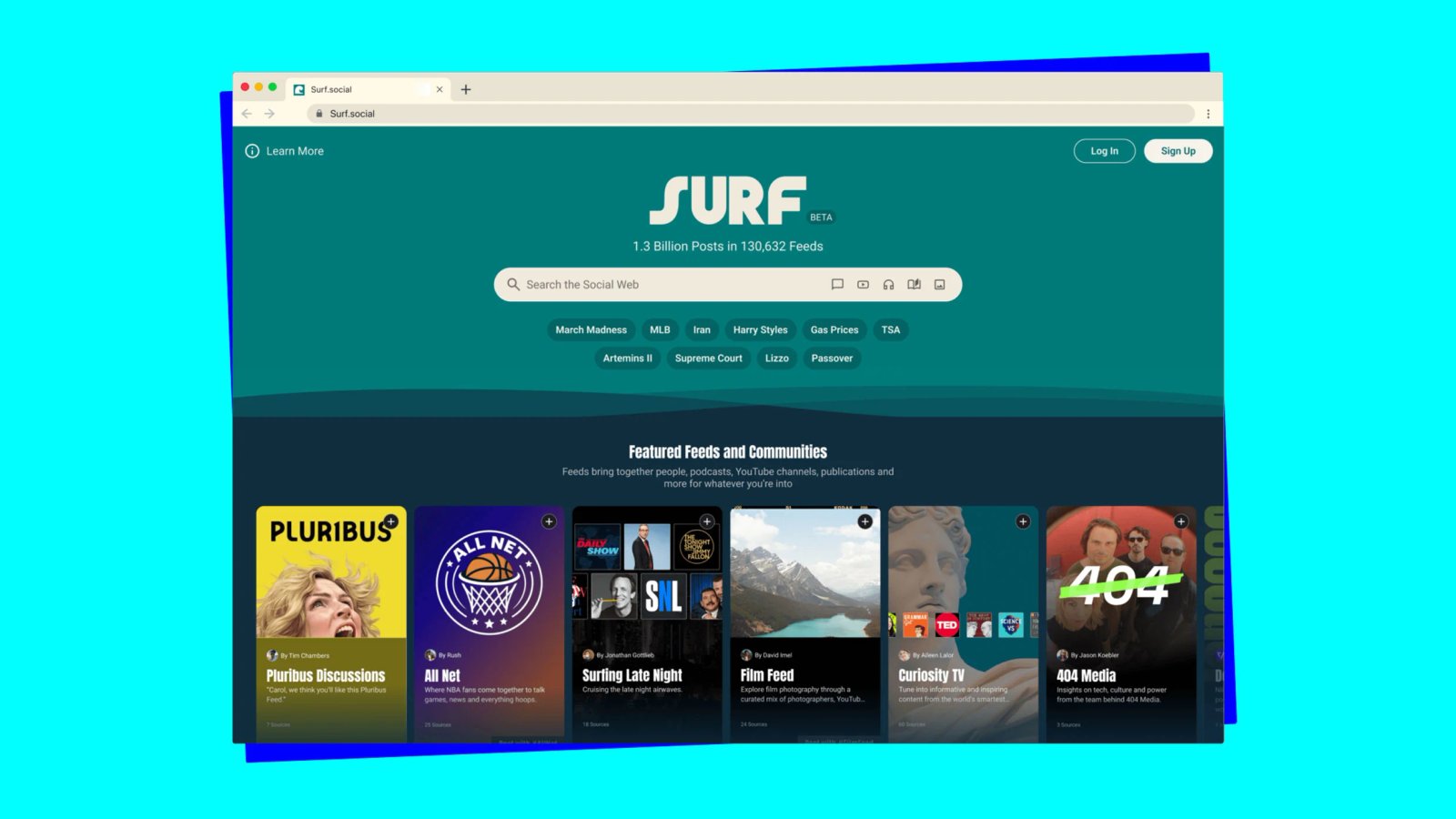
This week, the company finally deemed Surf ready for prime time. It’s now live in web form at Surf.social; a beta Android version is in the Google Play store. (The iPhone and iPad versions still have a waitlist.) If you’ve grown jaded about social networking or the web in general, I recommend taking a look.
Surf’s sheer ambition makes it a challenge to describe coherently. It weaves together material from Bluesky, Mastodon, and Threads—along with YouTube videos, podcasts, blog posts, and articles—and yet it isn’t really a substitute for those services’ own apps. It’s a way to create and share custom feeds about your interests that run on autopilot once you’ve set them up, but that’s optional—you can also just lurk and peruse other people’s feeds. And even though it runs inside a web browser, it feels a little like what browsers themselves might have become if they hadn’t largely stopped evolving almost 20 years ago.
All I know for sure is that using Surf leaves me feeling better about the state of the internet. I am aware that the net is rapidly filling up with AI-generated slop, and that, furthermore, the technology’s impact on search and advertising threatens to disincentivize humans from bothering with the medium at all. But for now, there’s still lots of great stuff out there—and Surf is a refreshingly inventive way to find it.
It would be inaccurate to describe Surf as an algorithm-free zone. Like Flipboard before it, it uses computer science to help identify what individual pieces of content are about so they can be woven together thematically. Unlike Facebook or TikTok, however, it isn’t a giant machine designed, above all, to keep you scrolling. Flipboard worked with individuals and outlets such as The Verge, 404 Media, and Rolling Stone to ensure that the app launched with a bevy of feeds worth following. The result feels curated, not stuffed to capacity.
Even though Surf is decidedly human, it’s organized around interests and passions, not friendships or followers. It’s possible to skim individual Bluesky and Mastodon accounts, but that’s secondary to subscribing to topic-based feeds. Not surprisingly, politics and current events are available in great supply. But so are quieter pursuits that can get drowned out in the din of social networking in its more conventional form: books, cooking, hobbies, and fandoms of all kinds.