Cannes sure isn’t the Oscars. It’s always been more niche, more art house, more, well, French. For decades, films that won the Palme d’Or, the highest prize at Cannes, were celebrated by auteur-worshipping film geeks and ignored by the mass market. But that’s changing (more on that below).
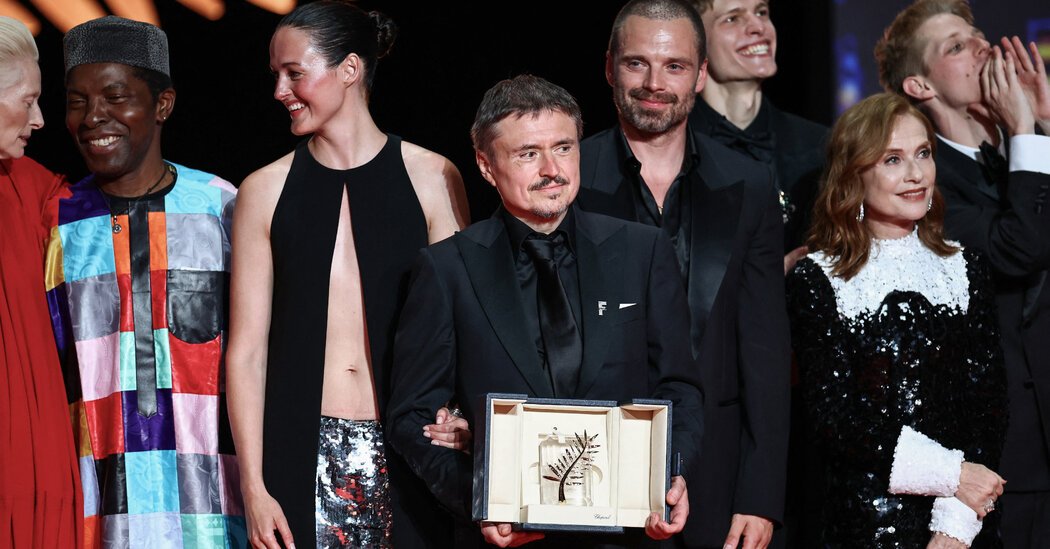
This year’s Palme d’Or went to “Fjord,” a multilingual drama by the Romanian filmmaker Cristian Mungiu set amid the culture wars. I spoke to my colleague Kyle Buchanan, our awards season columnist who spent the past week at the festival, about this and other films that made an impact, and how the festival has changed.
The absurdity and importance of Cannes
Kyle, everyone gets the Oscars. But why should someone who doesn’t follow art house cinema care about Cannes?
Well, if you’re interested in awards season at all, this is where it starts. For example, “Anora” won the Palme d’Or at Cannes two years ago, then went on to win the Oscars for best picture, best director and best actress. Last year, “Sentimental Value” and “The Secret Agent” were both nominated for best picture, and those campaigns began after winning big awards at Cannes.
It used to be that, at most, one best-picture nominee would come from here each year. Then “Parasite” won the Palme d’Or in 2019 and became the first film not in the English language to win the Oscar for best picture. Ever since then, this festival has just taken on a completely different weight. Last year, four of the five international-film nominees first premiered at Cannes.
So Cannes isn’t just a film festival. It’s ground zero for the awards race.
So what’s it been like this year?
It’s been a really divisive year. Most of the films in competition were polarizing, and even this year’s Palme winner, “Fjord,” seems bound to provoke discourse. The film stars Sebastian Stan and Renate Reinsve as conservative parents whose children are taken from them by ostensibly well-meaning and progressive Norwegians.
But it also feels like all the conversations here were dominated by A.I.
You had Demi Moore, who’s on the jury, and the director Nicolas Winding Refn speaking very positively about a technology that’s expected to create a lot of upheaval in Hollywood. Steven Soderbergh even used A.I. to generate a lot of the imagery for his documentary “John Lennon: The Last Interview,” though some of the audience members I spoke to felt that was in opposition to Lennon’s humanist ethos. So yeah — the A.I. era has come to Cannes.
How about the other films: Any particular highlights or lowlights this year?
One of the best-received films was “All of a Sudden,” which comes from the “Drive My Car” director Ryusuke Hamaguchi. He makes very long, very talky movies, but this three-hour film about the friendship between two women (Virginie Efira and Tao Okamoto) still found a lot of admirers. So did performances by Sandra Hüller (“Fatherland”) and Javier Bardem (“The Beloved”). But the most divisive movie by far was “Hope,” a South Korean action flick that had its ardent defenders, even though I felt it played more like an endless video game cutscene.
Kyle, you’ve been going to Cannes forever. What makes you go back every year?
I think my first Cannes was either 2011 or 2012. And I still find it genuinely exciting, even though it can also be completely absurd.
Cannes is incredibly glamorous. Although it can also be incredibly old-fashioned. If you’re a man and you show up to a premiere without a bow tie, they won’t let you in. For years, if you were a woman and you weren’t wearing high heels, same deal. That was a major sticking point for a long time — until Kristen Stewart showed up in Converse. And they were not going to turn away Kristen Stewart.
Cannes is also fun: The French and Italian critics still sometimes boo at screenings when they don’t like a film, though that happens less now — which may be a loss, honestly.
And of course there are the infamous parties …
Oh my God, yes. There used to be these massive parties that the entertainment company Lionsgate threw for “The Hunger Games,” where they’d rent a giant chateau and dress it up like the Capitol. There was a party I went to once in Antibes that you could only get to by helicopter.
The parties aren’t as massive anymore, but there’s still a level of spending that makes you feel like Hollywood has never been in better shape, which we know not to be the case. But part of what Cannes does is to produce enough glitz and glamour to make people believe.
Finally, you told me that every year before the festival you’re excited for the movie you don’t know about yet. What movies should World readers keep an eye out for this year?
I was quite taken with “The Black Ball,” a sweeping Spanish epic from Javier Ambrossi and Javier Calvo, who won the directing prize. It’s a triptych of gay stories taking place over a century, and the movie has it all: war, romance and two musical performances from Penélope Cruz. Netflix picked it up with the expectation of a robust Oscar campaign in mind.
One of my other favorites was “The Man I Love,” starring Rami Malek as an actor dealing with AIDS in 1980s New York. This is a smart, sexy film full of life, from the director Ira Sachs, who recently directed the bisexual love triangle “Passages.” I like movies that transport you someplace, and this one definitely does — although it’s hard to imagine wanting to be spirited away from the south of France, even for two hours!
MORE TOP NEWS
A possible deal to end the Iran war
The U.S. and Iran have agreed in principle to a preliminary deal that would fully reopen the Strait of Hormuz and require Iran to commit to disposing of its stockpile of highly enriched uranium, a senior U.S. official said yesterday. The deal is still awaiting final approval from President Trump and Iran’s supreme leader, which could take days, the official added. Here’s the latest.
Iranian leaders and state media have offered no further official details on what is in the potential agreement or on what is being discussed. But some of the country’s leaders have cast it as a victory that required no major concessions.
OTHER NEWS
-
Russia pummeled Kyiv in a prolonged missile and drone attack and fired a rare intermediate-range ballistic missile, a move seen as nuclear muscle flexing.
-
Hundreds of people stormed a hospital in the Democratic Republic of Congo to demand the body of a suspected Ebola victim, and the isolation ward was burned down.
-
In New Delhi, Marco Rubio, the U.S. secretary of state, said ties with India remained strong, despite fury over Trump’s trade and immigration policies.
-
A bombing near a passenger train in southwestern Pakistan killed at least 14 people. A separatist group claimed responsibility.
-
A gunman opened fire near the White House and was shot and killed by Secret Service officers.
Top of The World
The most clicked link in your newsletter on Friday was about the fate of Timmy the whale.
SPORTS
Tennis: The French Open has begun in Paris, featuring Novak Djokovic, Taylor Fritz and Mirra Andreeva. Follow our live updates.
Pigeons today are often reviled, but the reason they’re everywhere is because we bred them to be dependent on us. An analysis of pigeon bones found at a Late Bronze Age site in Cyprus suggests the birds were domesticated some 1,000 years earlier than previously thought — possibly as early as 1400 B.C. But by the Industrial Revolution, humans started seeing pigeons as a nuisance and “just kind of abandoned them,” the lead researcher said.
European governments are racing to secure rare metals for renewable technologies like batteries and wind turbines. But these large industrial projects are not always welcome.
In northern Norway, the development of a copper mine is threatening the livelihoods of the Indigenous Sami people, who rely on fishing and reindeer herding. The mine is below important reindeer calving grounds, and its permit allows it to dump up to 30 million tons of waste into a nearby fjord, a key spawning site for Atlantic salmon. Read more about one of Norway’s most contentious environmental disputes.
AROUND THE WORLD
Pasta worthy of a pilgrimage
In the mountains of Sardinia, off mainland Italy, a woman named Paola Abraini makes pasta by stretching a ball of dough into long, thin strands and laying them out to dry in a large triangular pattern. The end result is called su filindeu, the threads of God, the rarest of the more than 350 shapes of pasta that are officially recognized in Italy.
For most of its history, su filindeu was a tradition passed down through a single line of matriarchs. The world’s largest pasta company, Barilla, was unable to replicate the intricate process. But Abraini has spent years teaching the craft to others, effectively bringing the threads of God back from the brink of extinction. Watch her at work.
RECOMMENDATIONS
Decode: What is the vagus nerve, and is all the talk of stimulating it a scam?
Read: Our columnist lists the month’s best new works of historical fiction.
Style: Being a well-dressed wedding guest is not about money or maximalism. It’s about creating a look that hangs well together.
A popular snack on the streets of Kampala, Uganda, the rolex — a cheeky reference to the watch brand — is a vegetable omelet rolled up in a chapati. The basic version has diced onions, shredded cabbage and often green peppers, but Ugandans have been known to add whatever else is on hand. Check out how a rolex is made.