Adapt or die: How do you grow and evolve to fit into an alien environment? How do you create change in the face of overwhelming power? And how do you tell your extraterrestrial overlords you need a pen and paper to do the research they’ve demanded?
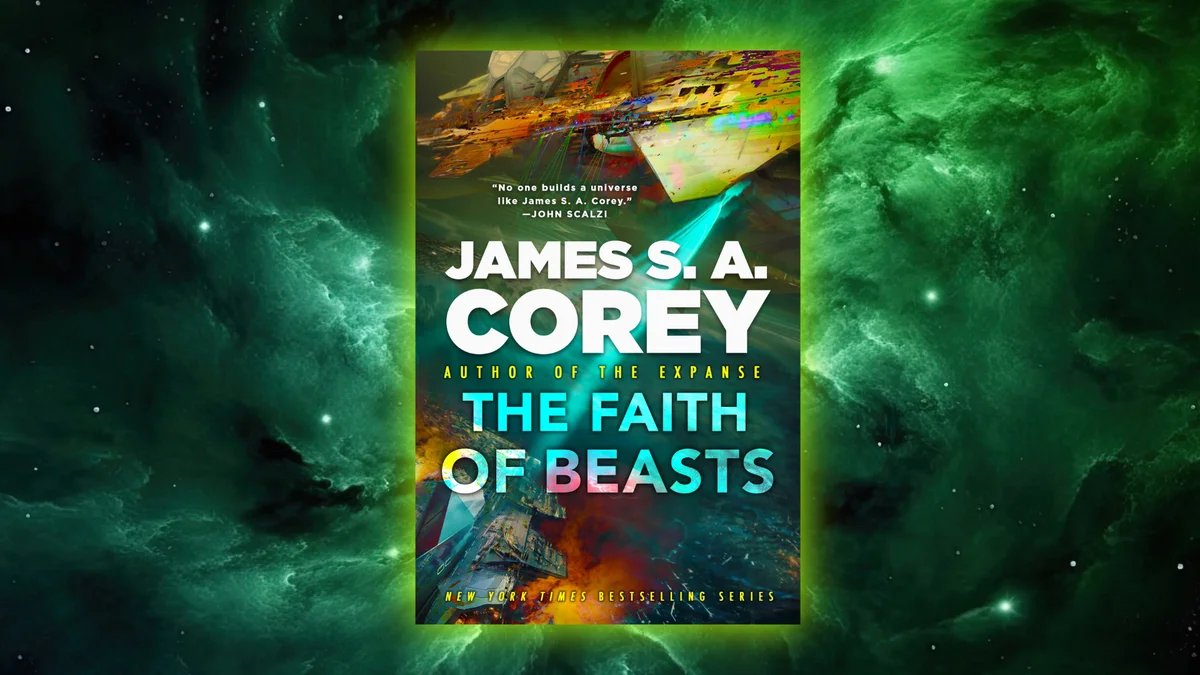
James S. A. Corey, the nom de plume of the duo behind the Hugo Award–winning space saga The Expanse, explore these essential questions and more in The Captive’s War series—whose second novel, The Faith of Beasts, is out this week. Instead of The Expanse’s sprawling epic of humanity’s journey to the stars, The Captive’s War sees humans brought under the thumb of a ruthlessly controlling alien empire and struggling to resist, build lives and maybe even find a way to win.
Scientific American caught up with Corey—actually writers Daniel Abraham and Ty Franck—to ponder frighteningly realistic extraterrestrial invasions, changing concepts of personhood, weird alien societies and the terror of tenure-track research.
On supporting science journalism
If you’re enjoying this article, consider supporting our award-winning journalism by subscribing. By purchasing a subscription you are helping to ensure the future of impactful stories about the discoveries and ideas shaping our world today.
As Abraham puts it, “The faster-than-light drives in this series are probably not the ones that we’ve done the most rigorous work on, but the biology is fun.”
[An edited transcript of the interview follows.]
After the iconic Expanse series, did you two know you wanted to keep working together, or did it take some convincing?
ABRAHAM: I mean, I was up for it. Ty, do you have regrets?
FRANCK: I have many regrets [laughs]. I think that we were always talking about doing other stuff after The Expanse, and I had pitched Daniel an idea while we were still writing The Expanse that wound up becoming The Captive’s War.
ABRAHAM: The idea of an epic sci-fi retelling of the Book of Daniel, with the idea of following somebody into a vast and overwhelming empire and being instrumental in the empire falling. I always thought it was fun, so it was pretty easy to pick as the next gig.
In The Expanse, human society is front and center. Were you excited for a chance to invent so many alien societies instead?
ABRAHAM: It was a way to exercise some of my biology degree—which I’ve never used professionally otherwise.
FRANCK: The one thing that Daniel and I didn’t want to do is another series that felt like The Expanse. The Expanse was very human-centric, very near-future, and so [this was] a chance to do something that was very far-future and not human-centric. Humans are integral to the story, but they’re, in many ways, the least powerful; they have the least agency in the story.
ABRAHAM: There’s always a danger, when you’ve had something that did well, that you turn into your own cover band. You end up trying to recapture or rechew the same thing that did well last time. It’s a vice, something to avoid.
The Expanse spanned a lot of different tones and genres, but this series is a lot more compact and focused. What are the main beats you’re hoping to explore?
FRANCK: I know Daniel always was very interested in telling stories of resistance through just existing, [the idea] that staying alive sometimes is an act of rebellion.
ABRAHAM: One of the things that we were playing against was the alien invasion story where the humans punch their way out of problems, where, once again, violence is the way to redeem the day—or luck, like War of the Worlds, [where something like] a virus happens to take out the bad guys. When you look at stories of resistance, like in the Book of Daniel, so much of it is about much softer kinds of power. That was a fun place to go.
FRANCK: We all love these stories, but the version where enormously powerful aliens come to Earth and we defeat them with F-18s, I didn’t want to do that. I didn’t want to be like, “For some reason, our missiles work on alien ships.” There’s a character in the first book who is explicitly that character, the guy who thinks we’re going to win with violence: we’re going to take their guns from them, and we’ll fight them, and we’ll defeat them with their own weapons, and we’ll win. That character is killed so matter-of-factly; the aliens are so much more powerful than that that the servant of their servant of their servant just kills those guys, and the actual overlord aliens don’t even notice it happen. That’s the story we wanted to tell. You can’t win this fight with violence, so how do you win?
Sometimes just surviving is an act of resistance and finding the grass that grows in the cracks in the asphalt. Sometimes all you can do is grow up through a crack in the asphalt and find a niche in this very unforgiving environment and live in that niche, and maybe there you can find a way to resist.
What was the most interesting alien creature you came up with?
FRANCK: We were in an interesting position with this book because, normally, I’m the one coming up with the crazy ideas, and Daniel is the one reining me back. With this one, we switched places. Daniel was coming up with all these crazy things, and I was the one going, “No, let’s not be quite that Star Trek.” At one point, he came up with this sentient color blue, and I was like, “That’s a little too Lovecraft for me,” so we turned it into a swarm of almost impossible-to-see gnatlike creatures that have bioluminescence.
ABRAHAM: My favorite of the alien species in the new series is the antagonist, the Carryx, just because we spend the most time in their interior lives, and it’s such a weird place, being part of a superorganism but also a distinct individual—being socially determined, having your body change when your status within the hive changes and [having] all the weird, very nonhuman cognitive things that come out of being part of a hive. That was fun to play in.
FRANCK: Being a member of a superorganism and also sentient [is notable]. There are lots of superorganisms on Earth—we’ve got ants, we’ve got termites—but none of them is sentient or intelligent, right? They’re mechanisms that react to chemical stimuli. An ant leaves a trail saying, “There’s food here.” All the other ants follow the trail to get the food. It’s very simplistic. So the question of “What if each ant was individually sentient, they had their own thoughts, they had their own feelings about the universe, and they still had to obey the trail that says go get food?”—that is an interesting idea that I don’t know has been explored a ton in sci-fi before.
ABRAHAM: So much of the book is about convergent evolution, the idea that the environment teaches you how to live in it.
Another character, “the swarm,” explores this in a different way: it starts out as almost a blank slate and gets to define its own personhood over time.
FRANCK: What if you are a creature that can become whatever you want as you discover who you are? Humans go through a number of massive changes of who we think we are. What if we had the ability to physically alter ourselves at each of those stages?
As the swarm gains more experience of the world, becomes more familiar with what it is and starts to decide that it has agency…, what does it do with that information, given the enormous control over its own physiology that it has?
ABRAHAM: For me, part of the thing that was really fun about the swarm is interrogating the idea of a unified self…. That’s not [just] us doing that. That’s neuropsychology. That’s Buddhism. That’s a bunch of different studies of what cognition actually is and the degree to which cognitive life, being sentient, is being divided against yourself. The more you look for a single, unified self, a soul, a nugget that cannot be explained through physics, the less you find one. Being able to follow this character as they pick up all of the pieces of cognition and all of the pieces of being a person without really understanding what it is that they exactly are, gives you a chance to dig into some of the deeper mysteries of what it is to be a person. And because I’m profoundly confused about that, it’s a good place to think it through.
FRANCK: And one of the things you get to do with the swarm is have a creature, a being, that reaches a point where it decides that it is a person. That’s a really interesting transition. We, as humans, don’t really consciously do that. I mean it happens to us at a certain point, but we don’t remember that moment.
ABRAHAM: Feels like it happened to me at about [age] 27…. Before that, it’s pretty much just ants. You’re just following chemical trails. It’s not pretty.
The main characters in this story start out as researchers in a lab together, and the concerns of academia keep surfacing despite the whole “being conquered by aliens” thing. Were you trying to say something about how hard it is to get a tenure-track job right now?
FRANCK: The aliens conquer you and say, “Hey, the reason that we’re keeping you alive is because we’re interested in your research….” The difference between this and tenure track is that if you don’t get tenure, the university doesn’t kill your whole family. These guys are going, “If you don’t get tenure here, we just eradicate your species.” So it’s slightly higher pressure than your tenure-track job.
ABRAHAM: It’s also an interesting way to talk about the difference between high status and low status and functionality in our world. They came in, and they took all of the high-status people on the assumption that they were the most capable. That was optimistic. They did not get the best woodworker. They did not get the best janitor. They did not get the best construction worker.
And finally, do you think our first widespread encounter with aliens will really go this poorly for humans?
ABRAHAM: The idea of actual aliens is so broad. I think there’s a strong argument that our first interaction with a genuinely alien species will be getting to Europa, taking a sample of the ocean water and saying, “Huh, fancy that!” I think that large-scale, intelligent, civilized, machine-using aliens—I’m not really planning on that happening.