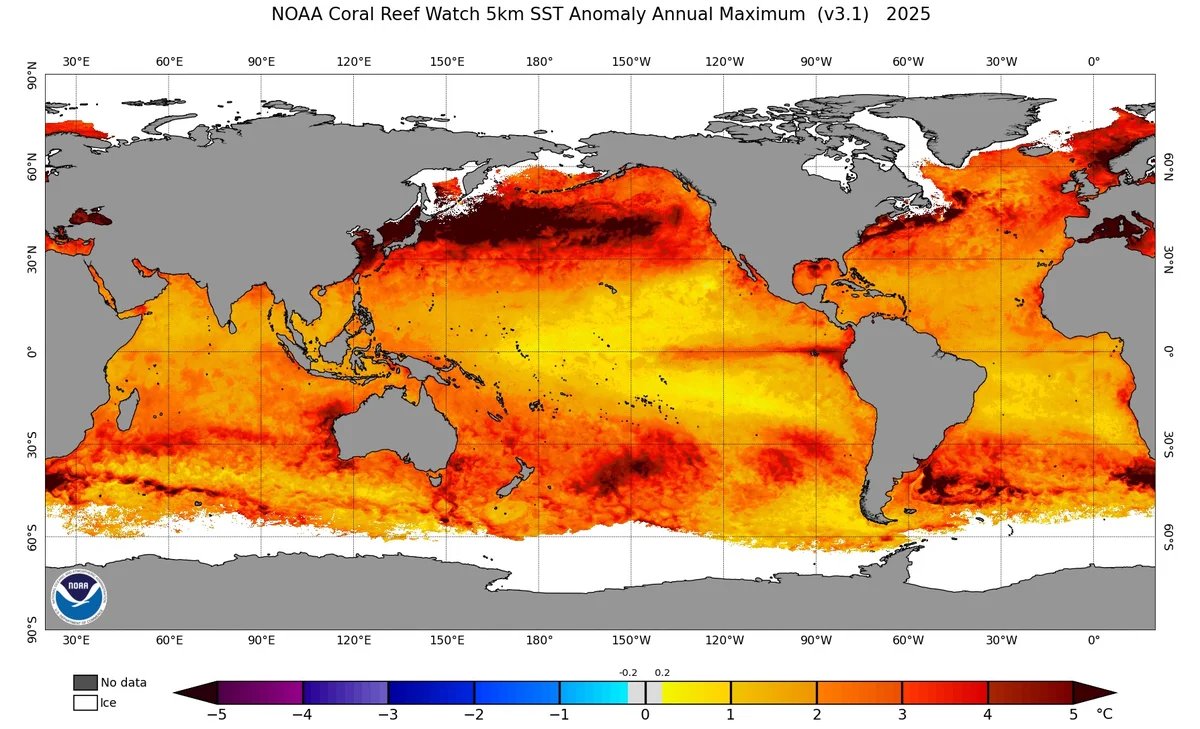
The oceans just keep getting hotter. According to new research from dozens of international scientists published in Advances in Atmospheric Sciences early on Friday, the world’s oceans stored more heat in 2025 than any other year on record.
In 2025 the upper 2,000 meters of the ocean absorbed a record-setting 23 zettajoules more energy than in 2024. This amount is some 37 times as much as the word’s energy consumption in 2023, according to scientists at the U.S. National Oceanic and Atmospheric Administration, the Institute of Atmospheric Physics at the Chinese Academy of Sciences, and the E.U.’s Copernicus Marine Service.
Average sea surface temperatures—a key metric that can affect weather patterns—were the third-highest on record, at about 0.5 degree Celsius (or about one degree Fahrenheit) above the average from 1981 to 2010.
On supporting science journalism
If you’re enjoying this article, consider supporting our award-winning journalism by subscribing. By purchasing a subscription you are helping to ensure the future of impactful stories about the discoveries and ideas shaping our world today.
These hot surface temperatures are a factor in Earth’s overall annual surface temperature; 2025 is expected to be the second- or third-hottest year on record.
The oceans are like the climatic version of soundproofing in a music studio; they absorb about 90 percent of the excess heat captured by the rising levels of greenhouse gases in the atmosphere. Hotter oceans contribute to rising sea levels, disrupt fragile marine ecosystems and fuel extreme weather. Without urgent action to address the climate crisis, scientists warn, the oceans will only continue getting hotter.
It’s Time to Stand Up for Science
If you enjoyed this article, I’d like to ask for your support. Scientific American has served as an advocate for science and industry for 180 years, and right now may be the most critical moment in that two-century history.
I’ve been a Scientific American subscriber since I was 12 years old, and it helped shape the way I look at the world. SciAm always educates and delights me, and inspires a sense of awe for our vast, beautiful universe. I hope it does that for you, too.
If you subscribe to Scientific American, you help ensure that our coverage is centered on meaningful research and discovery; that we have the resources to report on the decisions that threaten labs across the U.S.; and that we support both budding and working scientists at a time when the value of science itself too often goes unrecognized.
In return, you get essential news, captivating podcasts, brilliant infographics, can’t-miss newsletters, must-watch videos, challenging games, and the science world’s best writing and reporting. You can even gift someone a subscription.
There has never been a more important time for us to stand up and show why science matters. I hope you’ll support us in that mission.