We are in the space age. Rockets launch to space almost every day. Orbital space stations have now housed humans continuously for decades. The sky is swarming with satellites and space telescopes. Humans have been to the moon—and are going back. And robots are scattered across the solar system and puttering around on the surface of Mars.
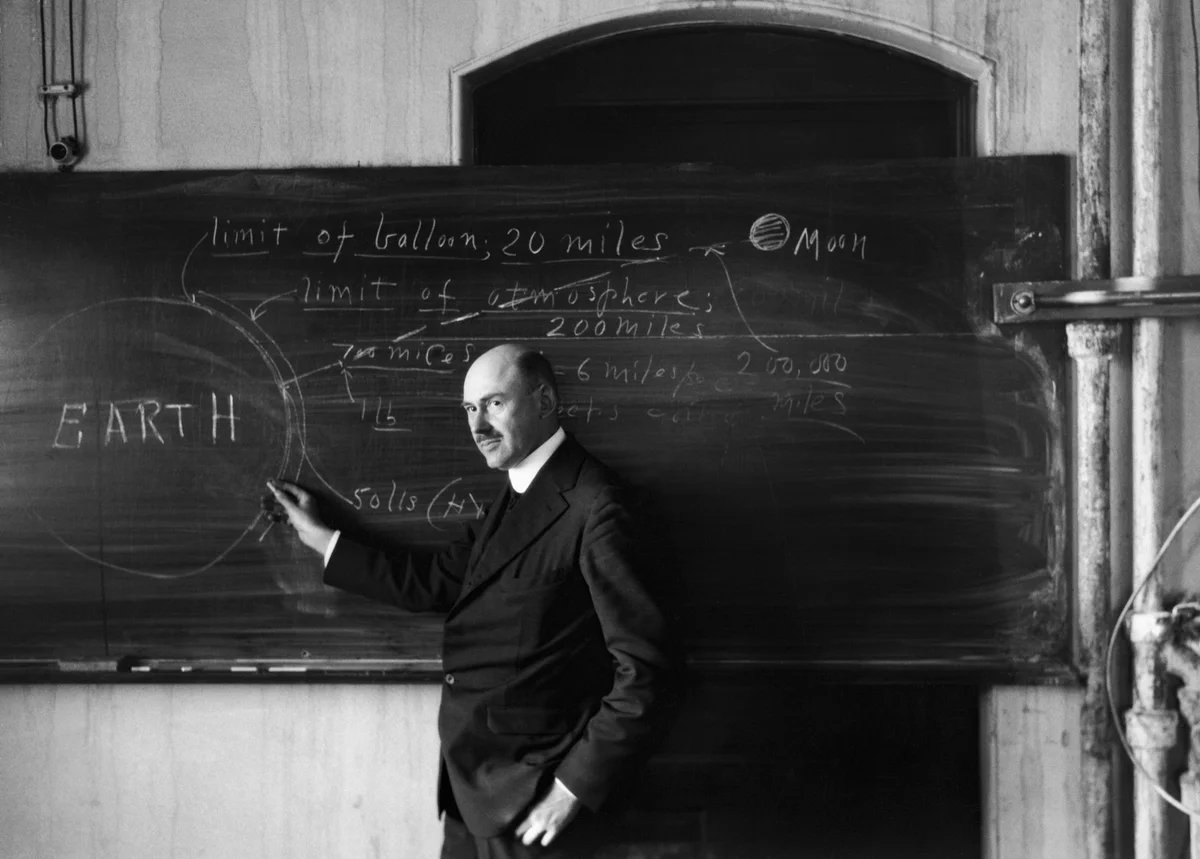
All of this incredible innovation owes a debt to a modest experiment that took place 100 years ago: On March 16, 1926, American physicist and engineer (and occasional Scientific American contributor) Robert H. Goddard launched an 11-foot-tall, 10-pound rocket prototype nicknamed “Nell” from a cabbage patch in Auburn, Mass. Nell was airborne for just a few seconds, but its flight was a milestone—the first-ever liftoff of a liquid-fueled rocket.
Before that moment among the cabbages, solid fuel was used in all previous rockets, dating all the way back to the gunpowder-filled “fire arrows” that were employed to fight invading Mongols in 13th-century China. Liquid fuels imbued rockets with a more powerful thrust and, thanks to their variable flow, also offered more control—precisely what would be needed for any serious attempt at spaceflight. Other early visionaries—Russia’s Konstantin Tsiolkovsky and Germany’s Hermann Oberth—had also realized the transformative potential of liquid-fueled rockets, but Goddard was the first to prove it.
On supporting science journalism
If you’re enjoying this article, consider supporting our award-winning journalism by subscribing. By purchasing a subscription you are helping to ensure the future of impactful stories about the discoveries and ideas shaping our world today.
The rest, as they say, is history. To commemorate the centenary of Goddard’s flight and understand what the future holds for rocketry, Scientific American spoke with two NASA experts—Kurt Polzin, chief engineer of the Space Nuclear Propulsion Project at NASA’s Marshall Space Flight Center, and David Manzella, senior technologist for in-space propulsion at NASA’s Glenn Research Center.
[An edited transcript of the interview follows.]
Given how modest Goddard’s “Nell” prototype was compared with today’s rockets, do you think it’s really accurate to say Nell’s flight a century ago marks the beginning of “modern rocketry?”
KURT POLZIN: Robert Goddard was a pioneering figure who moved rocketry beyond its early roots in solid propellant systems, such as gunpowder-packed canisters. His scientific and analytical approach established a framework for systematically engineering and improving rocket components, a methodology still followed today.
Goddard’s milestone flight laid the groundwork for the development of various space propulsion systems, including chemical rockets, nuclear-thermal rockets, and both solar- and nuclear-electric propulsion. Despite their differences, these systems share a common principle: converting a source of energy—whether chemical bonds, nuclear reactions or solar power—into a high-velocity stream of gas or particles that produces thrust.
Notably, Goddard’s insight extended to electric propulsion. In his notes, he recognized the potential of accelerating charged particles, such as electrons, for propulsion—a concept that anticipated the ion thrusters now used in modern spacecraft.
Space launches are now so commonplace that they’re scarcely seen as newsworthy. One might have the impression that we’ve reached the limit of what Goddard-inspired chemical rockets can do. What do you see as the remaining frontiers?
POLZIN: Chemical rockets, often associated with Goddard’s pioneering work but now encompassing a century of collective innovation, have been the backbone of space exploration. Traditional propellant combinations such as liquid oxygen–liquid hydrogen, liquid oxygen–kerosene and various solid rocket motor propellants have been extensively refined. Recent developments from “new space” companies have introduced alternatives such as methane and hybrid propellants, which could offer further advantages in reliability, cost and operational flexibility.
Innovative approaches such as propulsive boost-stage landings (used by SpaceX’s Falcon 9 and Blue Origin’s New Glenn rockets, for instance) have reduced launch costs and increased launch frequency, making space more accessible than ever before. Chemical rockets will likely remain the primary means of reaching orbit for the foreseeable future, but it’s important to remember no “ultimate” rocket can really exist—different missions require different solutions, and no single rocket design can serve every purpose.
Looking ahead, several frontiers remain for chemical rocketry. Advances in cryogenic fluid management may enable long-duration missions using chemical propellants by preventing boil-off, while continued work on nuclear propulsion and the proliferation of miniature propulsion systems for “CubeSats” and “SmallSats” promise to further expand the landscape. And we haven’t even started to scratch the surface on use cases such as flying rockets on other planets, either to change locations or to boost payloads or astronauts off the surface.
David, this question is for you. In-space propulsion systems are rather different than rockets used to launch payloads from planets. What excites you about where rocketry is headed?
DAVID MANZELLA: Right, so I personally work on in-space propulsion systems, which are the technologies used to propel spacecraft once they reach orbit. For those systems, the fundamental challenge is not having a thrust-to-mass ratio of greater than 1; that is, they typically produce less thrust than would be required to lift a payload into orbit. But you need in-space propulsion because things placed in orbit are valuable, and you usually want to operate them for many years.
Currently that means, when you launch something, right from the start, you need to take all the fuel you’ll need and use over that spacecraft’s lifetime. The technologies we work on attempt to address this problem by making extremely fuel-efficient rocket engines—what we typically call thrusters—and one of the best ways to do that is to augment your propellant by adding electrical energy to it. And that energy is generated in space.
Today that’s done using photovoltaic solar arrays. Keep in mind, though, that the more powerful those electrical systems are, the more oomph these electric propulsion thrusters can provide and the bigger the things we can push in space.
My favorite poster child for this is NASA’s in-development Power and Propulsion Element, which has a 60-kilowatt power system that its onboard propulsion system could use to push an 18,000-kilogram spacecraft to the moon using less than 3,000 kg of propellant. Quite a contrast to launch vehicles, where 90 percent of the mass is propellant, right?
That’s impressive. And I know the Power and Propulsion Element has yet to fly in space—you and your colleagues powered it up for the first time ever, in fact, in a test last year. What are you excited about further in the future?
MANZELLA: The exciting part of the future is that even higher-power systems can be developed, and photovoltaic solar arrays could one day be replaced with nuclear systems generating orders of magnitude more electricity. NASA is developing the technology to enable this for things that include the human exploration of Mars today. That’s what excites me!
POLZIN: Let me jump in on this, too. What excites me most about the future of rocketry is the expanding horizon of both performance and application. Rockets, at their core, are tools—indispensable for enabling the exploration and utilization of space but not the instruments of discovery themselves. Their true value lies in their capacity to deliver the technologies and payloads that drive scientific investigation, exploration and, increasingly, the establishment of a lasting human presence beyond Earth.
On the performance front, innovation continues to push boundaries. Advances in propulsion systems promise greater efficiency, reliability and reach. This is realized through incremental improvements in chemical rockets, experimentation with new propellant combinations such as methane or hybrids or the pursuit of systems such as solar electric and nuclear propulsion. These developments are crucial for tackling ambitious missions, such as crewed journeys to Mars or deep-space sample return missions. And a diverse array of propulsion systems is essential to meet a broad spectrum of scientific, commercial and exploratory goals.
From the perspective of application, the most exciting developments involve moving beyond exploration to expansion and utilization. We are beginning to think boldly about questions like: How do we safely deliver and return humans from Mars? How can we collect and return samples from distant bodies in the solar system? What infrastructure is needed to transition from initial exploration to establishing a permanent presence in space? The vision extends further and involves leveraging resources and capabilities gained from expansion into space through NASA’s Artemis program, enabling sustainable operations and new opportunities for science, industry and even daily life beyond our planet.
Ultimately, the future of rocketry is about empowering new possibilities. As end users gain access to a growing range of launch options, they are better equipped to pursue diverse missions: advancing scientific knowledge, developing commercial ventures or building the foundations of a permanent spacefaring civilization. The field thrives on bold thinking and inventive solutions, and I am most excited to see how these will shape the next era of space exploration and development.
MANZELLA: We are indeed entering a new age in the history of humankind where each and every one of us could be impacted by space-based systems daily. I think that trend will only accelerate in the future. It’s clear that space is becoming an ever increasing part of our way of life as technology continues to advance. And yes, much of this progress traces back to Robert Goddard’s first flight a century ago.