Chalk up another victory for “Conan the Bacterium”—a rugged germ that fresh research suggests could conquer the solar system.
Better known as Deinococcus radiodurans, this microbe is arguably the toughest organism known to science. Past studies have shown it can endure extreme cold, intense radiation, harsh chemicals and profound dehydration—all evolutionary adaptations, perhaps, to what’s thought to be its natural home in the high, dry and sun-scorched deserts of northern Chile.
Now a new experiment from researchers at Johns Hopkins University shows this hardy “extremophile” can also survive the immense shocks and mechanical stresses associated with asteroid strikes on Mars.
On supporting science journalism
If you’re enjoying this article, consider supporting our award-winning journalism by subscribing. By purchasing a subscription you are helping to ensure the future of impactful stories about the discoveries and ideas shaping our world today.
D. radiodurans “is the closest thing we can get to what we think a Martian life-form might look like without having an alien in our lab,” says Lily Zhao, a doctoral student at Johns Hopkins University, who led the experiment. “And we tried to kill it, but we couldn’t.”
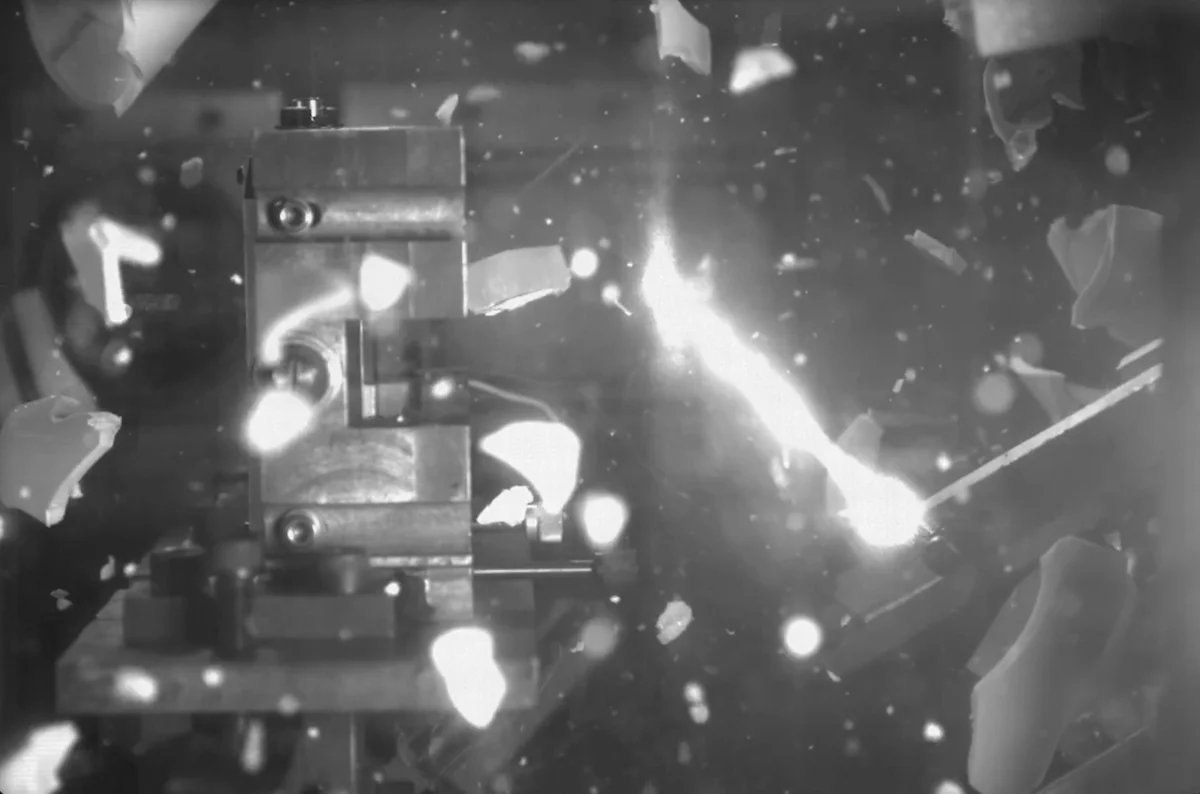
To do so, the researchers fired a high-speed projectile from a gas gun at colonies of D. radiodurans that were sandwiched between two steel plates. The bacteria could withstand split-second exposures to extreme pressures of up to three gigapascals (GPa). That’s 30 times greater than pressures at the deepest point in Earth’s oceans—and similar to the crushing blow of an asteroid cratering into Mars and blasting fragments into space.
K. T. Ramesh, an impact expert at Johns Hopkins, who supervised the work, was shocked by the results. “Our expectation was that most of them would die,” he says, because other types of microbes in previous high-pressure studies had survival rates of only about 1 percent or less. Instead nearly all the D. radiodurans microbes survived initial 1-Gpa shots. Even at the highest pressures of 3 Gpa, more than half survived. Subsequent analyses, guided by Johns Hopkins microbiologists Cesar A. Perez-Fernandez and Jocelyne DiRuggiero, showed that some of the microbes had perished from ruptured cell walls but also confirmed the survivors could repair their damaged DNA, regrow and reproduce.
These images show Deinococcus radiodurans microbes before (left) and after (center, right) high-pressure impact experiments.
Lisa Orye/Johns Hopkins University/Zhao et al.
Along with the microbe’s other feats of strength, its extraordinary resilience suggests it has all the basics required for interplanetary hops onboard an impact’s ejected debris that could sow life throughout the solar system, the researchers say. Called lithopanspermia, this far-out idea dates to musings in the 1870s about germ-riddled meteorites. Scientists began taking it more seriously in the 20th century, however, as space exploration revealed potentially habitable conditions on other planets and as cellular biology showed some microbes to be astonishingly adaptive and robust.
“In terms of fundamentals—radiation, freezing, desiccation—this ‘pressure’ component was really the last question mark,” Zhao says, “because, if life couldn’t even survive impact pressures, then the rest doesn’t matter since cells won’t survive being launched into space in the first place.”
The team’s results, published on Tuesday in the journal PNAS NEXUS, carry weighty implications for understanding the origins of life on Earth—and the search for life elsewhere in the universe.
The finding bolsters the case that life across a solar system may spread a bit like the common cold: if one bio-fevered planet sneezes out debris, others can catch it, too. And given that asteroids have been chipping away at the sun’s retinue of worlds for more than 4.5 billion years—and that, eons ago, Mars was a warmer, wetter, more clement place—the result boosts the possibility, however slight, that life on Earth got its start on Mars. Meteorites from the Red Planet routinely pelt our planet, although most burn entirely in the atmosphere or fall into desolate stretches of land or sea.
Scientists are not suggesting that homegrown D. radiodurans microbes are direct émigrés from Mars. Rather this terrestrial organism’s capabilities are a sort of existence proof. “If you can get one life-form, an extremophile, to survive these kinds of conditions, that shows there’s a ‘seed’ for biology to build on,” Ramesh says. “You’ve got the DNA; you’ve got the cellular structures. And from there, biology can move—it doesn’t start in one place and just stay there.” Evolutionary adaptation handles the rest.
“This is a fantastic experimental representation of how microorganisms could propagate between neighboring planets or beyond in the universe by hitching a ride in rocks that were ejected from an impact,” says Moogega Cooper, a planetary protection engineer at NASA’s Jet Propulsion Laboratory, who works on the space agency’s Curiosity Mars rover and wasn’t part of the latest study.
Planetary protection engineers such as Cooper ensure Earth’s life doesn’t stow away on spacecraft to contaminate and gain a flagellum-hold on other worlds, where it could muddle the search for extraterrestrial life and potentially wreck alien ecosystems. They also safeguard our own planet from otherworldly life-forms brought back from space. “Finding signs of life beyond our planet in a way that clearly differentiates it from Earth life must be done in a clean manner,” Cooper says.
The NASA-led Mars Sample Return (MSR) program—a decades-in-the-making quest to bring potentially life-bearing Martian material back to Earth—is now in shambles, its budget zeroed-out just as the space agency’s Perseverance rover had gathered the requisite samples, leaving them stranded on the surface of Mars. But another effort is quietly waiting in the wings: the Japan Aerospace Exploration Agency’s (JAXA’s) Martian Moons Exploration (MMX) mission is set to launch later this year on a voyage to grab samples from Mars’s moon Phobos for return to Earth in 2031. In light of the Johns Hopkins study, it’s suddenly conceivable that MMX might deliver some of what MSR had promised.
“Phobos orbits Mars twice daily at an orbital distance of just 3,700 miles and has effectively been acting as a vacuum cleaner for ejecta from the Martian surface for the last billion years,” says Michael Daly, a pathologist and extremophiles expert at Uniformed Services University of the Health Sciences in Maryland. “The Johns Hopkins group’s research brings renewed focus to the possibility of detecting not only prebiotic small molecules but also macromolecular remnants of whole cells and viruses ejected from Mars’s surface. Indeed, the remarkable ability [of D. radiodurans] to potentially survive both the immense pressures of meteorite impact and eons of deep-space radiation suggests that the MMX Phobos moon samples returned to Earth may require a higher level of planetary protection.”
Phobos has been considered uninhabitable and is therefore classified as an “unrestricted” celestial body by the United Nations–affiliated Committee on Space Research (COSPAR), which dictates planetary protection protocols. That status means minimal biohazard measures are required for visiting spacecraft. Daly notes, however, that recent discoveries of sugars, amino acids and other biological building blocks on asteroids could allow impact-delivered organisms to be planted and fertilized in the Martian moon’s soil, allowing long-term survival. That is, COSPAR may need to reconsider its designation—with unclear repercussions for the soon-to-launch MMX mission.
“So you go to Phobos, you bring material back, and maybe you bring back [biological] Martian material,” Ramesh says. “Maybe you have to be worried about this now, right? You may have to be more careful than we previously thought.”
Cooper, the NASA planetary protection expert, notes that the Martian moon’s “unrestricted” status emerged in part from an authoritative 2019 report from the National Academies of Sciences, Engineering, and Medicine and that NASA has already funded an in-progress study to further assess impact-ejected microbial survival on Phobos. “The burden of proof will require more research,” she says. “But future experiments could support a deeper conversation exploring unrestricted sample return from Mars in an updated safety assessment like the JAXA MMX mission.”
Norman Sleep, a Stanford University geophysicist and pioneer in modern lithopanspermia studies, thinks the MMX Phobos samples will justifiably receive extremely careful treatment regardless of the moon’s planetary-protection status. “Some people—I won’t say who—think that demanding planetary protection for bringing samples back from Phobos is like requiring a lifeguard for a swimming test at Death Valley National Park,” he quips. “But even so, it’s worth taking Herculean efforts to keep the Phobos samples from being contaminated by terrestrial microbes.”