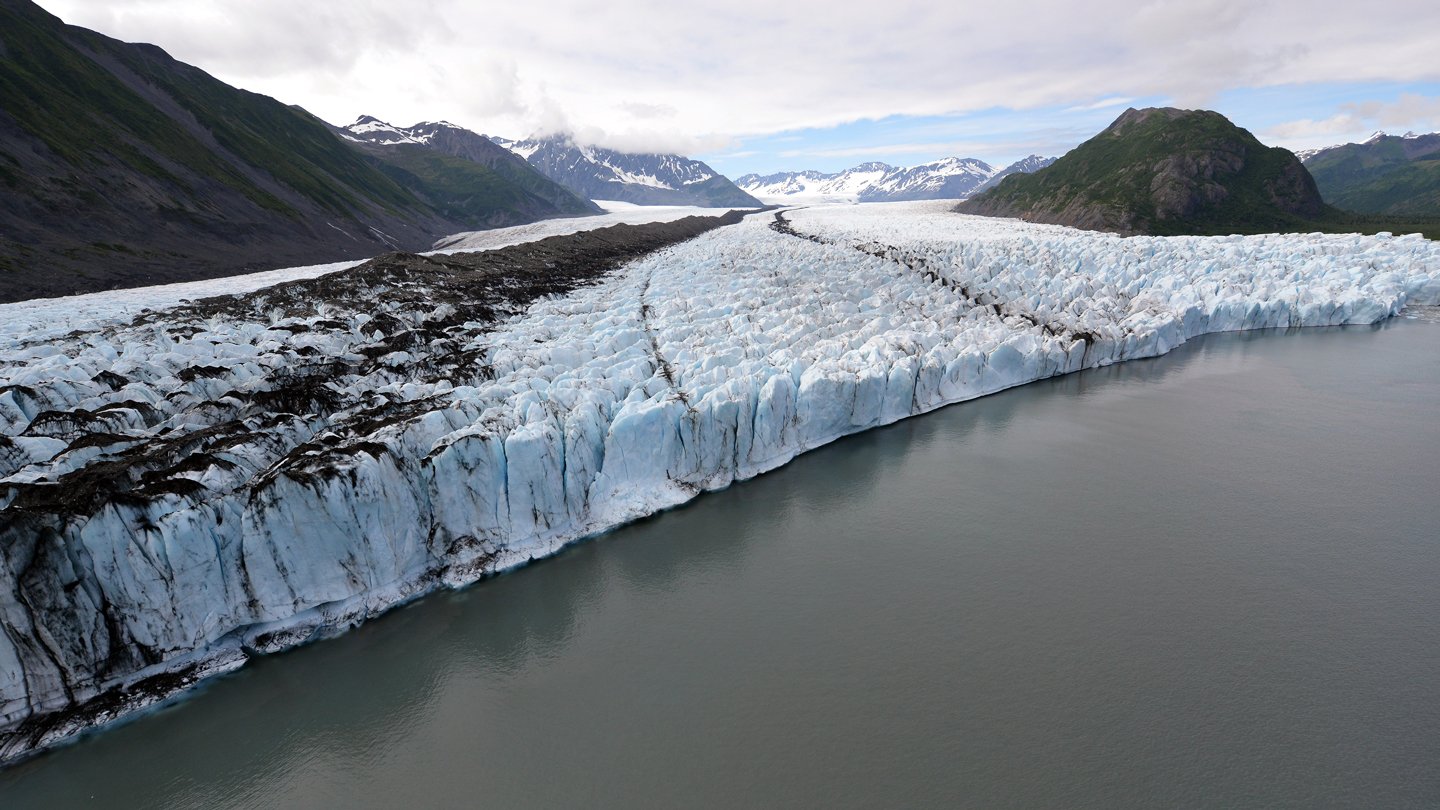
The St. Elias Mountains in southeast Alaska are dotted with over 100 lakes where glaciers crumble into milky, turquoise water. Those lakes are expanding at an ever-quickening pace.
The lakes will quadruple in size over the next century or two, scientists report March 9 in the Proceedings of the National Academy of Sciences. This growth will transform landscapes, create new salmon habitat and may even change the course of a major river.
“We are seeing the great age of ice retreat” in Alaska, says Daniel McGrath, a glaciologist at Colorado State University in Fort Collins. “These glaciers are just peeling back from the landscape,” revealing deep grooves they carved in the Earth, where lakes are now forming.
Glacial hydrologist Eran Hood of the University of Alaska Southeast in Juneau, who was not part of the study, adds that “understanding where these lakes are going to emerge is important” because it “changes the whole nature of the downstream ecosystem.”
Hugging the coastline along the Alaska-Canada border, the tiny mountainous region that includes the St. Elias Mountains is losing 60 cubic kilometers of ice per year. Because lakes absorb solar heat, the glaciers that shed ice into lakes are shrinking faster than those that terminate on dry land. Across southeast Alaska, these lakes attached to glaciers have expanded by 60 percent since 1986, reaching a combined area of 1,300 square kilometers.
McGrath and his colleagues wondered how far this runaway expansion might go. So, they combined satellite images with estimates of ice thickness — mapping deeply eroded grooves that are still hidden under glaciers.
The results were “eye-opening,” McGrath says. The team identified 4,200 square kilometers of glacier-covered grooves adjacent to existing lakes.
He and his colleagues predict that the lakes will continue to expand — causing rapid ice retreat — until they fill those grooves, reaching a combined size of around 5,500 square kilometers, an area the size of Delaware.
“By the end of this century, all of these lakes will probably be more or less fully developed,” says study coauthor Louis Sass III, a glaciologist with the U.S. Geological Survey at the Alaska Science Center in Anchorage. But those growing lakes are already reshaping entire landscapes in a way that is often overlooked in public discourse around glacier retreat.
Many of Alaska’s glaciers terminate on dry land, and their meltwater often creates barren, rocky floodplains downstream, where the streams alternate between trickles and floods — constantly branching and shifting course as they lay down sediment released by the glacier.
“Those habitats are fairly inhospitable for a lot of fish,” including some salmon, says Jonathan Moore, an aquatic ecologist with Simon Fraser University in Burnaby, Canada. The water is too cold, and fish eggs “get swept out or buried by the floods every year.”
But as glaciers retreat into lakes and those lakes expand, their meltwater has time to drop its sediment and warm a few degrees in the lake before spilling into a river. Rivers that carry less sediment are less prone to shifting channels.
A 2025 study by Moore and remote sensing scientist Diane Whited of the University of Montana found that as glacial lakes expanded over 38 years in southeast Alaska, the downstream river channels stabilized, allowing willows and bushes to spread across floodplains.
“It creates salmon habitat,” Hood says. A 2021 study by Moore and Hood predicted that by 2100, glacial retreat in southeast Alaska will transform 6,000 kilometers of river channels into decent habitat for some local species of salmon. The lakes themselves will create spawning grounds for sockeye salmon — an important commercial species.
But these changes will come with upheaval.
For instance, one major river, the Alsek, will probably shift its course as retreating glaciers cause two lakes to merge, providing an easier path to the ocean.
People in Juneau are feeling another dramatic effect of expanding lakes. At least once per year, a lake dammed by the nearby Mendenhall Glacier spills out in a flash flood that gushes through town, forcing some residents to build protective levees around their homes.
These ecosystems “are going to be transformed,” Moore says. “But that transformation is going to be pretty violent and pretty dangerous.”