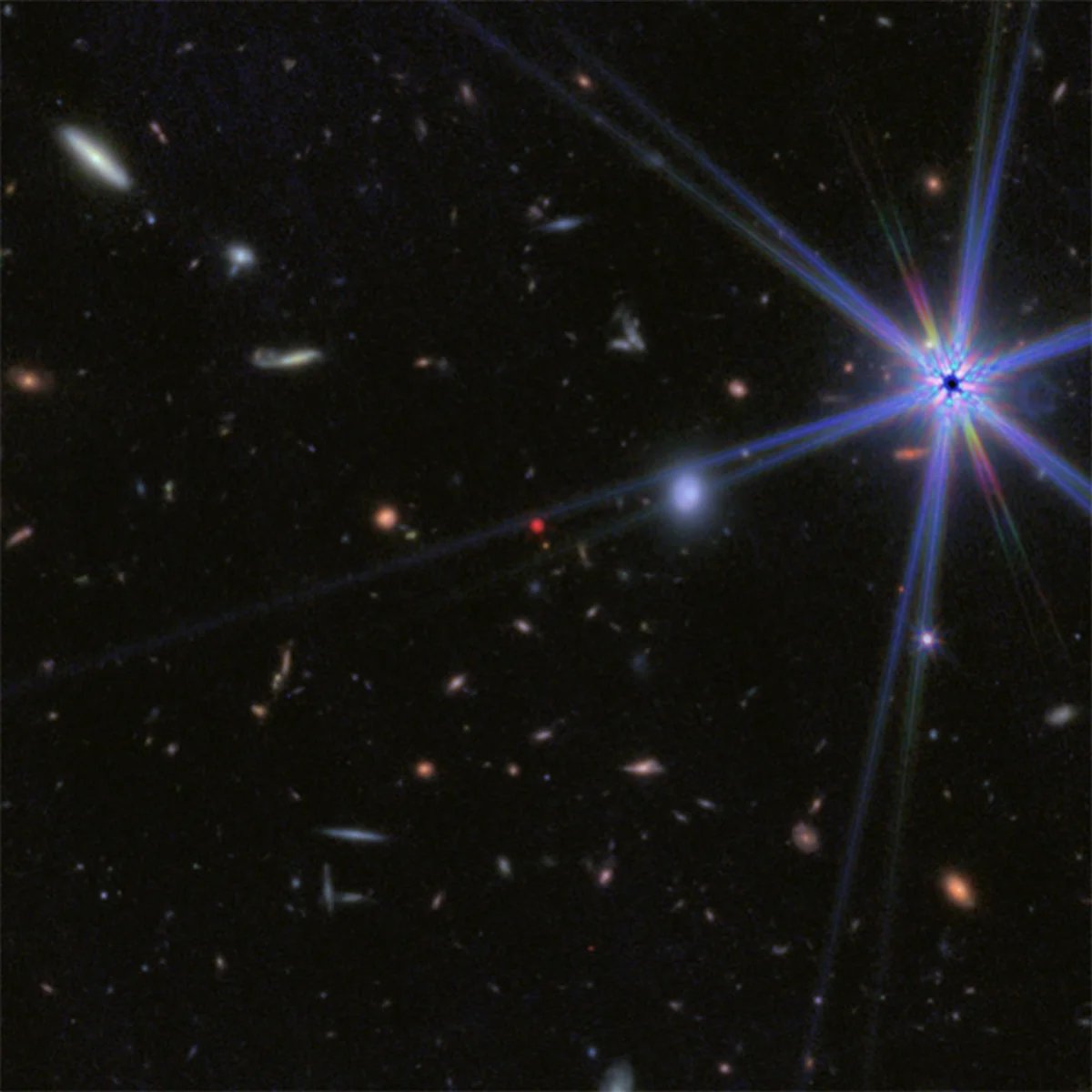
For the past few years, astronomers have grappled with a cosmic enigma first revealed by NASA’s James Webb Space Telescope (JWST). Practically everywhere JWST looked in the sky’s distant depths, probing a time when our universe was only several hundred million years old, it saw something hard to explain: bright, curiously compact specks that were ruby red. The spots were ubiquitous in scenes from this early epoch. But then, circa two billion years into the universe’s history, they vanished from JWST’s view just as inexplicably as they appeared.
Further investigations of these “little red dots” (LRDs) deepened the mystery. They looked far too massive and mature to be early galaxies brightened by swarms of newborn stars, yet they weren’t blasting out the x-rays and radio waves that are the hallmarks of supermassive black holes feeding on gas and dust. For a time, the LRDs were framed as breaking cosmology because they defied practically every expectation set by well-founded theories.
Now, however, an answer may be at hand. Published on Wednesday in Nature and derived from deeper, more time-consuming JWST observations of a dozen LRDs that split their light into its constituent colors, or spectra, a new study strengthens the case that these objects are, in fact, gigantic, growing black holes. If so, the seemingly missing x-ray and radio outbursts from these objects would be cloaked behind dense cocoons of ionized gas. Feeding black holes also usually emit copious ultraviolet radiation from the white-hot disks of material that pile up around their insatiable maws. For the LRDs, that ultraviolet light would filter through their cocoons, trickling out as visible light and creating the characteristic red hue. The LRDs would naturally fade away as the growing, gas-guzzling black holes hollowed out their cocoons.
On supporting science journalism
If you’re enjoying this article, consider supporting our award-winning journalism by subscribing. By purchasing a subscription you are helping to ensure the future of impactful stories about the discoveries and ideas shaping our world today.
If confirmed by additional data, this picture could mean that LRDs represent a new, previously unknown phase in the lives of supermassive black holes—and the youngest stage at which we’ve ever seen them.
“This cocoon makes these black holes look red and prevents much of their radiation from escaping and explains why they look so compact,” says the study’s lead author Vadim Rusakov, an astrophysicist at the University of Manchester in England. In this scenario, besides disguising the black holes, the cocoons also make these objects appear heavier because electrons from their shrouds of ionized gas scatter outgoing light in a way that mimics the light we see from more massive objects. Correcting for this effect, the research team calculated that the black holes hidden within the LRDs ranged between 100,000 and 10 million solar masses—relative pipsqueaks compared with more mature supermassive black holes, which can tip the cosmic scales at billions of solar masses. “The detailed physics inside the gas cocoon is still an open area of research,” Rusakov says. “But we now think the main mystery is solved: LRDs almost certainly host growing black holes.”
Not all astronomers are certain the case is closed, however. Of the myriad LRDs glimpsed with JWST, the Nature study only closely examines a dozen. It’s possible that further observations of many more LRDs could show they aren’t all one type of object—perhaps some are cocooned black holes, as the study suggests, and others are different things altogether.
Rodrigo Nemmen, an astrophysicist at the University of São Paulo, who authored an accompanying commentary on the Nature study, largely agrees with Rusakov and his team’s interpretation. The team’s work is “a major step forward,” presenting a model that’s “elegant and ties up a lot of loose ends,” he says. “LRDs once seemed to demand either impossibly efficient galaxy formation or implausibly massive black holes appearing out of nowhere in the young universe—either way, something was badly wrong with our models.” But with their estimated masses downsized per the Nature study, any black holes within LRDs would be easier for preexisting models to account for.
These conclusions aren’t entirely surprising, notes Rohan Naidu, an astrophysicist at the Massachusetts Institute of Technology, who also studies LRDs. On the same day in March 2025, a preprint version of the Nature study was posted online, as were preprints of two other investigations that focused on LRDs—one that was led by Naidu and another that was led by Anna de Graaff of the Center for Astrophysics | Harvard & Smithsonian. All three papers presented complementary results that suggested that LRDs are cocooned supermassive black holes. Additional work from theorists around the globe has further reinforced the idea.
Like many of his peers, Naidu is now so confident in the interpretation that he prefers to call LRDs “black hole stars,” because of some of the associated physics. “They effectively radiate like enormous stars,” he says, although LRDs can be a trillion times more luminous. “Instead of nuclear fusion holding up the ball of gas like in our sun, we … have a furiously feeding black hole whose radiation powers this structure.”
Yet despite the emerging consensus, key questions remain unanswered.
The crux of contention, Nemmen says, is just how much ionized gas a cocoon would hold and thus how much electron scattering would interfere with the measurement of a lurking black hole’s actual mass. Interpreting JWST’s spectral data, he says, is “notoriously tricky business,” wherein even minor changes could cause the resulting mass estimates to shift significantly—in principle, diminishing them so much that the case for hidden black holes would weaken.
But such an outcome seems unlikely, Rusakov says, given the multiple, independent lines of supporting evidence, as well as the lack of any other plausible mechanism that allows all the various pieces of the LRDs puzzle to fit neatly together. “Without the ionized gas, the data simply don’t make sense,” he says.
And even if the LRDs mystery has been solved—and cosmology’s reigning paradigm saved—a host of new questions would arise. “Can we find even smaller black holes [in the early universe] with JWST? Do they start tiny and grow, or are they born already quite big?” Rusakov asks. “LRDs might be our best candidates to find out.”