As the United States threatened over the past week to resume strikes on Iran, officials there pursued a twofold strategy: engaging in a frenzy of diplomatic negotiations while also aggressively planning for all-out combat.
On Saturday, the diplomatic option appeared to be winning out.
After President Trump announced in a social media post that an agreement with Tehran was almost finalized, three senior Iranian officials told The New York Times that Iran had agreed to a memorandum of understanding that would stop the fighting and reopen the Strait of Hormuz. They spoke only on the condition of anonymity because they were not authorized to discuss the sensitive negotiations.
There was no formal response from Iran to Mr. Trump’s announcement, but the deputy foreign minister, Kazem Gharibabadi, said in a social post early Sunday morning that Iran was “seeking peace with strength, pursuing diplomacy with dignity and firmly defending the territorial integrity, independence and rights of our beloved Iran.”
While Mr. Trump has repeatedly suggested that an agreement was near, the comments from the three Iranian officials were among the strongest signs since a cease-fire took effect early last month that the two sides may be moving closer to a deal.
As part of the agreement, the Iranian officials said, Iran would allow ships to pass through the Strait of Hormuz, a waterway crucial to the world’s oil and gas trade, without tolls or fees — for now. In turn, they said, the United States would lift its naval blockade on Iran. The agreement would also halt fighting on all fronts, they added, including in Lebanon, where Israel has continued to clash with the Iran-backed militant group Hezbollah.
The agreement leaves thorny questions related to Iran’s nuclear program for a later date, the officials said. A plan for its stockpile of highly enriched uranium, which the United States has insisted it give up, would be negotiated within 30 to 60 days, they said, adding that the deal would release $25 billion in Iranian assets frozen overseas.
It was not clear whether the proposal the Iranian officials said they had agreed upon was the same draft that Mr. Trump referred to in his social media post. The three Iranian officials said a few hours before Mr. Trump’s announcement that Iran had sent a draft of the agreement to the White House for the president’s approval.
The talk of peace on Saturday came after several days in which Iran ratcheted up its war rhetoric and hard-core supporters of the government staged belligerent displays of defiance.
Iranian military commanders openly threatened to burn down the infrastructure of Arab neighbors in the Persian Gulf if Mr. Trump carried out a threat he had made to target Iran’s critical infrastructure, including its power plants.
During a live broadcast on state television, an anchor picked up a machine gun and fired into a flag of the United Arab Emirates, which has borne the brunt of Iran’s attacks during the war, with live bullets.
At mosques in Tehran and other Iranian cities, volunteer fighters, including women and teenagers, received firearms training, according to videos on state television. And at a mass wedding ceremony in a Tehran square last week, couples rode on military vehicles decorated with flowers and declared that the brides’ dowries would be drones.
“Our military forces have made the best possible use of the cease-fire period to rebuild their capabilities,” Gen. Mohammad Bagher Ghalibaf, the speaker of Iran’s Parliament who has been leading negotiations with the United States, said in an audio address to the nation earlier this month. “We will make the enemy regret any renewed aggression against Iran.”
At the same time, Iranian officials courted regional mediators, signaling that they would be open to resolving the standoff diplomatically to avert the resumption of war.
Foreign Minister Abbas Araghchi spoke to European and regional counterparts and the United Nations secretary general, António Guterres, seeking to defuse tensions, according to readouts by Iran’s foreign ministry. Iran also hosted Prime Minister Shehbaz Sharif of Pakistan and its top army chief, Field Marshal Syed Asim Munir, who met with Iran’s political and military leadership and pushed for Tehran to agree to a proposed agreement.
“The Iranians have shown that Trump can achieve less through threats and coercion than through diplomacy,” said Omid Memarian, a senior a senior analyst at DAWN, a Washington-based think tank focused on U.S. foreign policy. “For both sides, negotiations are becoming unavoidable because of the enormous costs of continuing the war.”
The Iranian officials said that the new supreme leader, Ayatollah Mojtaba Khamenei, who was injured on the first day of the war and is in hiding, had authorized General Ghalibaf to make decisions about the agreement and had informed other top generals and the negotiating team about how much Iran was willing to concede.
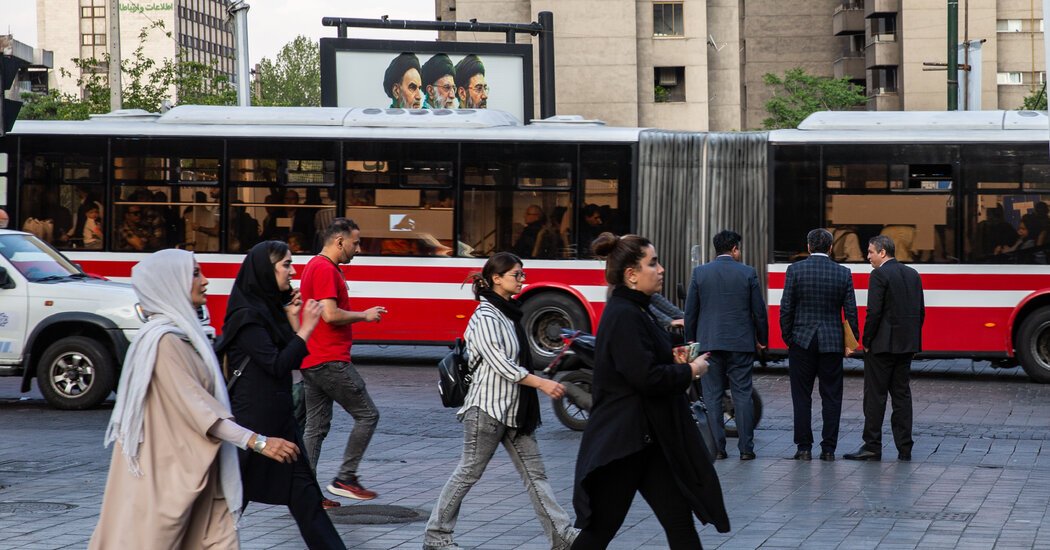
Many ordinary Iranians welcomed the news of a potential agreement. Iran is still reeling from the economic fallout of the war, including widespread layoffs, skyrocketing inflation, a shortage of medicine and gasoline, and damage to the country’s critical infrastructure amounting to more than $300 billion.
Many Iranians had been anticipating that airstrikes would resume as early as this weekend. Mr. Trump had repeatedly threatened to destroy power plants and infrastructure, causing panic among citizens already struggling from the economic impact of the bombardment and blockade.
“We were trying to figure out if we should leave Tehran if bombs fall again, and buying water and batteries,” Nazanin, 56, an engineer in Tehran, said in a phone interview, asking to be identified by only her first name. “I gave a big sigh of relief.”