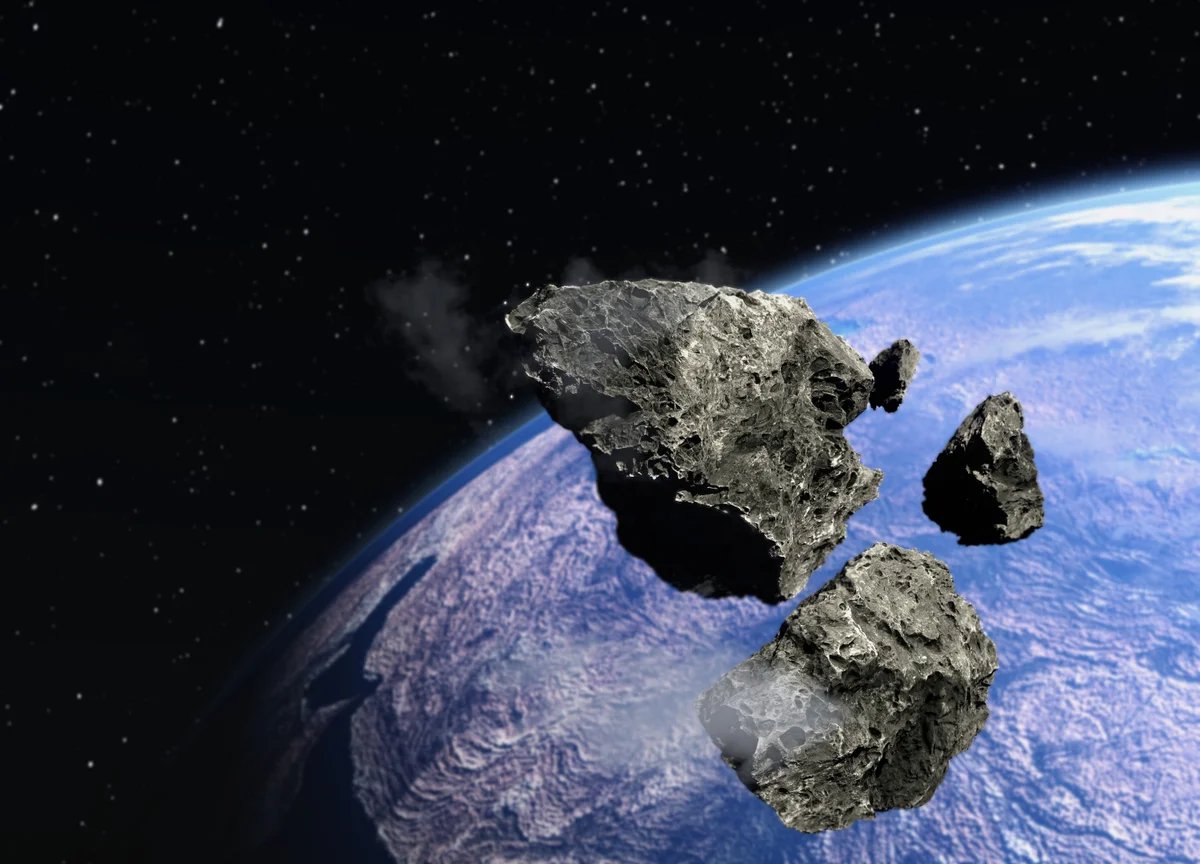
It’s the stuff of movies: an asteroid is on a collision course with Earth, and we have to do something to stop it—or die.
Disturbingly this scenario is also the stuff of the actual universe. Scientists have discovered more than 2,000 “potentially hazardous” asteroids. To merit that official NASA designation, an object must be at least 460 feet in diameter and have an orbit that passes within about 4.7 million miles of our planet.
Protecting Earth from these rocky hazards falls under a field called “planetary defense.” A group of researchers at the University of California, Santa Barbara, has a deceptively simple idea for how to take care of such an asteroid: pulverize it.
On supporting science journalism
If you’re enjoying this article, consider supporting our award-winning journalism by subscribing. By purchasing a subscription you are helping to ensure the future of impactful stories about the discoveries and ideas shaping our world today.
“Pulverize It” is, in fact, the name of the group’s proposed planetary defense program. It’s a pretty accurate moniker: the scientists have devised a system that would smash almost any asteroid to ineffectual bits by using rockets and projectiles that have already been developed. It can deploy in response to a warning time that is large or small. “We possess the technology, right now, to set up a planetary defense system,” says Philip Lubin, a U.C. Santa Barbara professor and the project’s principal investigator. But we haven’t.
Asteroid Aggression
Historically planetary defense research has focused on deflecting asteroids by using momentum to nudge their cosmic course away from Earth. That’s what NASA did with its Double Asteroid Redirection Test (DART) spacecraft, which slammed into the moonlet asteroid Dimorphos in September 2022 and changed its orbit, to show it was possible to do so.
But that relatively gentle kind of defense only works if scientists discover hazardous asteroids far enough in advance (and the bigger the threat, the bigger the warning time must generally be). A space rock might only be detectable when it gets so close to Earth that we no longer have time to divert it from its dangerous course.
Another limitation of deflection is that an asteroid must be small enough that slamming into it will alter its path enough, says Sasha Cohen, a researcher at U.C. Santa Barbara who works on Pulverize It. After all, you can’t coerce a semitruck into the right lane by running your bicycle into it.
Pulverize It takes a different approach. The team doesn’t plan to nudge hazardous asteroids into collision-free orbits but to instead crack them into many small parts—as one does in the appropriately named classic arcade game Asteroids.
A simulation from the Pulverize It research project shows the explosion created when an impactor hits an asteroid.
To do this, Lubin and his colleagues propose starting with a proven existing rocket, such as SpaceX’s Falcon 9, which successfully launched 165 times in 2025.
The rocket would carry “penetrators,” or projectiles that would blast the asteroid apart. Those could be passive tungsten bullets in the case of small asteroidal enemies or a nuclear explosive, delivered into a hole drilled by the tungsten bullets, if the threat was more formidable.
“It’s kind of a blanket method for planetary defense that can cover almost all threat types,” Lubin says. The nuclear option is complicated, however, because many countries, including the U.S., technically agreed not to detonate or position nuclear weapons in space.
Policy complications, however, are for policy people; Lubin says these are beyond the group’s paygrade. Lubin’s team is interested in the physics and engineering. What would it take to pulverize an asteroid? That’s part of what Cohen has been working on: running simulations on NASA supercomputers—with support from the NASA Innovative Advanced Concepts program—to study the mass and speed required for a penetrator to break up asteroids of different sizes and with different warning times.
Those calculations beg additional ones, though: Pulverize It wouldn’t turn an asteroid into dust, just smaller pieces. Those pieces could hit Earth, especially if the warning time is short and the asteroid is already close. So can the team ensure the pulverized pieces are small enough that they won’t present their own hazard?
That’s where some the work of Cohen and Lubin’s colleague Brin Bailey, a research scientist at U.C. Santa Barbara, comes in. The program’s goal is to pulverize such an asteroid into bits ideally around 13 to 16 feet in diameter (but no larger than about 50) so that they will burn up while they enter Earth’s atmosphere. That would mean, ideally, that no one would get bonked on the head.
But even the interaction between the atmosphere and asteroid pieces as they burn and burst apart could be dangerous, if the asteroid is disrupted when it’s close to Earth. “Each burst will produce an acoustic shock wave and also an optical flash,” Bailey says, “so bright light, little sound.” The scientists must plan to minimize those effects, they add, to avoid breaking windows or starting fires. This simulated work is helped along by a donated GPU from NVIDIA.
If we ever use a nuclear explosive to shred an asteroid, the resulting fragments would be radioactive. That’s why Bailey’s work also simulates the potential radiological effects from the aftermath of an asteroid pulverization to ensure that any pieces that were to fall from space wouldn’t expose people to unsafe levels of radiation. These terrestrial studies suggest that Earth’s atmosphere can effectively distribute almost any asteroid’s energy, preventing it from blasting flora and fauna on the ground.
Taking Action
Pulverize It isn’t an official planetary defense program. It’s just a potential plan. There is, in fact, no fully operational mitigation strategy for addressing a potentially hazardous asteroid. The field of planetary defense largely exists in the realm of scientific study; in the U.S., that involves research by NASA.
Lubin advocates for transforming that research into action. Who leads that effort is, again, he says, above his pay grade. But some experts, including Peter Garretson, a former Air Force strategist and current fellow at the American Foreign Policy Council, have advocated turning it over to the Department of Defense. In fact, Lubin is positioning Pulverize It as a potential addition to the Golden Dome framework, President Donald Trump’s missile defense plan. After all, Pulverize It is similar to a missile defense program—both aim to find a speeding bullet in the sky and shoot it down with another kind of bullet. Most scientists are dubious about the viability of the Golden Dome, which relies on technology the U.S. doesn’t yet have, but Lubin hopes aligning the projects might gain support for planetary defense.
If Lubin can move this idea from academia to action, he would like to see the Pulverize It system perpetually ready to launch rather than having to wait for a dangerous asteroid to approach and be detected before a response plan is created. The current strategy is more like “let’s wait for a threat to present itself; then we’ll have a group meeting and decide what to do,” Lubin says.
Whatever the ultimate “to do” is—pulverize or otherwise—being prepared is probably better than scrambling to avoid a pummeling.