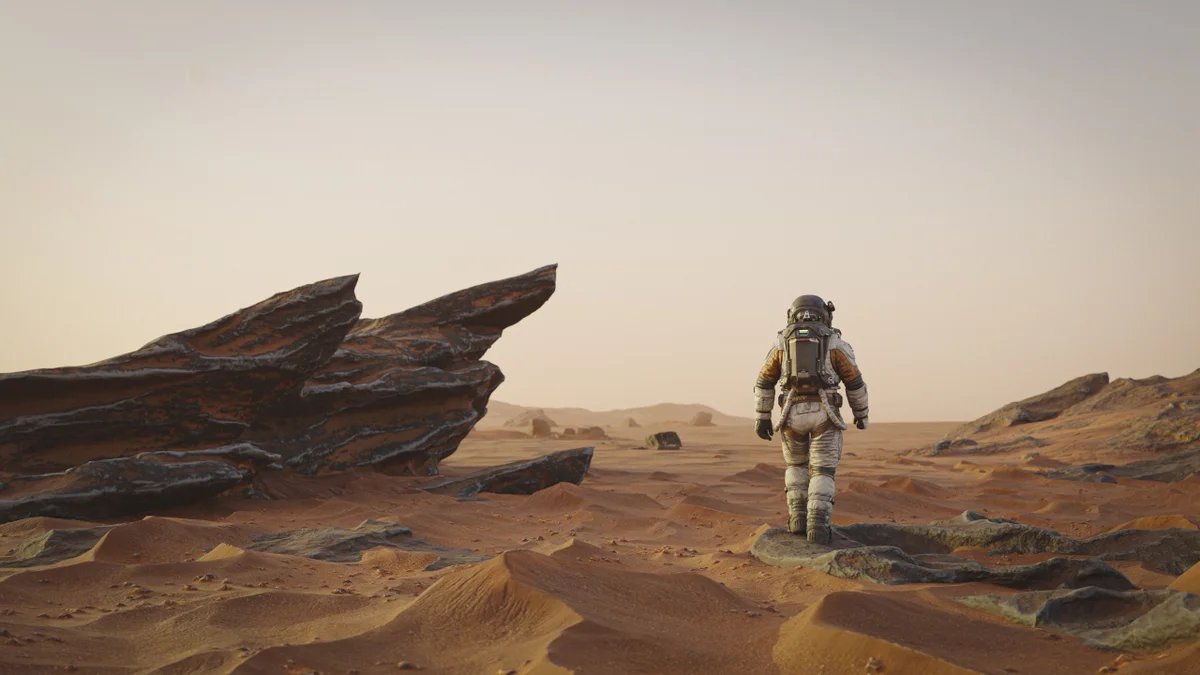
If humans are ever to land on Mars, they will need somewhere to stay—a protective shell that can shield them from the sun’s harsh rays. One possible answer: great, glassy domes of ice.
Mars is rich in ice, both on and under its surface—with more predicted to lie farther below its dusty exterior. If future astronauts were able to access it, they could use that ice to build hardy shelters, according to new preliminary research presented on Tuesday at the annual meeting of the American Geophysical Union.
Each structure could range from a few tens of square meters to a couple of hectares in size with a domed roof and space for living and growing food for sustenance. Designed to be entirely clear, the domes would let in sunlight but not harmful ultraviolet rays from the sun, says Robin Wordsworth, an earth and planetary sciences professor at Harvard University and a co-author of the new research. “Sunlight is particularly important to grow plants without artificial lighting and for human psychology,” he says.
On supporting science journalism
If you’re enjoying this article, consider supporting our award-winning journalism by subscribing. By purchasing a subscription you are helping to ensure the future of impactful stories about the discoveries and ideas shaping our world today.
The proposal could solve a major problem that any future crewed Mars mission would need to confront: how to build and supply a safe habitat for humans. Elon Musk’s SpaceX is attempting to tackle the issue, at least in part, with its Starship rocket program. Starship is designed to haul 100 metric tons of cargo into space, which means it could feasibly bring building materials with it. But it is still in development. And even if SpaceX does make it to Mars, the company will likely need to send many rockets at a time to support a human mission there.
For the new research, the scientists used mathematical models to work out the amount of ice that would be needed for the habitats. Combined with exterior coatings, that could warm their interior to a livable temperature of around 68 degrees Fahrenheit (20 degrees Celsius), according to Wordsworth.
Certainly, communities from across our planet have harnessed ice in similar ways before. In addition to the igloos built by some Inuit in the Arctic, people have lived in ice caves and other shelters that offer warmth, stability and protection from the weather.
What is less clear, however, is how future Mars astronauts would be able to gather enough ice to build anything. Wordsworth points out that, although his team’s idea requires a lot of ice, it’s easier to process and extract than other materials, such as silica, that could be used to build structures on Mars.
It’s also unclear how crews would protect their igloos from Mars’s famous dust storms, which could interfere with the structures’ insulating effect. Wordsworth admits that the storms present a serious challenge.
“We haven’t addressed dust directly yet,” he says, “but compressed air jets blown onto the surface of the dome following a dust storm would be one possible solution.”
It’s Time to Stand Up for Science
If you enjoyed this article, I’d like to ask for your support. Scientific American has served as an advocate for science and industry for 180 years, and right now may be the most critical moment in that two-century history.
I’ve been a Scientific American subscriber since I was 12 years old, and it helped shape the way I look at the world. SciAm always educates and delights me, and inspires a sense of awe for our vast, beautiful universe. I hope it does that for you, too.
If you subscribe to Scientific American, you help ensure that our coverage is centered on meaningful research and discovery; that we have the resources to report on the decisions that threaten labs across the U.S.; and that we support both budding and working scientists at a time when the value of science itself too often goes unrecognized.
In return, you get essential news, captivating podcasts, brilliant infographics, can’t-miss newsletters, must-watch videos, challenging games, and the science world’s best writing and reporting. You can even gift someone a subscription.
There has never been a more important time for us to stand up and show why science matters. I hope you’ll support us in that mission.