Every now and again I find myself pondering the scientific veracity of pop songs. I’m a nerd, and I like music, so sometimes those worlds collide. It can be interesting to think about, and the investigation itself can be instructive—even fun!
Consider, for instance, the song “I Melt with You,” by the new wave band Modern English. It was arguably the group’s biggest hit, and it’s still in rotation on classic rock radio stations.
The song isn’t about science at all, yet it has these remarkable lyrics:
On supporting science journalism
If you’re enjoying this article, consider supporting our award-winning journalism by subscribing. By purchasing a subscription you are helping to ensure the future of impactful stories about the discoveries and ideas shaping our world today.
I’ll stop the world and melt with you
You’ve seen the difference
And it’s getting better all the time
There’s nothing you and I won’t do
I’ll stop the world and melt with you
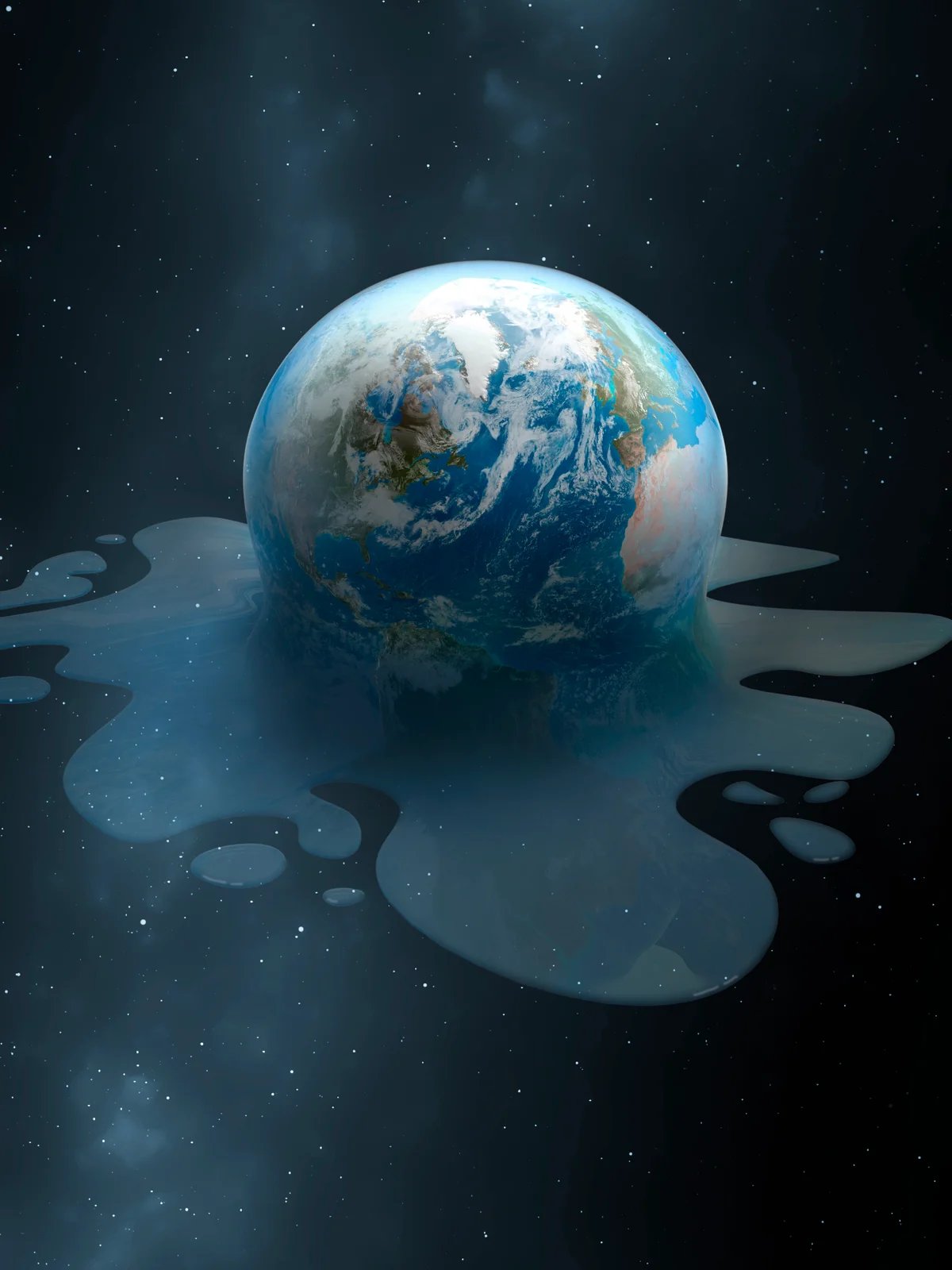
So is it right? If we stop the planet (let’s assume this means halting Earth’s spin), will it melt? Amazingly, we can figure this out. The key here is the amount of energy it would take to literally stop the world.
The energy of motion is called kinetic energy. You can think of it as how much energy must be imparted to a massive object to get it moving at a certain speed. You already have an intuitive feel for this when it comes to familiar objects; throwing a baseball at 100 kilometers per hour is a lot easier (takes less energy) than getting a car up to that same speed. And, of course, for a given object, the higher the velocity, the more energy needed to get it up to that speed.
Now, this is for linear, straight-line motion. There’s also rotational kinetic energy, and again, this is intuitive: it’s easier to spin a basketball than a car. In this case, though, you also have to consider the size of the object. The larger it is, the more rotational energy it has for a given mass and spin.
Calculating these numbers isn’t all that hard. (It could be a high school homework problem.) The real difficulty is in knowing what numbers to use. We have to make a lot of simplifying assumptions or else this quickly burgeons into a Ph.D. thesis. For example, Earth isn’t a solid, homogeneous sphere but is instead layered. It has a dense core, a lighter mantle, and so on, each with a different composition, which all affect its total spin energy. Still, we’re not going for pinpoint accuracy here, just a very rough number to see where we stand.
Working through the equations, we find that Earth’s rotational energy is about 200,000,000,000,000,000,000,000,000,000 (2 × 1029) joules, the metric unit of energy. A single joule isn’t much—it takes about 300,000 joules to raise a liter of water from room temperature to its boiling point—but 2 × 1029, or more than anoctillion of them, is a lot.
For comparison, it’s about the same as our current annual global energy use—over the course of roughly half a billion years.
That energy is stored in Earth’s spin, which was gained as our planet formed 4.6 billion years ago. Because physics is generally okay with doing some operations forward or backward, this means we’d also need that much energy to stop our planet from rotating.
This presents two problems, as I see it. One is how to do it and the other is what happens when you do.
The how is not trivial. That’s a fantastic amount of energy. Think of it this way: 66 million years ago an asteroid 10 km wide—and several times the volume of Mount Everest—slammed into Earth at a speed 20 times faster than a rifle bullet. Its immense kinetic energy was instantly converted into heat, creating a colossal explosion that carved out a crater 200 km across, wiping out the nonavian dinosaurs and creating a global ecological catastrophe that took millions of years to recover from. And yet the total energy released in that event was about 1023 joules, or about a millionth of Earth’s rotational kinetic energy.
In other words, if you want to stop our planet’s spin by hitting it with asteroids (aimed just so to provide maximum braking power), you’d have to do the dinosaur-killer impact again, then repeat it 999,999 times.
I’m not a biologist, but it seems like this process might be detrimental to life on Earth.
But this asteroidal solution to our thought experiment brings up a good point: changing the energy of an object usually leads to heating it. Try to stop a spinning basketball using friction from your hand and it’ll noticeably heat your skin. Doing this for Earth would rapidly dump all that heat into the planet itself (and have other important catastrophic consequences). You may see where this is going.
So how much energy would it take to melt Earth? This is very difficult to calculate, but happily physicists have done some of the work. In The Encyclopedia of Volcanoes, the energy to melt just Earth’s mantle—which is in fact a solid and not a liquid—is shown to be about 3 × 1030 joules. (Interestingly, it would take about the same amount of energy to melt Earth’s solid inner core.) That’s more than a factor of 10 greater than Earth’s rotational energy, so right away we have our answer: stopping the world won’t melt it—at least, not entirely.
Well, what about if we limit it to just Earth’s crust because that’s where we all live? Making some quick assumptions (such as that it’s a 10-km-thick granite shell), I calculate that about 1030 joules of heating would be needed to completely liquify the crust (though I’ve seen somewhat lower estimates). So melting the crust is iffy, though it’s not like Earth will be habitable after; the oceans would easily boil away with that much energy dumped in them.
Is it possible to despin Earth without overly heating it? Perhaps, if you do it slowly: for example, you could mount rocket engines with their business ends facing east, then ignite them. A back-of-the-envelope calculation indicates a Falcon 9 rocket can generate about a trillion joules of energy, so if you set up a million of them and let them burn continuously for a few million years you can stop Earth’s rotation. Again, there might be some negative environmental impacts from this (as well as fueling issues). Better check with the appropriate federal regulatory agencies.
Still, perhaps we need to expand what we mean by “stop.” If Modern English meant stopping Earth in its orbit around the sun, how much energy would that take? This is actually much easier to calculate because we know Earth’s mass (6 × 1024 kilograms) and orbital velocity (30,000 meters per second): a whopping 3 × 1033 joules. That’s not only enough to melt Earth through and through but it’s also enough to vaporize it! Literally blowing up the world, Death Star–style, “only” takes about 1032 joules, so stopping the planet cold in its orbital track would indeed make our world very, very hot. In that scenario, the song is actually understating the case.
Conclusion: Depending on how you interpret the song, you can indeed melt the world by stopping it. At the very least, it’ll do serious damage—or, as Modern English put it in their hit song, “I saw the world crashing all around your face.”
I’ve seen the difference, but it’s definitely not getting better all the time.
My thanks to my friend Michael Walter, director of the Carnegie Science Earth & Planets Laboratory, for his help with melting Earth’s mantle.