Feedback is New Scientist’s popular sideways look at the latest science and technology news. You can submit items you believe may amuse readers to Feedback by emailing feedback@newscientist.com
Professor Chuckles
Academic writing is dull. There, we said it. The rules and norms of it are such that most papers and monographs are plodding and pedantic, filled with jargon, and frankly exhausting to read. In the pursuit of rigour, academics often achieve rigor mortis.
But sometimes we come across a joyful exception. Take a paper published in March in Proceedings of the Royal Society B and sent to us by our colleague Jacob Aron, who described it as “pure Feedbacknip, if such a thing exists”. It opens thusly:
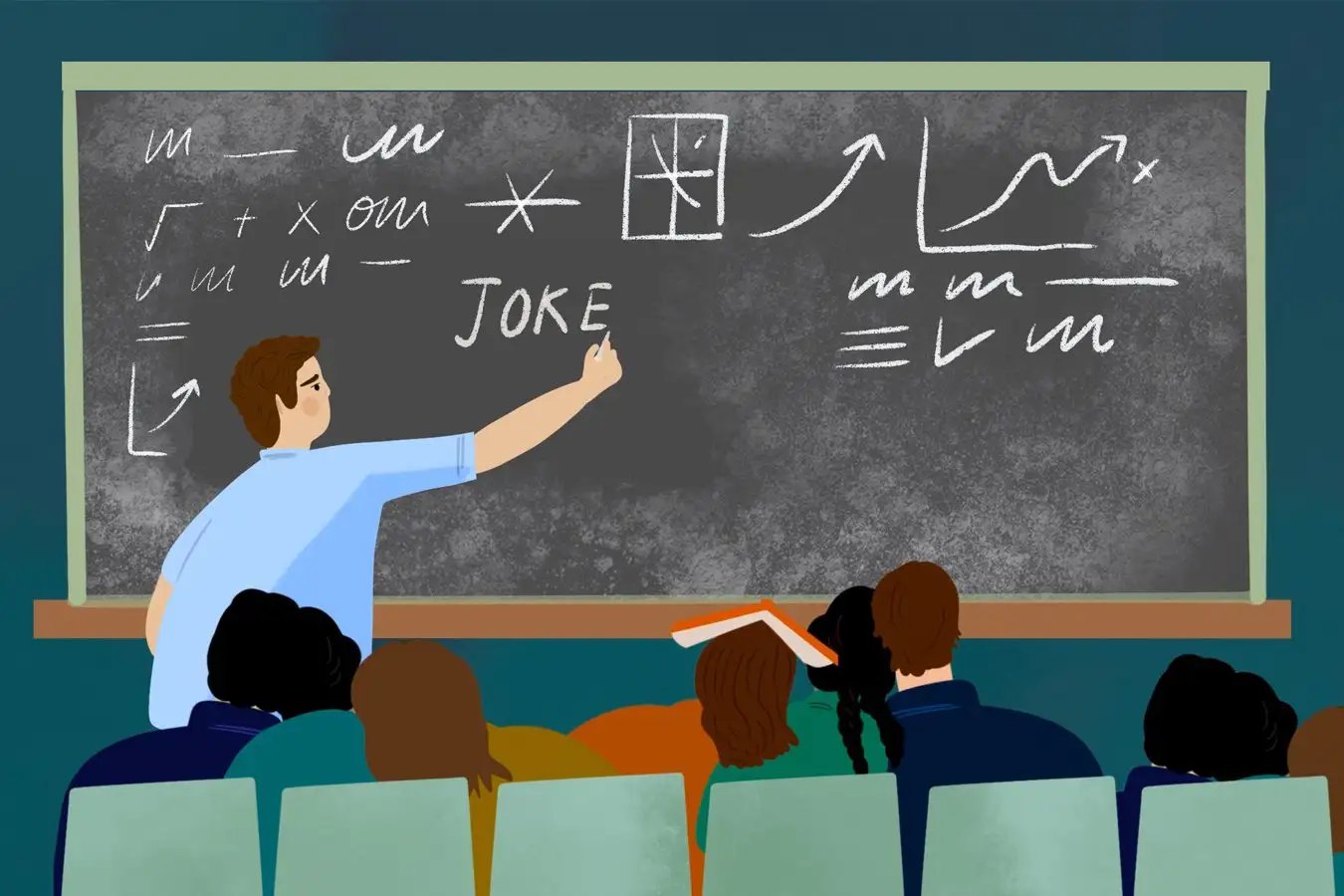
“At some point in every scientific conference – usually right before lunch – a strange transformation occurs: the audience turns into zombies. As caffeine levels plummet and eyes begin to glaze over, not even the most beautifully formatted graph is able to penetrate the collective fatigue. Then, a brave speaker cracks a joke and, suddenly, the room snaps back to life.”
So begins “Statistically significant chuckles: Who is using humour at scientific conferences?” by Stefano Mammola at the Water Research Institute in Verbania, Italy, and his colleagues. Mammola is a biologist who studies cave-dwelling animals and spiders, but he conducted this side project “to combat the tedium of long conference sessions”.
He explains that humour helps the audience pay attention and makes the speaker more engaging, yet academics rarely use humour in their presentations, and this causes a problem. As Mammola puts it: “Why do so many scientific talks have the energy of a sedated sloth? Where are the jokes, the puns, the playful delivery? Or, as Ewers bluntly put it: why are most scientific talks so boring?”
That mention of Ewers, by the way, refers to a 2018 study by Robert Ewers at Imperial College London, titled “Do boring speakers really talk for longer?”. To investigate, Ewers sat in on 50 talks at a meeting where speakers were given 12-minute slots. In each case, he decided whether the talk was boring after 4 minutes.
He reported: “The 34 interesting talks lasted, on average, a punctual 11 minutes and 42 seconds. The 16 boring ones dragged on for 13 minutes and 12 seconds… For every 70 seconds that a speaker droned on, the odds that their talk had been boring doubled.”
Ewers recommended that speakers should “focus on pertinent information”, which is bad news for Feedback because we just spent three paragraphs on a sidenote.
Let’s get readers paying attention again: where do you find a stupid shoplifter? Squashed under Walmart.
OK, back to Mammola. He and his team sampled 531 talks at 14 biology-related conferences. Almost half the speakers, 223 in total, told no jokes at all, and the number of speakers who told more than five jokes was vanishingly small. Fully 367 of the jokes were situational and revolved around things like broken slide projectors.
And the hit rate was low: “Jokes eliciting whole-room laughter were rare (9 per cent), while the majority fell flat or landed mildly, earning mostly quiet chuckles (67 per cent).” The researchers suggest that ending on a joke might be a good idea because “a well-placed closing joke serves as the cherry on top, leaving the audience with a positive lasting impression”.
On that note: What do you call a cannibal who works at a university? Hannibal Lecturer.
A diary for the ages
Reader Richard Mohr had a disconcerting experience while proofreading a book chapter he had written. One passage, discussing policies that converted common land into privately owned land, included this line: “Enclosures of previously common land proceeded across England from the 11th to the 18th centuries.”
The date span had been highlighted in bright yellow. Thinking it might be a note from his editors, Richard clicked on it, only to discover that the mark-up was the work of his computer. The machine was proposing to create a calendar item, or, as Richard says, “offering to record ‘the 11th to the 18th centuries’ as a ‘new event’ in my diary”.
To give the computer some credit, it did at least concede that this 800-year timespan would constitute “work” and last “all-day”.
Paid in AI
Artificial intelligence continues its remorseless march into every aspect of our lives, and it seems it may even find its way into our pay packets. At least, that’s true if you work for an AI company, some of which are now proposing to pay engineers, in part, with allocated time on AI servers.
To be more precise, the companies would include “tokens” in their compensation packages. Tokens are the smallest units of text that a generative AI can process. For example, the word “darkness” would be broken up into two tokens, “dark” and “ness”. If you pay to use an AI model, the company charges you per token.
Jensen Huang, Nvidia’s chief executive, recently made waves when he suggested AI companies would offer an annual token budget as part of their salary package, with top engineers being paid a few hundred thousand dollars of actual money, plus about half as much again in tokens. In other words, if you’re an in-demand engineer, one of the ways your employer might invest in you is by throwing a lot of AI tokens your way, thus boosting your productivity, which, of course, is what we all want in a salary.
This tickled something in Feedback’s brain, but we couldn’t quite place it until we realised: it’s like a brewery paying its workers in barrels and yeast.
Got a story for Feedback?
You can send stories to Feedback by email at feedback@newscientist.com. Please include your home address. This week’s and past Feedbacks can be seen on our website.